
 By Layla Zulfa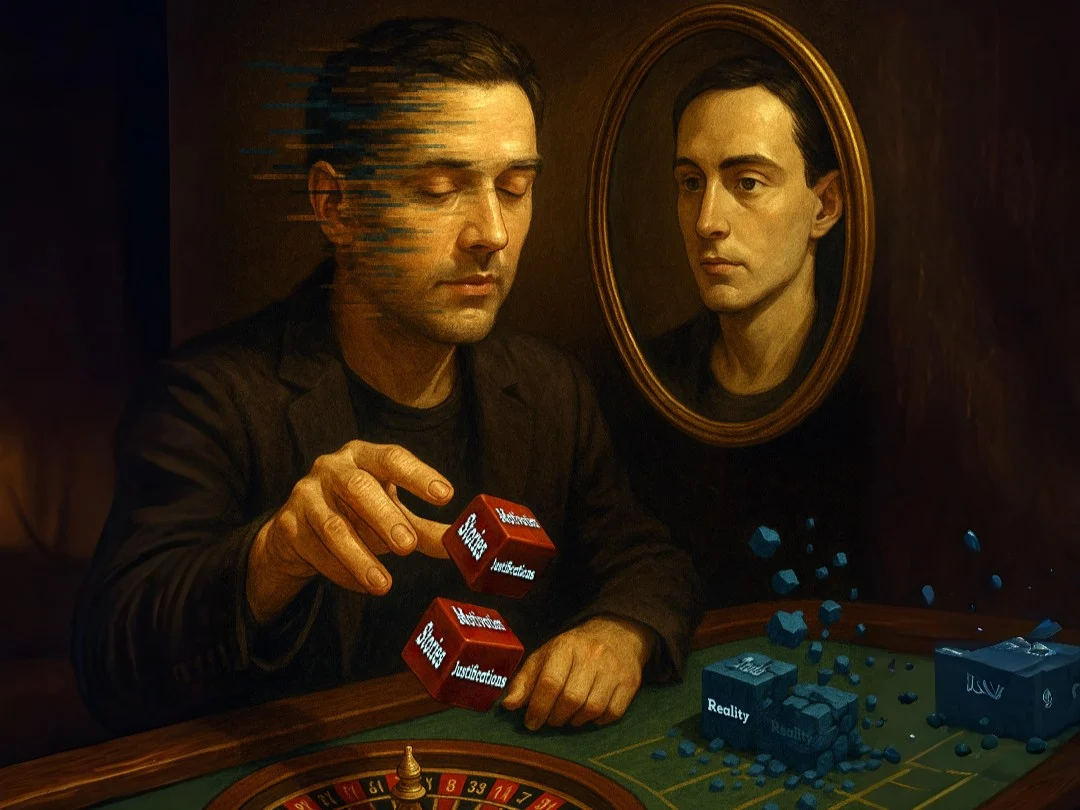
By Guy Hochman
For decades, the standard model of human behavior has rested on a flattering assumption: that we are, at our core, rational agents. Economists long championed the concept of Homo economicus—a creature of cold calculation and utility maximization. When the evidence of our flawed decision-making became too vast to ignore, psychologists pivoted to the more forgiving Homo heuristicus, portraying us as efficient, if occasionally error-prone, simplifiers navigating a world of infinite complexity.
But both labels fail to capture the fundamental truth of the human condition. We are neither cold calculators nor mere lazy thinkers. We are Homobiasos: a species defined by our unique ability to rationalize with our eyes wide shut. We are master storytellers, weaving intricate narratives that force our choices to appear coherent, moral, and intelligent, even when they are profoundly flawed. We do not simply misread reality; we filter it through a lens of psychological comfort, constructing a narrative that protects our ego and validates our impulses.
The Illusion of Rationality: A Reappraisal
The prevailing view in decision science has long been a binary one: analytic thinkers are seen as the guardians of logic, while intuitive thinkers are the vessels of bias. However, contemporary research suggests this dichotomy is a profound oversimplification.
When we observe human decision-making, we are not witnessing a system that simply "breaks down." Instead, we see an integrative process. In complex choice tasks, individuals do not merely rely on singular, lazy heuristics. They actively scan multiple dimensions of a problem, testing competing explanations and weighing variables. As research by Ayal and Hochman demonstrates, this process is not driven by cognitive laziness but by a deep-seated need for "motivated coherence."
The mind does not process information like a machine seeking an objective truth. It operates like an attorney building a case for a client. The "client" in this scenario is our preferred self-image—the version of ourselves that is wise, moral, and in control. We are not processing facts to reach a conclusion; we are selecting facts to justify the conclusion we have already arrived at emotionally.
Two Minds, One Motive
The "Dual-System" theory—the idea that the brain shifts between System 1 (intuitive/fast) and System 2 (deliberative/slow)—has dominated the field for years. While useful, it suggests that "slowing down" to deliberate will inevitably lead to more rational outcomes.
Evidence increasingly suggests the opposite. Deliberation can be just as biased as intuition, if not more so. Studies by Ayal et al. and Krava et al. have shown that when people engage in deliberation, they often use their intellectual capacity to assign weight to irrelevant cues, effectively using "eloquent reasoning" to legitimize poor judgment. Deliberation, in this context, does not act as a corrective to bias; it acts as a tool to reinforce it.
We reason not to check our instincts, but to provide them with a formal defense. Whether through rapid intuition or painstaking deliberation, both systems serve the same master: the desperate need to feel internally justified.
Rationalization as Moral Anesthesia
The defensive nature of our cognition is perhaps most visible in the moral domain. Most of us maintain a firm belief in our own integrity, yet we frequently cheat—often in small, incremental ways that allow us to benefit without triggering a sense of corruption.
This phenomenon is managed through moral rationalization—the stories we tell ourselves to explain why a dishonest act is "actually" a victimless necessity or a virtuous trade-off. This psychological mechanism is remarkably potent. Research indicates that when individuals are given the opportunity to lie for a "good cause," such as benefiting a charity, they cheat more aggressively. Yet, intriguingly, these individuals display lower physiological arousal, often successfully deceiving even professional lie-detection instruments.
This is because the mind is effectively administering "moral anesthesia." By reframing dishonesty as virtue, we alleviate the psychological tension—or "ethical dissonance"—that would otherwise arise when our actions conflict with our moral values. As Friedrich Nietzsche famously observed, "We lie to ourselves more than we lie to others." In the life of Homobiasos, rationalization is not an act of malice; it is an act of self-protection.
The Strategic Value of Ignorance
If rationalization is the active defense of our ego, then "motivated ignorance" is its silent partner. In many high-stakes environments, such as financial and pension planning, individuals actively avoid information.
This is not a matter of cognitive load or simple apathy. It is an existential strategy. When individuals are presented with data that threatens their sense of competence or fairness, they often choose to look away. Admitting uncertainty or systemic unfairness is to admit vulnerability, a state the human psyche finds intolerable.
This refusal to know is not an error in the sense of a mistake; it is a calculated effort to maintain self-worth. When the truth has no defense against a person determined to believe a lie, as Mark Twain noted, the "lie" is not a failure of intelligence—it is a cornerstone of psychological stability. We prioritize coherence over accuracy, and self-respect over insight.
Anxiety and the Modern Mind: The AI Paradox
The same mechanisms that govern our personal choices and moral behavior are now shaping our reaction to the most disruptive force of our time: Artificial Intelligence.
In recent studies, we have identified two distinct, yet related, anxieties: anticipatory anxiety (the fear of change) and annihilation anxiety (the existential fear of being replaced or rendered irrelevant). Our research reveals a U-shaped engagement curve. Those who avoid AI entirely suffer from heightened anxiety, as do those who are over-exposed. A moderate, controlled engagement seems to act as a buffer.
However, the way we articulate these fears is telling. We frame our hesitation as "prudence" and our fear as "logical concern for humanity." Yet, these are often just narratives constructed to maintain emotional equilibrium in the face of a rapidly changing technological landscape. We do not regulate our technology for the sake of progress; we regulate it to keep our anxieties at bay.
Implications for Society and Self
The realization that we are Homobiasos has profound implications. It suggests that biases are not "bugs" in the human software that can be patched with better education or more data. They are fundamental "features" of our psychological architecture. They are the narrative mechanisms that keep societies functional, relationships stable, and the individual ego intact.
The danger, therefore, is not in the existence of bias itself, but in our lack of awareness regarding its self-serving nature. When we believe that our rationalizations are objective truths, we become dangerous to ourselves and others. We become immune to feedback and allergic to contradiction.
Conclusion: Toward an Honestly Biased Future
To accept that we are Homobiasos is not a counsel of despair. It is a call for a more sophisticated kind of honesty. We may never be truly "rational" in the sense that the classical economists hoped. We will always be creatures of narrative, seeking comfort in coherence.
However, we can learn to spot the stories we tell ourselves. When we feel the urge to justify a decision, to ignore a piece of uncomfortable data, or to frame an unethical act as a virtuous necessity, we can pause. We can recognize that we are not seeking truth, but rather "meaning management."
The mirror of Homobiasos does not reflect stupidity or moral decay; it reflects the true nature of humanity. Our stories are our way of keeping ourselves whole in an overwhelmingly complex and often contradictory world. By acknowledging that our eyes are psychologically half-closed, we gain the power to open them—if only for a moment—to see the world as it is, rather than as we need it to be.
We may never be perfectly rational, but we can strive to be more honestly biased. And in that honesty, there is at least the possibility of wisdom.
 Dwi Wanna
  Jia Lissa
  Raul Delapena Setiawan