As the United States approaches its semiquincentennial—the 250th anniversary of its founding—the nation finds itself at a critical financial crossroads. Recent market volatility has once again ignited a fierce debate among economists, historians, and investors regarding the ultimate store of value.
In early 2026, a sharp decline in the stock market wiped out nearly all of the S&P 500’s year-to-date gains. While mainstream financial commentators dissected the immediate technical reasons for the Friday sell-off, long-term market strategists looked at a broader, more historical comparison: the relationship between paper assets and physical gold.
Though the S&P 500 has occasionally outpaced gold in short-term bursts, a long-term retrospective reveals a startling reality: gold continues to outperform paper equities in key comparisons dating back to 1971—the pivotal year President Richard Nixon severed the final link between the U.S. dollar and the gold standard. Supported by a stunning 65% gain in gold prices during 2025, the precious metal’s historical resilience challenges the foundational assumptions of modern fiat monetary policy.
Main Facts: The Battle of Assets
To understand the current financial landscape, one must analyze the raw data comparing gold to the S&P 500. Since August 1971, when the United States officially abandoned the Bretton Woods system, the dollar has operated as a pure fiat currency, backed only by the "full faith and credit" of the federal government.
The consequences of this shift are clearly demonstrated in long-term asset performance comparisons across several critical historical milestones: 1970, 2000, 2020, and the opening months of 2026.
+------------------------------------------------------------------------+
|                     GOLD VS. S&P 500 PERFORMANCE                       |
|          Historical Comparison of Cumulative Returns (Approx.)         |
+--------------------------------------+---------------------------------+
| Era / Starting Point                 | Outperforming Asset             |
+--------------------------------------+---------------------------------+
| Since 1970 (Pre-Nixon Shock)         | Gold                            |
| Since 2000 (Dot-Com Bubble Peak)     | Gold                            |
| Since 2020 (Pandemic Era)            | Gold                            |
| Early 2026 (Year-to-Date)            | S&P 500 (Highly Volatile)       |
+--------------------------------------+---------------------------------+
While the S&P 500 has clawed back territory during historic bull markets, gold’s long-term purchasing power has remained remarkably stable. The 65% surge in gold prices during 2025 served as a stark reminder of this trend, occurring alongside a rapidly expanding U.S. national debt that is currently growing at an unprecedented rate of approximately $2 trillion per year.
Chronology: The Summer Milestones of American Monetary History
The evolution of the American monetary system can be traced through a series of transformative summer events. These milestones highlight the cyclical struggle between hard money (specie) and paper currency (fiat).
  1776: Continental Currency Collapse
    │
    ▼
  1791: Hamilton’s First Bank of the United States
    │
    ▼
  1861: Civil War & Lincoln’s Greenbacks
    │
    ▼
  1896: William Jennings Bryan’s "Cross of Gold" Speech
    │
    ▼
  1971: The Nixon Shock (End of Gold Backing)
Summer 1776 – The Birth of a Nation and the Continental Currency Crisis
As the Continental Congress signed the Declaration of Independence, it faced the monumental task of financing a revolution. Lacking the power to tax, the nascent government printed paper "Continentals." Unbacked by gold or silver, the currency rapidly inflated, giving rise to the phrase "not worth a Continental." This early hyperinflationary disaster left a lasting impression on the nation’s founders.
Summer 1791 – Hamilton’s Bimetallic System
To restore public credit and stabilize the economy, Treasury Secretary Alexander Hamilton established the First Bank of the United States. Hamilton instituted a strict bimetallic system, defining the U.S. dollar in terms of specific grains of silver and gold. This established a century and a half of price stability.
Summer 1861 – The Civil War and the Greenback Experiment
Faced with the existential threat of the Civil War, President Abraham Lincoln’s administration suspended specie payments. To fund the Union Army, Congress authorized the printing of unbacked paper notes, popularly known as "Greenbacks." This temporary departure from the gold standard triggered immediate inflation, though it was eventually reversed post-war.
Summer 1896 – The Battle of the Standards
The debate over monetary backing reached a fever pitch during the 1896 Democratic National Convention. William Jennings Bryan delivered his famous "Cross of Gold" speech, advocating for free silver to expand the money supply and aid indebted farmers. However, the victory of William McKinley secured the nation’s commitment to the gold standard through the Gold Standard Act of 1900.
Summer 1971 – The Nixon Shock
On August 15, 1971, President Richard Nixon announced the unilateral suspension of the U.S. dollar’s convertibility into gold for foreign governments. Intended as a temporary measure to combat inflation and runaways gold redemptions, this action permanently dismantled the Bretton Woods system, ushering in the global era of unbacked fiat currencies.
Supporting Data: The Philosophical and Legal Foundations of Sound Money
The United States’ initial 150-year run of remarkable price stability was no accident; it was a deliberate design choice by the authors of the Constitution, who had personally witnessed the destructive power of unbacked paper money.
The Founders’ Warning: Jefferson, Paine, and Madison
The primary authors of the American experiment left behind extensive warnings regarding the dangers of paper currency.
Thomas Jefferson was particularly outspoken on the matter. In an 1802 letter to his Treasury Secretary, Albert Gallatin, Jefferson wrote:
"Specie is the most perfect medium because it will preserve its own level; because, having intrinsic and universal value, it can never die in our hands, and it is the surest resource of reliance in time of war."
As the nation grappled with inflation during the War of 1812, Jefferson’s criticisms of unbacked paper bank notes grew even sharper. Writing to John W. Eppes in 1813, he observed:
"Capital may be produced by industry and accumulated by economy, but jugglers only will propose to create it by legerdemain tricks with paper."
Jefferson’s warnings extended to the systemic threat posed by private banking institutions controlling the money supply. In an 1816 letter to John Taylor, he cautioned:
"If the American people ever allow private banks to control the issue of their currency, first by inflation, then by deflation, the banks and corporations that will grow up around [them] will deprive the people of all property until their children wake up homeless on the continent their fathers conquered."
+-----------------------------------------------------------------------------+
|                     FOUNDING PHILOSOPHIES ON SOUND MONEY                    |
+------------------+----------------------------------------------------------+
| Founder          | Core Belief / Quote                                      |
+------------------+----------------------------------------------------------+
| Thomas Jefferson | "Paper is poverty... it is only the ghost of money."     |
| Thomas Paine     | "Gold and silver are the emissions of nature; paper is   |
|                  |  the emission of art."                                   |
| James Madison    | Drafted constitutional limits preventing states from     |
|                  |  making anything but gold and silver a legal tender.     |
+------------------+----------------------------------------------------------+
Thomas Paine, the influential author of Common Sense, echoed these sentiments in his 1786 treatise Dissertations on Government, the Affairs of the Bank, and Paper Money:
"Gold and silver are the emissions of nature: paper is the emission of art. The value of gold and silver is ascertained by the quantity which nature has made in the earth. We cannot make that quantity more or less than it is, and therefore, the value being dependent upon the quantity, depends not on man… Nature has provided the proper materials for money: gold and silver, and any attempt of ours to rival her is ridiculous."
These views were codified into the United States Constitution, drafted primarily by James Madison. To ensure the federal government and states could not easily inflate the currency, they included strict constitutional limits:
Article I, Section 8 grants Congress the power: "To coin Money, regulate the Value thereof, and of foreign Coin, and fix the Standard of Weights and Measures."
Article I, Section 10 explicitly prohibits the states from monetary overreach: "No State shall… coin Money; emit Bills of Credit; make any Thing but gold and silver Coin a Tender in Payment of Debts."
The Greenback Legal Battle and Chief Justice Chase
The only significant departure from this standard during the 19th century occurred during the American Civil War. To prevent economic collapse, Treasury Secretary Salmon P. Chase oversaw the issuance of Lincoln’s paper "Greenbacks."
In a fascinating turn of historical irony, Chase was later appointed Chief Justice of the Supreme Court. In the landmark case Hepburn v. Griswold (1870), Chase cast the deciding vote declaring the very Greenbacks he had authorized as Treasury Secretary to be unconstitutional. He ruled that making paper currency legal tender for pre-existing debts violated the Fifth Amendment’s protection of property rights, effectively undoing his own wartime policies.
Though subsequent rulings eventually reversed this decision, Chase’s portrait was later placed on the $10,000 bill (printed between 1928 and 1946), forever linking his legacy to the highest denominations of American fiat currency.
Official Responses and Contemporary Perspectives
Modern monetary policymakers and mainstream economists offer a very different view of the gold standard, arguing that rigid commodity-backed currencies are ill-suited for a complex, globalized economy.
The Modern Central Bank Defense
The Federal Reserve and modern Keynesian economists argue that a fiat currency system provides policymakers with the flexibility needed to manage the business cycle. By adjusting interest rates and controlling the money supply through quantitative easing, central banks can intervene during economic downturns, provide liquidity during banking panics, and maintain stable employment levels.
From this perspective, a gold standard is overly restrictive, limiting a government’s ability to respond to crises like the 2008 financial collapse or the 2020 global pandemic. Critics of gold also point out that its supply is subject to mining discoveries, which can introduce arbitrary deflationary or inflationary shocks to the economy.
The Sound Money Counter-Argument
Conversely, proponents of the Austrian School of economics and hard-money advocates argue that this "monetary flexibility" is precisely what drives long-term economic instability. They contend that artificial manipulation of interest rates misallocates capital, inflates asset bubbles, and systematically devalues the purchasing power of the dollar.
        FIAT MONETARY SYSTEM                 GOLD-BACKED SYSTEM
     ┌─────────────────────────┐         ┌─────────────────────────┐
     │  Monetary Flexibility   │         │    Price Stability      │
     ├─────────────────────────┤         ├─────────────────────────┤
     │  Risk of Debasement     │         │  Limited Money Supply   │
     ├─────────────────────────┤         ├─────────────────────────┤
     │  Discretionary Policy   │         │    Rule-Based Policy    │
     └─────────────────────────┘         └─────────────────────────┘
With the U.S. national debt expanding by trillions of dollars annually, sound money advocates warn that the current fiat trajectory is unsustainable, threatening the dollar’s status as the global reserve currency.
Implications: The Late 2020s and Beyond
As the market fluctuations of early 2026 demonstrate, paper assets remain highly vulnerable to systemic economic shocks, inflation, and shifting monetary policies. The implications of these dynamics are profound for both institutional and retail investors.
Persistent Debt Expansion: With no political consensus on curbing government spending, the U.S. national debt is projected to grow indefinitely. This continuous expansion of the money supply will likely exert persistent downward pressure on the purchasing power of the dollar, bolstering the long-term investment case for gold.
Central Bank Accumulation: Despite public rhetoric downplaying the role of gold, central banks around the world have been purchasing physical gold reserves at record rates in recent years. This trend suggests a strategic effort to diversify away from dollar-denominated assets amid growing geopolitical and fiscal uncertainty.
Portfolio Diversification: For individual investors, the historical data suggests that gold is far from a dead asset. While it may experience periods of consolidation—or "well-deserved naps"—during equity bull markets, its role as an inflation hedge and ultimate portfolio diversifier remains highly relevant.
As the United States celebrates its 250th anniversary, the country’s monetary system looks vastly different from the gold-backed framework established by its founders. Yet, the economic laws identified by Jefferson, Paine, and Madison remain unchanged. Paper currencies may dominate the modern financial landscape, but history suggests that gold’s role as an enduring anchor of wealth is far from over.

 By Lina Hope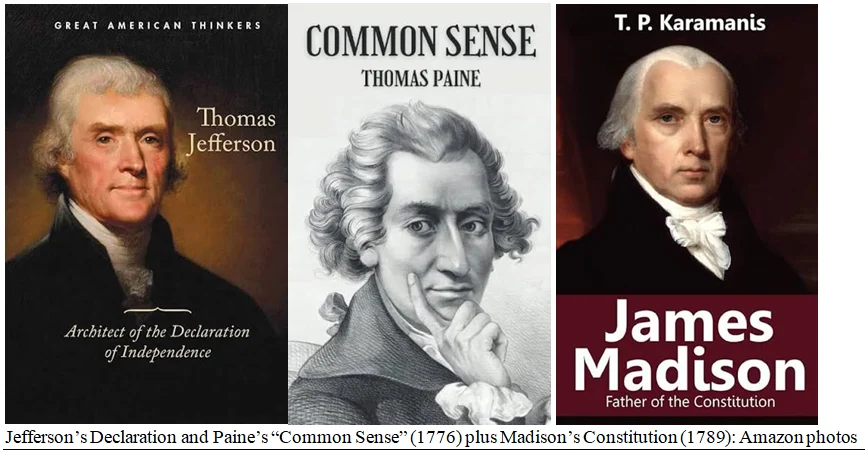



 Azzam Bilal Chamdy
  Pevita Pearce