
 By rifanmuazin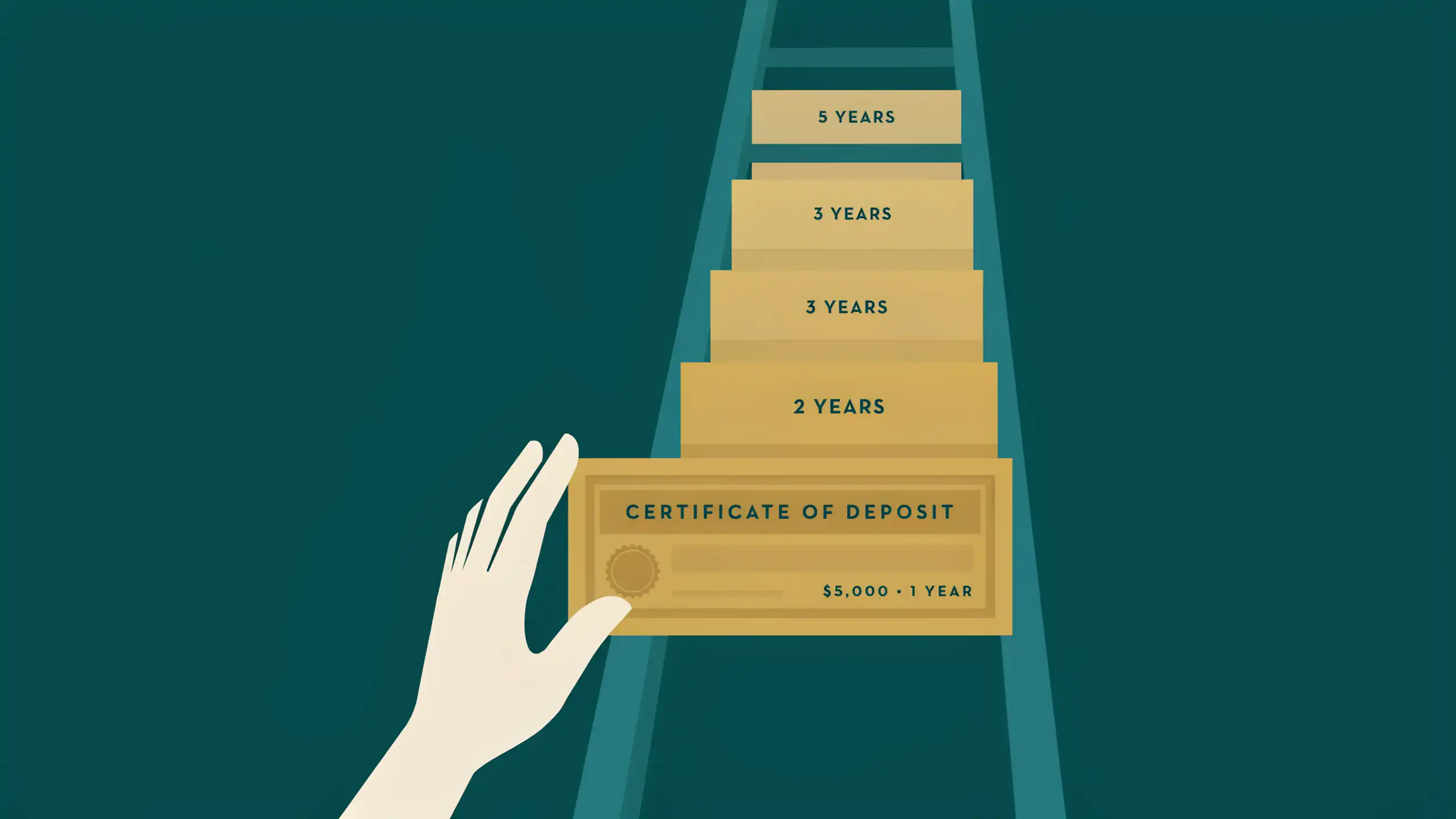
For generations, the Certificate of Deposit (CD) has served as the bedrock of conservative wealth preservation. It is a financial instrument defined by simplicity: you deposit a lump sum, agree to leave it untouched for a fixed term, and in exchange, the bank pays you a guaranteed interest rate—typically higher than that of a standard savings account.
However, the traditional CD model has long been plagued by a fundamental flaw: the "liquidity trap." Once your capital is committed to a 12 or 24-month term, it is effectively locked away. Should an unexpected emergency arise, the cost of accessing those funds is a stiff early withdrawal penalty, which can strip away months—or even years—of accrued interest.
For many, this trade-off between yield and access has been a deterrent. But there is a sophisticated strategy used by veteran investors to bypass this dilemma: the CD ladder.
Understanding the CD Ladder Strategy
At its core, a CD ladder is a structured investment approach that involves splitting a total savings amount into several smaller CDs with staggered maturity dates. Instead of placing $10,000 into a single 24-month instrument, an investor might divide that capital into four $2,500 segments maturing at 3, 6, 12, and 24-month intervals.
This structural shift transforms a static investment into a dynamic, rolling portfolio. By ensuring that one portion of your savings is always approaching maturity, you gain the benefit of higher long-term yields while maintaining a recurring "window of liquidity."
The Chronology of a Ladder: How It Functions
To appreciate the efficacy of a CD ladder, one must look at its lifecycle over a standard 24-month period.
Phase 1: The Initial Construction
You begin by diversifying your time horizons. By purchasing rungs at 3, 6, 12, and 24 months, you create a schedule where your capital is not all tied up simultaneously.
Phase 2: The First Maturation
When the first 3-month CD reaches its maturity date, you arrive at a critical decision point. If you have an unforeseen financial need—a home repair, a medical bill, or a car replacement—you can withdraw those funds penalty-free. If your financial landscape remains stable, you "roll over" the proceeds into a new 24-month CD.
Phase 3: The Rolling Cycle
As the 6-month, 12-month, and 24-month CDs hit their respective maturity dates, the cycle repeats. Because you are consistently reinvesting the maturing funds into the longest term (the 24-month rung), you eventually reach a point where every dollar in your portfolio is earning the higher long-term interest rate, while a portion of your capital becomes available every three months.
Supporting Data: Why Laddering Outperforms
The math behind the ladder is compelling, particularly when compared to the volatility of interest rate environments.
Hedging Against Rate Fluctuations
The ladder acts as a natural hedge against interest rate risk. If the Federal Reserve raises rates, the "short" rungs of your ladder mature quickly, allowing you to reinvest that capital into higher-yielding products. Conversely, if interest rates fall, your longer-term rungs remain locked in at the higher, previously secured yield. This minimizes the "opportunity cost" associated with guessing market direction.
Yield Optimization vs. Savings Accounts
While high-yield savings accounts offer flexibility, their rates are variable and can be adjusted downward by the bank at any time. CDs offer a fixed-rate guarantee. By laddering, you capture the premium associated with time-commitment without sacrificing the flexibility of a liquid savings vehicle.
Institutional Perspectives and Market Implications
Financial experts and institutional advisors often advocate for the CD ladder as a "sleep-well-at-night" strategy. Unlike stock market investments, which are subject to equity risk, CDs are typically FDIC-insured (or NCUA-insured for credit unions) up to $250,000 per depositor, per institution.
The Role of Online Banks and Credit Unions
In the current landscape, the disparity between "big-box" branch banks and online institutions is significant. Research indicates that online banks and credit unions frequently offer rates substantially higher than traditional national banks. This is largely due to lower overhead costs; without the expense of maintaining thousands of physical branches, these institutions can pass the savings to consumers in the form of higher Annual Percentage Yields (APY).
The "Cost of Exit" Calculation
A crucial component of any laddering strategy is understanding the fine print regarding early withdrawal penalties. These penalties are not standardized; they vary by institution and by the length of the term. A prudent investor must review these terms before purchasing a rung. As a rule of thumb, always calculate the worst-case scenario: if you were forced to break the ladder early, would the interest earned up to that point cover the penalty?
Implications for Personal Finance
Implementing a CD ladder requires a shift in mindset. It is not a "get rich quick" scheme; it is a discipline of structured cash flow management.
Strategic Sizing
The success of the ladder depends on proper sizing. The initial rung should be aligned with any known upcoming expenses. If you know you have a major property tax bill due in six months, your ladder should be calibrated so that a rung matures just before that date. A ladder only functions optimally if you are never forced to break it prematurely.
The Psychological Benefit
Beyond the numbers, the ladder provides psychological comfort. By avoiding the "all-or-nothing" approach, savers are less likely to abandon their savings goals during market volatility. It creates a predictable rhythm of maturity, allowing the saver to treat their liquid assets as a rotating resource rather than a dormant pile of cash.
Conclusion: A Tool for the Modern Saver
The CD ladder remains one of the most effective, low-risk tools in the personal finance toolkit. By dissolving the traditional trade-off between yield and access, it empowers the individual to take control of their cash management.
Whether you are a conservative investor seeking to protect your principal, or an individual looking to build an emergency fund that earns more than a standard bank account, the ladder provides a reliable, mathematical path to financial stability. In an era of economic uncertainty, the ability to maintain liquidity while capturing long-term growth is not just a convenience—it is a distinct financial advantage.
As you look to build your own ladder, remember the golden rule of this strategy: Shop around, compare the early withdrawal penalties of multiple institutions, and match your maturity schedule to your actual life goals. By doing so, you stop being a passive depositor and become an active architect of your financial future.
Editorial Disclosure: The content provided in this article is for informational purposes only and does not constitute financial advice. All financial decisions should be made based on your specific circumstances and in consultation with a qualified financial advisor. Offers from third-party companies mentioned herein are independent of our editorial process, and while we may receive compensation from certain providers, our analysis remains objective and focused on consumer education.
 Lina Irawan
  Dwi Wanna
  Azzam Bilal Chamdy