
 By Raul Delapena Setiawan
By Melina Moleskis
Imagine a single mother living in an urban apartment. Her life is a constant, exhausting exercise in triage: she juggles a low-wage job, the relentless demands of household chores, and the crushing anxiety of ensuring her children are fed. Her home is dimly lit, her appliances are antiquated energy-hogs, and her monthly budget is a zero-sum game. Every month, she faces a brutal, recurring dilemma: pay for electricity, buy groceries, or set aside a pittance for the inevitable emergency.
For families in this position, the relentless necessity of prioritizing immediate utility bills consumes every ounce of their mental bandwidth. There is no space left to plan for the future. As governments around the globe accelerate their climate agendas, the "green transition" is colliding with the harsh realities of household economics. While policy experts focus on carbon targets and grid upgrades, a critical, human-centric challenge is being overlooked: energy poverty.
To bridge the gap between climate ambition and social equity, policymakers must move beyond traditional economic incentives and embrace the science of cognitive scarcity.
The Anatomy of Energy Poverty: A Hidden Crisis
Energy poverty—the inability of households to secure essential energy services—is not merely a lack of income; it is a structural trap. Research consistently shows that low-income households bear the heaviest burden of energy costs. This is not due to profligate usage, but rather to the poor energy efficiency of their environments.
Many vulnerable families reside in aging, poorly insulated buildings, relying on outdated appliances or aging vehicles that consume energy at exorbitant rates. They are, in effect, paying a "poverty premium"—a higher price for energy because they lack the capital to invest in the efficiency upgrades that would lower their long-term costs. As climate policies begin to phase out fossil fuel subsidies and introduce carbon pricing, these households are the first to feel the squeeze, often forced into deeper precarity.
The Participation Gap: Why Aid Goes Unclaimed
Governments have responded with a variety of interventions, ranging from direct income support to subsidies for building renovations, such as insulation and solar panel installation. In the European Union, the impending launch of the Social Climate Fund in 2026 marks a significant commitment to mitigating these impacts.

Yet, there is a persistent, frustrating trend: a profound gap between the availability of aid and its actual utilization. Academics and policymakers have observed that a large percentage of eligible households simply never apply for the support they are entitled to. This is not a matter of ignorance; it is a manifestation of systemic behavioral barriers. When the system is designed with the assumption that every citizen has the time, energy, and mental clarity to navigate complex bureaucracy, it inevitably leaves behind the very people it aims to help.
Cognitive Scarcity and the "Tunneling" Effect
The root of this inaction lies in the concept of "cognitive scarcity," as defined by behavioral economists Sendhil Mullainathan and Eldar Shafir. When an individual faces chronic resource deprivation, their mental bandwidth is drastically reduced. The brain, under the constant pressure of survival, enters a state of "tunneling."
Tunneling is the cognitive equivalent of wearing blinders. When a person is consumed by the immediate need to pay for rent or medicine, they cannot process long-term investments—such as a government grant application that could save them thousands over a decade. The mental load is so severe that it is often compared to losing an entire night of sleep.
Under these conditions, "hassle factors"—the friction of long forms, ambiguous instructions, or the fear of rejection—become insurmountable walls. A 20-page application is not just a form; it is a barrier to entry that requires a level of cognitive focus that a person in survival mode simply cannot afford to spare.
Chronology of a Failed Policy Journey
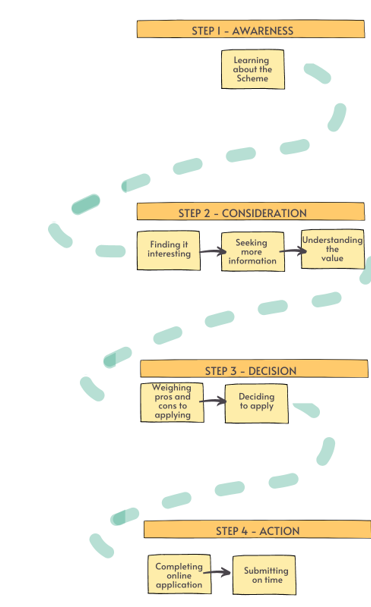
To understand why traditional policy approaches often fail, we must look at the "behavioral journey" of a vulnerable household. In our recent work with the Cyprus Institute, we mapped the trajectory of a typical applicant for energy efficiency grants.
- Discovery: The household becomes aware of a grant scheme. For many, this information is delivered through channels they do not frequent or in language that feels overly technical.
- Consideration: The applicant evaluates whether the effort of applying is worth the potential reward. At this stage, they are hit by "hassle factors"—the realization that they need documents from multiple government departments, or that the application requires internet access and a high level of digital literacy.
- Application: The actual act of filling out the form. Here, the "scarcity mindset" triggers procrastination. The fear of making a mistake, combined with the lack of immediate feedback, often leads the applicant to abandon the process mid-way.
- Outcome/Implementation: The waiting period. If the process is opaque, the anxiety of "what if I get rejected?" often prevents the applicant from following up, causing them to disengage entirely.
In Cyprus, where 19% of the population lives in vulnerable conditions, the participation rate in historical schemes has hovered around 45%. This means more than half of those who need help most are effectively excluded, not by law, but by the design of the process.
Supporting Data: The Case for Behavioral Intervention
The data from recent studies in behavioral economics provides a roadmap for change. Small, low-cost structural adjustments can drastically alter outcomes.
- Social Proof: People are more likely to participate in schemes if they see their peers—neighbors or people from similar socioeconomic backgrounds—doing so successfully.
- Loss Aversion: Framing is critical. Instead of telling a family how much they will "save" with solar panels, effective communication highlights how much they are "losing" every month by not having them. This triggers a stronger psychological response.
- The "Passport" Approach: Reducing information overload by providing a one-page "executive summary" of a complex 50-page policy document has proven to increase comprehension and action rates significantly.
Official Responses and Policy Shifts
Government agencies are beginning to take note. The shift from "information-heavy" communication to "action-oriented" design is becoming a priority for institutions like the EU. There is an increasing recognition that policy success should be measured not by how much money is allocated, but by the uptake rate among the most vulnerable.
"We are moving toward a model of ‘choice architecture’ where the default option is the helpful one," notes one policy expert. By pre-filling applications with data already held by the government (such as tax records or utility numbers), agencies can remove the most significant hurdles for the applicant, effectively turning a marathon-length task into a simple verification step.
Implications for a Just Transition
The implications of these findings are profound. If we want a "just transition" to a green economy, we must stop treating citizens as perfectly rational agents who have the capacity to maximize their own long-term interests at all times.
Instead, we must adopt a "Human-Centered Design" approach to climate policy. This involves:
- Simplification: Removing unnecessary steps, jargon, and redundant documentation.
- Proactive Assistance: Moving from a "pull" model (waiting for applications) to a "push" model (using data to reach out to those who qualify).
- Community Integration: Using local community centers or trusted neighborhood leaders to facilitate the application process, thereby reducing the stigma of seeking help and building social trust.
Conclusion
The struggle against energy poverty is as much a psychological challenge as it is an economic one. By ignoring the cognitive load of poverty, policymakers inadvertently bake exclusion into their designs. However, by embracing behavioral science, we can remove the invisible barriers that prevent vulnerable households from accessing the benefits of the green transition.
It is time for policy to catch up with the realities of the human brain. When we simplify the process, we do more than just distribute funds; we empower families to break the cycle of scarcity and participate in a future that is sustainable for everyone. The path to a net-zero world must be paved with empathy, accessibility, and a deep understanding of what it means to live on the edge.
 Dwi Wanna
  Jia Lissa
  Nana Muazin