
 By Lina Irawan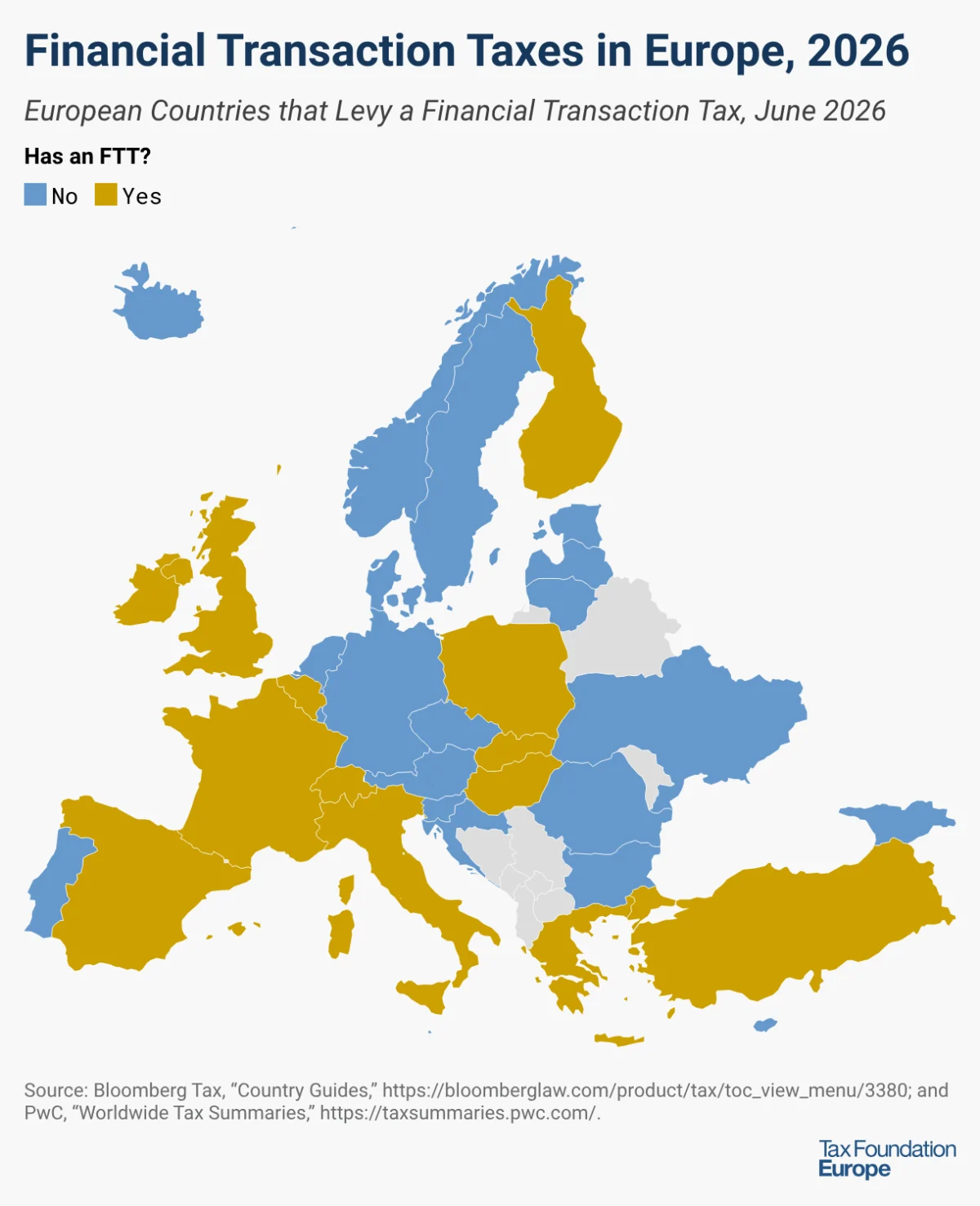
As of June 2026, the European financial landscape remains a complex patchwork of regulatory frameworks concerning Financial Transaction Taxes (FTT). While the dream of a harmonized, European Union-wide "Tobin tax" has frequently stalled in the halls of Brussels, individual member states and neighboring nations have taken unilateral action. These levies, designed to curb speculative volatility, discourage high-frequency trading (HFT), and bolster national tax revenues, have created a fragmented investment environment that requires sophisticated navigation by institutional and retail investors alike.
Main Facts: The Diversity of European Taxation
The application of FTTs across Europe is far from uniform. There is no singular "European rate"; instead, the tax burden depends heavily on the jurisdiction of the issuer, the nature of the security, and the technical mechanisms of the transaction.
For investors, the primary takeaway is that "financial transaction tax" can refer to several distinct instruments: stamp duties on share transfers, levies on specific types of derivatives, and broader taxes on business bank debits.
Countries like France, Italy, and Spain have targeted their FTTs at large-cap domestic equities to minimize the impact on broader market liquidity. Conversely, nations such as Hungary and Slovakia have implemented broader taxes that capture a wider range of bank-mediated transactions, effectively turning the tax into a cost of doing business for any entity with a local corporate account. Meanwhile, major financial hubs like the Netherlands and Germany currently maintain no specific FTT, positioning themselves as tax-efficient gateways for capital markets.
Chronology: The Evolution of the FTT Debate
The concept of taxing financial transactions gained significant political momentum following the 2008 global financial crisis. Proponents argued that such taxes could provide a "double dividend": raising substantial government revenue while discouraging the kind of short-term, high-frequency speculation that can exacerbate market crashes.
- 2011–2013: The EU Proposal: The European Commission formally proposed a common FTT system for participating member states. The proposal was intended to cover shares, bonds, and derivatives. Despite intense lobbying, the proposal faced significant pushback from member states concerned about capital flight and the erosion of competitiveness.
- 2014–2017: Fragmentation: Recognizing the deadlock in Brussels, several nations moved forward independently. France introduced its FTT in 2012, followed by Italy in 2013. These years were marked by a "wait-and-see" approach from major powers like Germany, which remained supportive in principle but cautious about implementation.
- 2020–2023: Targeted Levies: The pandemic era saw a shift toward using FTTs as a revenue-generation tool for national recovery funds. Spain introduced its FTT in 2021, mirroring the French model of taxing large-cap equities.
- 2024–2026: Consolidation and Modernization: The current period has seen a stabilization of these regimes. Governments are now refining their tax codes to include modern financial products, such as specific levies on derivatives and adjustments for high-frequency trading modifications, as seen in the Italian model.
Supporting Data: Regional Breakdown
The following data reflects the current fiscal reality as of June 2026. The wide variance in rates underscores the importance of tax-efficient portfolio construction.
The Equity Tax Leaders
Several nations utilize stamp duties or share transfer taxes that significantly impact the cost of long-term holding.
- United Kingdom: The 0.5% Stamp Duty Reserve Tax (SDRT) remains a cornerstone of the UK market. The 1.5% rate on transfers to clearance systems acts as a deterrent for specific cross-border settlement structures.
- Ireland: With a 1% stamp duty on most share transfers, Ireland protects its SME sector by exempting listed companies with a market capitalization below €1 billion, a strategic move to encourage growth in the local exchange.
- Malta: While generally maintaining a 2% stamp duty, Malta provides critical exemptions for non-resident transactions, signaling an intent to remain an attractive domicile for international holding companies.
The Strategic Equity Levies
- France (0.01%–0.40%): France’s tax is surgically applied to listed companies with a market cap exceeding €1 billion. Notably, it includes a 0.01% levy on cancelled or modified orders, directly targeting the mechanics of high-frequency trading.
- Italy (0.04%–0.40%): Italy boasts perhaps the most sophisticated, albeit complex, regime. By taxing the "net daily balance" rather than every individual trade, it attempts to avoid over-taxing market makers, while its 0.04% HFT penalty applies to orders amended or cancelled within 500 milliseconds.
Broad-Based Financial Taxes
- Hungary (0.45%–0.9%): Hungary’s approach is the most aggressive in terms of breadth. It taxes payment, securities, and currency-exchange transactions. Because the tax is applied at the bank account level, it impacts the cost of capital for all corporate participants, not just stock market investors.
- Slovakia (0.4%–0.8%): Similar to Hungary, Slovakia levies a tax on gross debits from business bank accounts. This effectively functions as a tax on the flow of money, impacting securities purchases directly.
Official Responses and Political Discourse
The discourse surrounding FTTs is deeply divided. Supporters, including various civil society organizations and labor unions, argue that these taxes are essential for social justice. They suggest that since the financial sector benefits from public infrastructure and state-backed bailouts, it should contribute a "fair share" through transaction levies.
Conversely, the financial industry—represented by groups such as the Association for Financial Markets in Europe (AFME)—consistently warns that FTTs are "liquidity killers." Official responses from central banks and finance ministries in non-FTT countries, such as the Netherlands and Luxembourg, have historically emphasized that unilateral taxes drive trading volume to jurisdictions with more favorable tax regimes, thereby undermining the European Capital Markets Union.
The European Commission continues to monitor the situation. While there is no current mandate for a universal rate, the Commission has periodically expressed concerns regarding the "fragmented tax landscape," suggesting that it creates an uneven playing field that favors large, established players who can afford complex cross-border tax engineering over smaller institutional investors.
Implications for the Future of European Markets
The current state of FTTs in Europe suggests several long-term implications for the financial services industry:
1. The Rise of Tax-Efficient Routing
Investors are increasingly utilizing smart order routing (SOR) technology to avoid jurisdictions where the tax burden is highest. As trading becomes more globalized, the physical location of the exchange or the residency of the issuer has become a primary factor in algorithmic decision-making.
2. Derivative Migration
Because many FTT regimes specifically target underlying shares, there has been a documented migration toward derivative-based trading (such as CFDs or total return swaps) in jurisdictions where derivative trades are taxed at lower rates or are exempt. This shift essentially "hides" the transaction from the equity-focused tax, though regulators are responding by expanding the scope of their taxes to include derivative notional amounts.
3. The Competitiveness Gap
The lack of a harmonized system acts as a barrier to the integration of European capital markets. For a global fund manager, navigating the difference between the 0.2% Spanish FTT and the 0.1% Greek tax, while accounting for the UK’s stamp duty, creates a significant operational overhead. This complexity favors large, well-capitalized firms capable of maintaining dedicated tax-compliance departments, while potentially disadvantaging smaller, specialized investment houses.
4. Future Harmonization or Continued Divergence?
Looking toward the late 2020s, the trend appears to be one of continued divergence. While the dream of a unified EU-wide tax persists among some politicians, the economic reality of competing for global capital suggests that major financial centers will continue to resist any tax that threatens their competitive edge. Investors should expect the current "patchwork" to persist, with countries potentially tweaking their rates periodically to address budget deficits or to incentivize specific sectors, such as green finance or technology startups.
Conclusion
As of June 2026, the European Financial Transaction Tax landscape is defined by its lack of uniformity. Investors and corporate entities must operate with an acute awareness of the specific tax liabilities of each jurisdiction in which they hold or trade assets. From the specific HFT-focused levies in Italy and France to the broad-based bank account taxes in Hungary and Slovakia, the cost of capital in Europe is no longer just a function of market supply and demand—it is a function of fiscal policy. In this environment, tax compliance and efficient trade execution are not merely administrative tasks; they are critical components of alpha generation and risk management.
 Evan Lee Salim
  Basiran
  Jia Lissa