
 By Asep Darmawan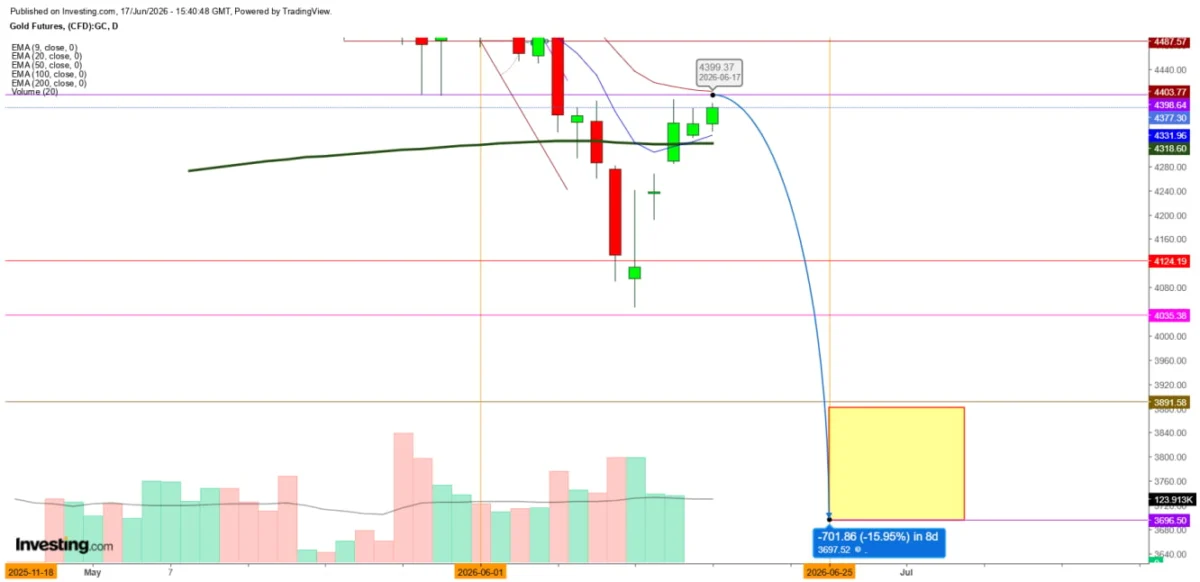
The global financial landscape is currently navigating a period of profound uncertainty, characterized by a convergence of geopolitical friction, shifting monetary policies, and a tangible deceleration in worldwide economic output. As investors turn their gaze toward Washington D.C. for the U.S. Federal Reserve’s latest interest rate decision, gold futures have emerged as the primary battleground for market sentiment. Despite intermittent optimism surrounding U.S.-Iran diplomatic overtures, the precious metal remains precariously balanced, caught between the gravity of technical breakdowns and the overwhelming weight of macroeconomic anxiety.
The Macroeconomic Backdrop: A World in Slowdown
The narrative driving current market sentiment was significantly reinforced by the World Bank’s latest global economic outlook, released this past Thursday. The report paints a sobering picture: global economic growth is now projected to hit 2.5% this year, a marked decline from the 2.9% forecast for 2025. This downward revision is not merely a statistical adjustment; it represents a fundamental struggle against the backdrop of persistent conflict in the Middle East.
Analysts are increasingly drawing parallels between the current climate and the post-pandemic recovery era. The ongoing volatility in Iran, coupled with strained global supply chains, has created an environment where the World Bank warns of the "weakest pace of growth since the Covid-19 pandemic." For gold—a traditional hedge against systemic instability—this environment should theoretically be bullish. However, the interplay between geopolitical shocks and central bank policy is creating a "whipsaw" effect, where technical price structures are rendered increasingly volatile by the intensity of real-time developments.
Chronology of Market Sentiment
To understand the current positioning of gold futures, one must look at the progression of the trading week:
- Monday and Tuesday: The market began with cautious optimism regarding potential progress in U.S.-Iran diplomatic talks. Prices attempted to stabilize, reflecting a "wait and see" approach as traders balanced geopolitical risk premiums against the prospect of de-escalation.
- Wednesday: As the date for the Federal Reserve’s interest rate announcement approached, trading volumes shifted. The focus turned entirely toward the U.S. central bank, with participants anticipating a hawkish stance aimed at curbing lingering inflationary pressures.
- Thursday: The release of the World Bank’s growth projections provided the structural framework for the current bearish sentiment. The news of a slowing global economy acted as a catalyst, forcing market participants to reassess their safe-haven holdings.
- Friday (Current): Gold futures are currently testing critical technical thresholds. With the Fed’s announcement imminent, the market is bracing for an immediate "jolt," with traders positioning themselves for a potentially sharp move in either direction.
Technical Analysis: The Anatomy of a Bearish Crossover
For the technical trader, the current daily chart for gold futures offers a grim preview of the road ahead. After opening the session at $4,350.97, the metal tested a high of $4,384.07 before retreating to a low of $4,337.22. It currently sits at $4,350.35, hovering dangerously close to a critical support zone.
The Moving Average Conundrum
The most concerning indicator for bulls is the "Bearish Crossover" currently manifesting on the daily charts. The 9-day Exponential Moving Average (EMA) sits at $4,332, while the 20-day EMA rests at $4,403. Most alarmingly, the 50-day EMA, at $4,539, has pierced the 100-day EMA at $4,567. This structural alignment is a classic indicator of long-term momentum decay.
While the metal is currently attempting to hold the key support at the 200-day EMA ($4,318.60), the sheer volume of selling pressure suggests that this floor is increasingly porous. If the price slips below this level, the psychological and technical damage could accelerate rapidly.
Resistance and The "Big Bear" Strategy
Anticipating the market’s next move requires a focus on the $4,403 resistance level. Institutional traders—often referred to as the "Big Bears"—are expected to utilize any upward bounce as an opportunity to load fresh short positions. A strategic stop-loss at $4,487 is currently being discussed in institutional circles, targeting a price objective of $3,696.50. Market models suggest that this target, should the current trend persist, could be tested within the next eight trading days.

Official Responses and Policy Implications
The Federal Reserve remains the architect of current market volatility. As the central bank prepares to announce its interest rate decision, the core mission remains the management of inflationary pressure. However, the "Fed put"—the idea that the central bank will intervene to stabilize markets—is currently being questioned.
The dilemma for the Federal Reserve is twofold:
- Inflationary Persistence: Despite a cooling economy, inflation remains sticky. Raising rates further risks deepening the recession predicted by the World Bank.
- Geopolitical Risk: The Fed cannot control the impact of the conflict in Iran on energy prices or global supply chains. By raising rates, they risk tightening the financial screws on a global economy that is already gasping for air.
Market participants are listening closely for any rhetoric regarding the duration of high-interest rates. A "higher-for-longer" narrative from the Fed would likely be the death knell for gold’s immediate recovery, as the opportunity cost of holding non-yielding assets becomes too high.
Global Economic Implications
The implications of a slowing global economy, as detailed by the World Bank, extend far beyond the price of gold. A sustained dip to 2.5% growth suggests a period of "stagflationary" pressure, where stagnant growth meets cost-push inflation. This is the worst-case scenario for policymakers.
For emerging markets, a stronger dollar—bolstered by higher U.S. interest rates—could lead to capital flight and currency devaluation, further exacerbating the global economic slowdown. For the average investor, the message is clear: the era of easy money is over, and the era of volatility has begun. The correlation between gold, the dollar, and geopolitical news has reached a point of maximum sensitivity.
Conclusion: Navigating the Jolt
As we move into the final hours before the Federal Reserve announcement, the gold market stands at a precipice. The technical indicators point to a bearish trend, the macro data confirms a weakening global outlook, and the geopolitical landscape remains a powder keg.
Traders should exercise extreme caution. While the potential for a rebound exists if the Fed takes a softer-than-expected tone, the overarching structural trend is clearly defined by the moving average crossovers. Investors are advised to watch the $4,318.60 support level with intense focus; a breach here would likely validate the bearish targets set by institutional analysts. In this environment, the "jolt" from the Fed will not just be a headline event—it will be the definitive turning point for the remainder of the quarter. The path of least resistance remains downward, and the market is already preparing for the volatility that will surely follow the central bank’s decision.
 Evan Lee Salim
  Nila Kartika Wati