
 By Raul Delapena Setiawan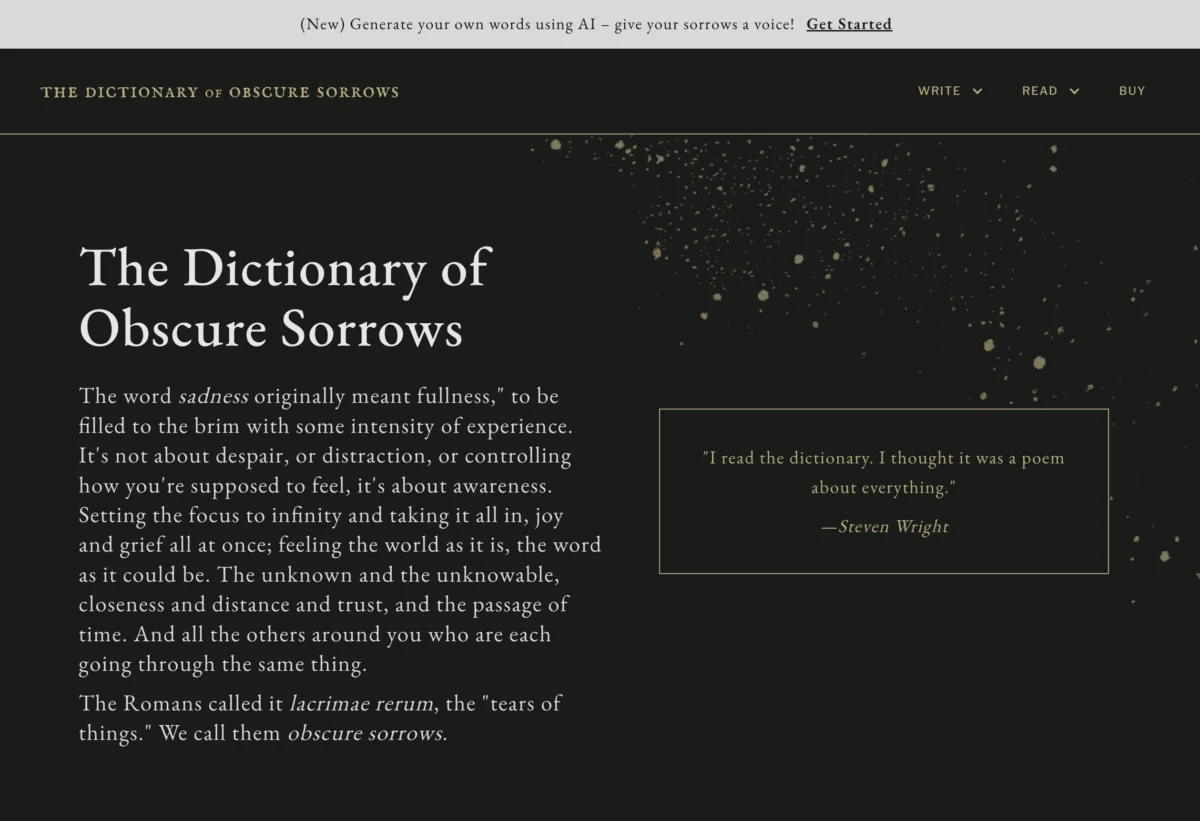
For over a decade, John Koenig’s The Dictionary of Obscure Sorrows has served as a sanctuary for the linguistically displaced. Since its humble beginnings on Tumblr in 2009, the project has meticulously cataloged the unspoken nuances of the human experience—emotions that are universally felt but rarely articulated. From the soul-stirring realization of "sonder" to the wistful ache of "anemoia," Koenig’s work has grown from a niche blog into a New York Times bestselling book, influencing culture, art, and even commercial branding.
However, a digital shadow has recently fallen over this celebrated work. Last week, a MetaFilter user discovered a website that, at first glance, appeared to be the long-awaited, polished, official home for Koenig’s project. But beneath the slick interface and responsive design lies a troubling reality: the site is an unauthorized bootleg, a parasitic construct built by a design agency that has repurposed an author’s life work, replaced its soul with AI-generated "slop," and monetized the resulting traffic—all while masquerading as the original creator.
A Timeline of a Digital Usurpation
To understand the scope of this deception, one must look at the timeline of the project’s evolution. John Koenig’s original domain, dictionaryofobscuresorrows.com, has served as the canonical archive for his neologisms for years. It is a humble, archive-style site reflective of its Tumblr roots.

In contrast, the imposter site, located at thedictionaryofobscuresorrows.com (note the addition of the definitive article "the"), emerged around August 2023. This site was designed to look like a high-end, professional publisher’s promotional portal. It featured a comprehensive author biography, press clippings, and, most alarmingly, the full text of Koenig’s copyrighted book.
While the text remained, the artistry did not. The original, curated photo-collage illustrations that defined the book’s visual identity were stripped away. In their place, the agency behind the site—a San Francisco-based web design firm called Qontour (formerly known as Prompt Digital)—inserted a series of DALL-E 2 generated images. These images, characterized by the typical uncanny artifacts and visual incoherence of early-generation AI, replaced the intentionality of human art with algorithmic approximations.
The site further incentivized this behavior by introducing an "AI Sorrow Generator," which encourages visitors to input their feelings, only for GPT-4 to churn out a synthetic word and definition. This "User-Generated Sorrows" gallery serves to inflate the site’s SEO, driving more traffic to a platform that effectively launders Koenig’s intellectual property to boost the visibility of a third-party agency.

The Anatomy of an Imposter
The deception is not merely a matter of unauthorized hosting; it is a calculated effort to displace the author in the digital hierarchy. Qontour, in their own portfolio, describes the project as a way to give "fans (like us)" a centralized hub. Yet, the mechanics of the site reveal a clear commercial intent.
The site is laced with Amazon affiliate links using Qontour’s own tracking codes, meaning that every book sale driven by the unauthorized site puts money directly into the agency’s pockets rather than the author’s. Perhaps more damaging is the site’s search engine dominance. Through aggressive SEO tactics, the bootleg site has consistently outranked the official Tumblr and the publisher’s own landing pages in Google search results.
The situation has reached a critical threshold with the advent of generative AI in search. When a user asks ChatGPT or Gemini about The Dictionary of Obscure Sorrows or John Koenig himself, the models frequently cite the Qontour-built site as the official destination. They erroneously attribute the project’s creation to the agency, effectively erasing the human author from the digital record of his own life’s work.

Official Responses and Legal Limbo
When confronted with the reality of the site, John Koenig was clear about his lack of involvement. "Yeah man, I had nothing to do with it," Koenig stated in an email correspondence. "Don’t know what to think or do about that, as the site is pretty slick. Nicer than my own, really."
Koenig’s response highlights the helplessness often felt by individual creators when confronted by well-resourced entities that treat the internet as a commons for their own enrichment. While Koenig’s publisher, Simon & Schuster, attempted to intervene by filing two DMCA takedown notices with Google in July of last year, the efforts were largely ineffective. The site remains active, and its search ranking remains high.
The legal framework surrounding the site is equally muddled. Qontour’s footer includes a copyright notice that acknowledges the content belongs to John Koenig, yet simultaneously attempts to license user-generated content under a CC Zero license and claims to hold a Creative Commons license over the site itself. As legal experts would note, one cannot license content they do not own, nor can they "re-license" an author’s intellectual property simply by hosting it on their own servers.

The "Original Sin" of AI: Consent and Displacement
The Qontour incident serves as a microcosm of a much broader, more existential conflict in the digital age. The agency openly touts its reliance on AI, stating that "Every page on this site was written in Claude" using an "author persona" called "Q." By using AI to mimic human expertise, they have created a mirror image of the original project that is fundamentally hollow.
This represents a departure from traditional "fan sites." Historically, fan sites were tributes—labor-intensive projects built by enthusiasts who sought to preserve and celebrate a creator’s work. Qontour, conversely, has utilized the language of "fandom" to camouflage a commercial operation that cannibalizes the very thing it claims to love.
The lack of consent is the pivot point. Generative AI models are trained on the entirety of the human literary corpus, often without the explicit permission or compensation of the authors who wrote it. When an agency then uses these tools to repackage that same work, they are engaging in a form of data laundering that extracts value from the human experience to benefit the machine—and the agency that operates it.

The Future of Digital Authorship
The implications of this incident extend far beyond one dictionary. We are witnessing the birth of an "AI-vibecoded" web, where authoritative, human-authored sources are systematically replaced by synthetic, optimized versions designed to siphon attention and revenue.
For journalists, novelists, and independent artists, the threat is twofold: first, their content is used to train the models; second, the output of those models is used to push their original work into obscurity. When search engines and AI assistants prioritize these AI-generated "answers," the connection between the reader and the original creator is severed.
There is a profound irony in the fact that The Dictionary of Obscure Sorrows—a project dedicated to finding the perfect words for complex human feelings—has become the victim of a technology that is famously incapable of feeling anything at all. As we move forward, the "uniquely modern sorrow" of seeing one’s work ingested and regurgitated by a machine will likely become a common experience.

Perhaps the most stinging indictment of this situation is the ease with which the public is fooled. The "slickness" of the Qontour site provides a veneer of legitimacy that convinces users, search engines, and even AI models that the artificial is authentic.
In the absence of robust legal protections or a shift in how search algorithms value original human authorship, the onus remains on the reader to discern the source. As for John Koenig, his original project remains the true home for these words—a repository of human experience that, unlike its AI-generated impostor, is built on the genuine, messy, and irreplaceable nature of being human.
Readers interested in supporting John Koenig’s original work should visit his official Tumblr or purchase the book through reputable, independent channels like Powell’s Books or local bookstores. To ensure your purchase directly supports the author, use his designated affiliate links, ensuring the creator—not a tech-savvy squatter—reaps the reward of his decade of work.
 Siti Muinah
  Iffa Jayyana
  Nila Kartika Wati