
 By Nana Muazin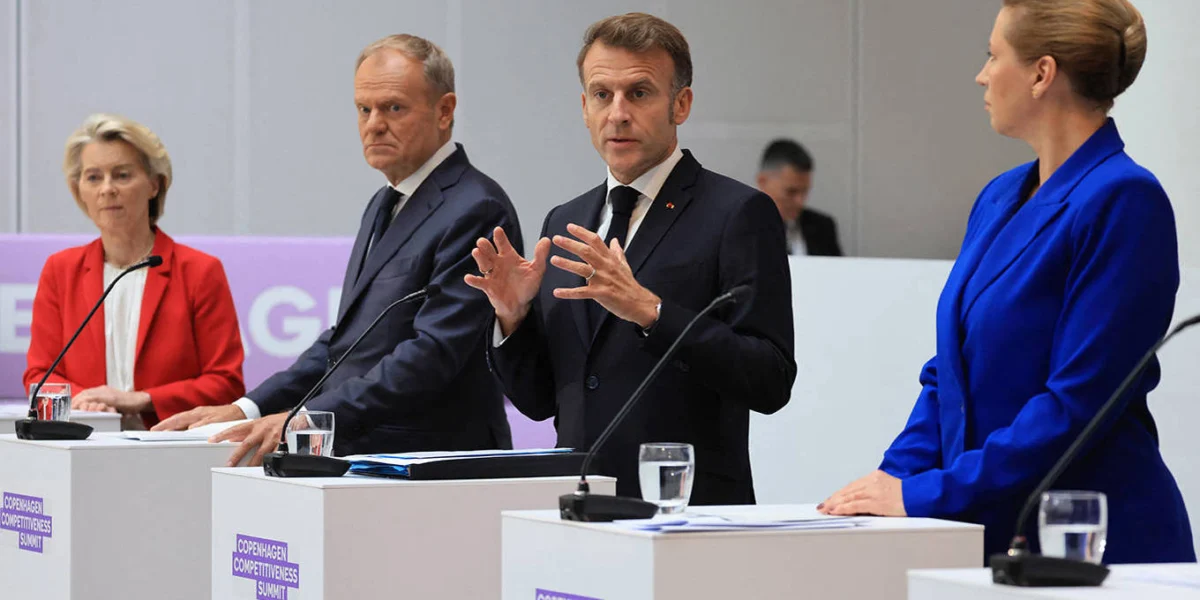
By Lars Sandahl Sørensen
June 17, 2026
The European economic landscape stands at a precarious juncture. While the continent remains a global powerhouse of innovation, culture, and social welfare, the engine of its prosperity—its industrial competitiveness—is sputtering. The message from the business community is unequivocal: European businesses are being strangled by a "policy paradox," where the regulatory burden grows in inverse proportion to the continent’s global economic standing. To reverse this trend, we require a radical shift toward simpler rules, expedited permitting, affordable energy, robust infrastructure, and the final, elusive completion of a truly functioning single market.
The Copenhagen Mandate: A Defining Moment
In October 2025, the historic city of Copenhagen served as the stage for a pivotal gathering: the Copenhagen Competitiveness Summit. The event was not merely a ceremonial meeting of minds; it was a desperate signal from the private sector to the political leadership of the European Union.
Standing side-by-side, French President Emmanuel Macron, European Commission President Ursula von der Leyen, Polish Prime Minister Donald Tusk, and Danish Prime Minister Mette Frederiksen were joined by the chief executives of 28 of Europe’s largest industrial conglomerates. The agenda was stripped of diplomatic pleasantries: How can Europe survive in an era of cutthroat global competition, characterized by the technological acceleration of the United States and the state-subsidized industrial might of China?
The summit concluded with a sobering consensus: Europe’s current trajectory is unsustainable. The "Copenhagen Declaration" that emerged from the event underscored that competitiveness is not a luxury—it is the prerequisite for funding the green transition, the digital transformation, and the social model that Europeans hold dear.
Chronology of a Competitiveness Crisis
The current malaise did not emerge overnight. It is the result of a decade-long accumulation of institutional friction and external shocks.
- 2015–2019: The Regulatory Proliferation: Following the post-financial crisis recovery, the EU embarked on an ambitious regulatory expansion. While initiatives like the GDPR set global standards, they simultaneously increased the "compliance tax" on European SMEs and multinationals alike.
- 2020–2022: The Twin Shocks: The COVID-19 pandemic exposed the fragility of European supply chains, followed immediately by the Russian invasion of Ukraine, which shattered the continent’s reliance on cheap Russian natural gas. This energy shock was the catalyst that finally made competitiveness a political priority rather than a boardroom concern.
- 2023–2024: The Geopolitical Pivot: Recognizing that the US Inflation Reduction Act (IRA) was drawing investment away from European shores, Brussels scrambled to introduce the Green Deal Industrial Plan. However, critics argued these were "too little, too late" and failed to address the underlying structural issues.
- October 2025: The Copenhagen Competitiveness Summit: A watershed moment where the business sector formally demanded a "competitiveness check" on all new EU legislation.
- Mid-2026: The Current Impasse: Despite the rhetoric, the gap between political promise and regulatory reality remains wide, prompting calls for a new, simplified legislative framework.
Supporting Data: The Case for Urgent Reform
The statistics paint a grim picture of European industrial decline. According to data analyzed at the Copenhagen Summit, European energy prices for industrial users remain significantly higher—in some sectors double or triple—than those of our primary competitors in North America.
Furthermore, the "permitting trap" continues to be a primary deterrent to investment. In the European Union, the average time to secure approval for a large-scale renewable energy project or a green-tech manufacturing facility remains between five and eight years. In contrast, jurisdictions in East Asia and parts of the United States have streamlined these processes to under 24 months.
The fragmentation of the Single Market also remains a silent killer of growth. While we share a currency and a common trade policy, the digital single market remains a patchwork of 27 different regulatory regimes. For a startup trying to scale, the cost of navigating these legal barriers is often prohibitive, leading many to relocate their headquarters to the United States. Venture capital investment in Europe, while growing, still lags behind US levels by a factor of three when adjusted for GDP, limiting the capacity for home-grown innovation to reach global scale.
Official Responses: Navigating the Policy Maze
The response from Brussels has been a mix of acknowledgement and defensive posturing. President von der Leyen has championed the "Competitiveness Agenda," focusing on the simplification of administrative burdens. "We recognize that our businesses cannot be expected to win the global race with one hand tied behind their backs by red tape," she stated during the Copenhagen proceedings.
However, the political reality is fraught with national interests. Prime Minister Tusk has been a vocal proponent of a "Security-First" economic model, arguing that competitiveness is inextricably linked to the continent’s defense capacity. "An economy that cannot sustain its own defense industry is an economy that cannot guarantee its sovereignty," Tusk noted.
French President Macron, meanwhile, has pushed for a more assertive "European Sovereignty" doctrine, suggesting that the EU must be willing to use state aid more strategically to support critical industries. Yet, this approach faces fierce opposition from Northern European member states, who fear that excessive state intervention will distort the single market and lead to a "subsidy race" that the wealthier nations will inevitably win.
The Implications: A Continent at a Crossroads
If the policy failures described above persist, the implications for the European project are severe. We are not merely talking about lower GDP growth; we are talking about the erosion of the European middle class and the decline of our industrial heartlands.
1. Deindustrialization and "Brain Drain"
Without affordable energy and faster permitting, Europe risks a permanent hollowing out of its manufacturing base. This is not a theoretical risk; we are already seeing energy-intensive industries—chemicals, steel, and glass—reallocating production to regions where energy is stable and regulations are predictable. Along with this capital flight, we are seeing a "brain drain" of talent, as Europe’s brightest minds in AI, biotechnology, and quantum computing flock to ecosystems where they can launch products in months, not years.
2. The Loss of Strategic Autonomy
Europe’s goal of "strategic autonomy" becomes a hollow promise if we are dependent on foreign powers for the critical technologies and resources required for the green and digital transition. If the infrastructure for the next generation of industry—hydrogen networks, high-speed connectivity, and standardized digital grids—is not built now, Europe will become a consumer of technology rather than a creator, forever reliant on foreign supply chains.
3. Social Unrest and Populism
The most dangerous implication is the political fallout. When the European social model can no longer be funded by the surplus generated by a competitive economy, the resulting austerity will feed political instability. Populist movements thrive on the narrative that the "Brussels machine" is indifferent to the plight of the working family. Restoring competitiveness is therefore the only way to safeguard the social contract and ensure that Europe remains a beacon of democratic stability.
Conclusion: The Path Forward
The path to a more competitive Europe is clear, but it requires a level of political courage that has been lacking in recent years. We need:
- Regulatory Sunset Clauses: Every new piece of regulation must be balanced by the removal of two existing, outdated regulations.
- The "One-Stop-Shop" for Investment: A unified, digital portal for permitting that treats the EU as a single economic space, rather than 27 individual jurisdictions.
- Energy Union Realization: Moving beyond national energy markets to a truly integrated European energy grid that ensures price stability and supply security.
- Deepening the Capital Markets Union: Creating a unified financial market that allows European savings to be invested in European innovation, rather than sitting idle in bank accounts.
The Copenhagen Competitiveness Summit was a wake-up call. The question is no longer whether we have the resources to compete; we have the capital, the talent, and the technology. The question is whether we have the institutional agility to move at the speed of the global economy. The time for incremental reform has passed; the era of decisive, structural change must begin now. If we fail to deliver, the competitiveness challenge will not just define the next election cycle—it will define the decline of a continent.
 Asep Darmawan
  Lina Irawan