
 By Nana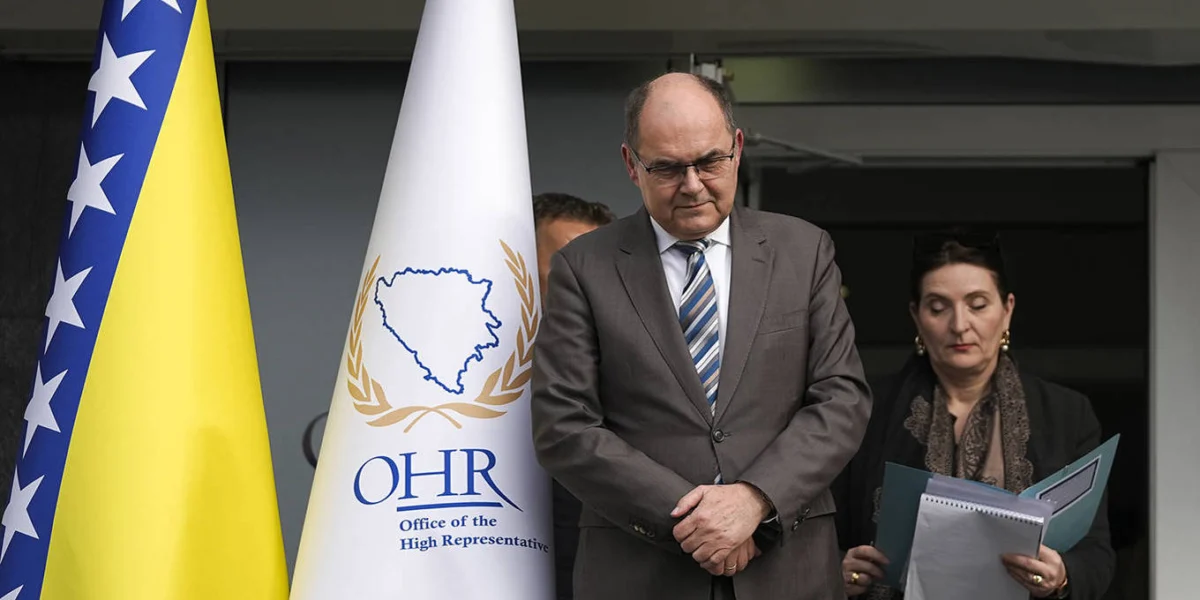
By Carl Bildt
June 19, 2026
STOCKHOLM — More than three decades have elapsed since the signing of the Dayton Accords brought an uneasy silence to the killing fields of Bosnia and Herzegovina. The 1992–1995 conflict, which claimed over 100,000 lives and displaced millions, was intended to be the crucible from which a modern, functional, and self-governing European state would emerge. Yet, as we stand in the summer of 2026, the nation remains a fragile protectorate, trapped in a bureaucratic limbo managed by the international community.
The recent intervention by the Trump administration in Bosnian internal affairs has sparked fresh controversy, characterized by many observers as a move driven by transactional politics rather than a genuine desire for state-building. Rather than serving as the catalyst for full independence, this intervention has underscored a harrowing reality: the vicious cycle of international tutelage shows no signs of abating.
Main Facts: A State in Suspension
At the heart of the crisis lies a fundamental contradiction. Bosnia and Herzegovina is an internationally recognized sovereign state, yet it is governed by an administrative structure—the Office of the High Representative (OHR)—that possesses near-dictatorial powers. This body can strike down legislation, remove elected officials, and impose laws without parliamentary oversight.
The Trump administration’s recent involvement has bypassed traditional diplomatic channels, appearing to favor specific political actors in the Republika Srpska while undermining the central institutions in Sarajevo. This has not only destabilized the fragile power-sharing agreement between the Bosniak, Serb, and Croat constituents but has also signaled to the international community that the United States is moving away from its role as a neutral guarantor of the Dayton Accords toward a more mercurial, interest-based engagement.
The core issue remains the "Dayton trap." The peace agreement succeeded in ending the war, but its architecture—designed for wartime exigency—has become a permanent obstacle to peacetime governance. Bosnia today is a country where administrative paralysis is the norm, and where the political elite benefit from a system that prioritizes ethnic identity over civic functionality.
Chronology of a Stagnant Peace
To understand why Bosnia remains a ward of the international community, one must look at the timeline of its fractured evolution:
- 1995: The Dayton Accords are signed. The OHR is established to oversee the civilian implementation of the peace agreement.
- 2000–2005: The "Golden Age" of international intervention. Sweeping reforms are implemented, including the creation of a unified armed force and a central tax authority. However, these are largely imposed by the High Representative, not enacted by local legislatures.
- 2006: The "Butmir Process" and subsequent efforts to reform the constitution fail, signaling that the local political class has grown comfortable with international oversight as a scapegoat for their own failures.
- 2014: Massive social protests erupt across the country, fueled by economic despair and corruption. The response from the international community is muted, focusing on stability rather than reform.
- 2022–2024: Heightened secessionist rhetoric from leadership in Republika Srpska, met with toothless sanctions and bureaucratic warnings from Brussels and Washington.
- 2026: The Trump administration intervenes, creating a new layer of ambiguity. The move is widely interpreted as a "corrupt intervention," prioritizing short-term regional alliances over long-term institutional stability.
Supporting Data: The Cost of Dependence
The stagnation of Bosnia and Herzegovina is not merely a matter of political opinion; it is reflected in every major socio-economic indicator.
- Brain Drain: Since 2013, it is estimated that over 500,000 people have emigrated, many of them young, educated professionals. The lack of faith in the state’s ability to provide a future is the primary driver of this demographic hemorrhage.
- GDP and Economic Stagnation: Bosnia’s GDP growth consistently lags behind its regional peers in the Western Balkans. The complexity of the administrative apparatus—comprising two entities, ten cantons, and a national government—creates a "choke point" for foreign direct investment.
- Public Sector Bloat: The cost of maintaining the administrative structure of the country consumes nearly 60% of the national budget, leaving little for education, healthcare, or infrastructure development.
- Judicial Failure: Transparency International consistently ranks Bosnia among the most corrupt countries in Europe. The judiciary, under the influence of political patronage, has failed to prosecute high-level graft, further entrenching the status quo.
Official Responses and Diplomatic Fallout
The reaction to the recent U.S. intervention has been deeply polarized.
The Washington View
The current administration in Washington maintains that its actions are intended to "break the deadlock" in Sarajevo. Spokespersons have argued that the traditional, bureaucratic approach of the European Union and previous U.S. administrations has led only to more stagnation. By dealing directly with regional power brokers, the White House claims it is attempting to achieve practical results where diplomacy has failed.
The European Perspective
In contrast, Brussels and many European capitals have reacted with alarm. EU officials have privately expressed concern that the U.S. move undermines the rule-of-law benchmarks required for Bosnia’s long-term integration into the European Union. "If the U.S. abandons the principles of the Dayton Accords in favor of transactional politics, the entire regional security framework becomes volatile," one senior diplomat noted on condition of anonymity.
The View from Sarajevo
Local political reactions are divided along ethnic lines. Some leaders view the U.S. intervention as a necessary push against a system that has become too rigid. Others, particularly those favoring a more centralized, civic-state model, see the intervention as a betrayal of democratic principles, fearing it paves the way for the eventual disintegration of the country.
Implications: A Future at Risk
The long-term implications of this drift are profound. If Bosnia and Herzegovina continues to be treated as a "project" to be managed rather than a sovereign partner to be integrated, several risks emerge:
1. The Normalization of Secessionism
By engaging with actors who openly advocate for the dismantling of the state, international powers are inadvertently validating secessionism. This creates a feedback loop where politicians are incentivized to keep the country in a state of permanent crisis to keep the international community’s attention.
2. The Erosion of the Rule of Law
When external powers intervene to bypass internal constitutional processes, they undermine the very institutions they are supposed to be strengthening. If the "rule of the powerful" replaces the "rule of law," the prospect of Bosnia ever meeting the standards for EU membership becomes virtually non-existent.
3. Geopolitical Vulnerability
Bosnia has become a theater for broader global competition. With the U.S. shifting its stance, other actors—including Russia, China, and regional powers—are finding more room to maneuver. This turns the Balkans into a chessboard for external forces, with the Bosnian people serving as the pawns.
Conclusion: Time for a Reboot
The time has come for a fundamental shift in the international approach to Bosnia and Herzegovina. The era of the "international protectorate" must come to an end.
A political reboot is not merely an option; it is an existential necessity. This requires a transition from the current system of oversight to one of local responsibility. The international community must stop acting as the "governor" of the country and start acting as a partner that holds local leaders accountable for their actions—not through the imposition of laws, but through the application of strict, merit-based conditionality.
For 30 years, we have provided the crutches upon which the Bosnian state leans. It is time for the international community to step back and allow the country to find its own footing. Failure to do so will not only ensure the continuation of a failed state but will perpetuate the suffering of a population that deserves a future free from the shadow of the past. The cycle of dependence must be broken; for Bosnia to truly live, the international intervention must finally die.
 Nana Muazin
  Asep Darmawan
  Lina Irawan