
 By Nila Kartika Wati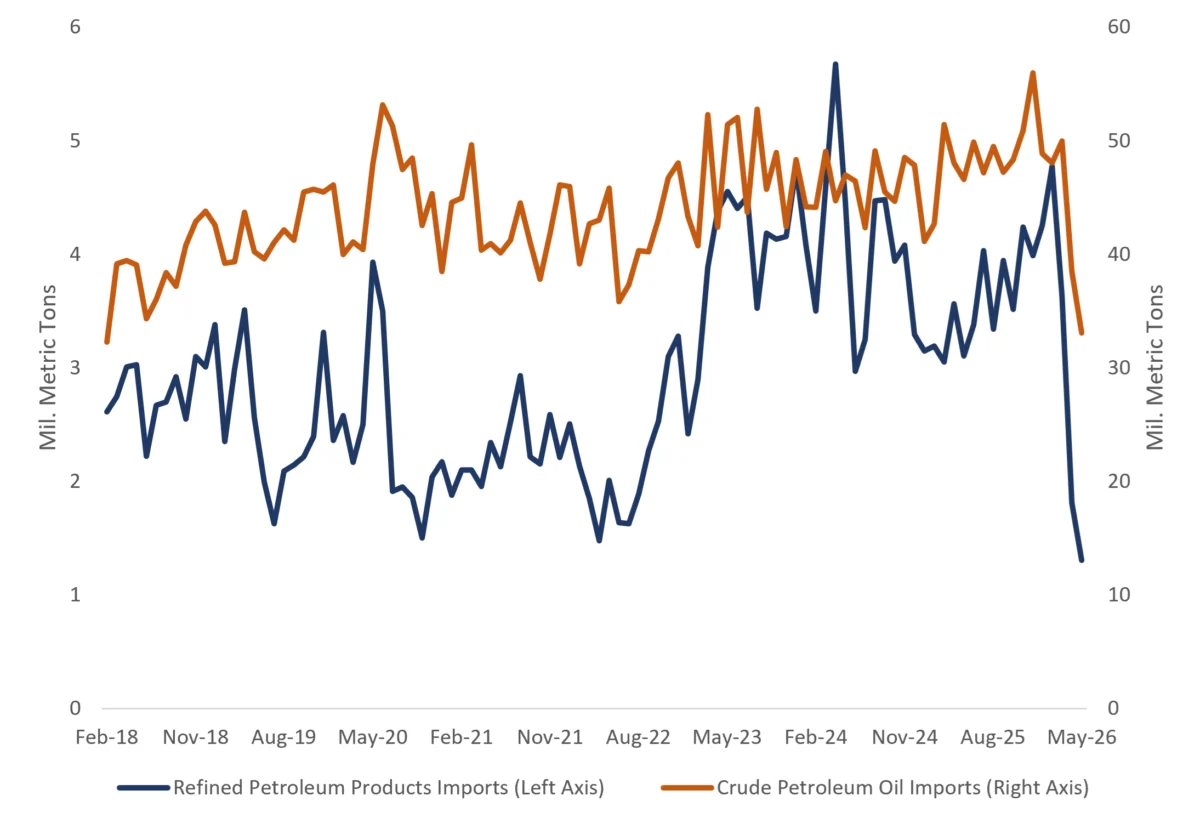
For decades, the standard playbook for oil market analysis was straightforward: a major conflict in the Middle East—particularly one threatening the vital arteries of the Strait of Hormuz—would trigger an immediate, violent spike in crude prices. Yet, more than 100 days into the current regional crisis, global energy markets are behaving with a baffling, almost eerie, sense of calm. As investors and policymakers grapple with the volatility of the region, a critical question emerges: Why is the price of oil remaining contained below the $100-per-barrel threshold, and what happens when the temporary buffers currently holding the market together begin to fray?
The answer lies in a complex interplay of shifting demand centers, advanced technological surveillance, and the evolving nature of maritime warfare in the 21st century.
The China Factor: A Massive Demand Vacuum
While geopolitical tensions are usually the primary driver of oil pricing, the current market reality is being dictated as much by Beijing as it is by the conflict in the Middle East. Data from Vortexa provides a startling look at the cooling of the world’s largest crude importer. Last month, Chinese crude imports via tanker plummeted to just 6.7 million barrels a day—a figure nearly 40% lower than the 2025 average.
To put this in perspective, a reduction of 4 million barrels per day is gargantuan; it is equivalent to the combined daily oil consumption of Germany and France. This massive drop in demand has acted as a mechanical counterweight to the supply risks posed by the closure of the Strait of Hormuz. Beijing has managed to slash these imports without suffering an immediate economic collapse, though the cooling effect is visible in the nation’s GDP growth, which slid from 5% in the first quarter to 4.6% in the second.
For market analysts, this raises a haunting question: If China’s economic appetite for energy returns to normal levels before the Middle East crisis finds a lasting resolution, the current price floor could vanish overnight. The Chinese retrenchment has essentially provided a "free pass" to the global energy market, masking the severity of supply disruptions that would otherwise have sent prices into a tailspin.
A Chronology of the Crisis and Market Adaptation
To understand how we arrived at this state of complacency, one must look at the timeline of the last three months:
- Initial Shock: The onset of the conflict in the Middle East triggered an immediate, sharp reaction in futures markets, with prices spiking as traders priced in the total closure of the Strait of Hormuz.
- The Pipeline Pivot: As the Strait became effectively blocked to conventional traffic, the market proved more resilient than anticipated. Saudi Arabia and the United Arab Emirates successfully ramped up pipeline capacity and implemented sophisticated tanker shuttle operations, ensuring that a significant portion of Gulf oil still reached global markets.
- Inventory Buffers: The market entered this crisis in a state of relative surplus. Combined with the record-setting release of strategic petroleum reserves (SPR) by various nations, the immediate physical shortage was mitigated.
- Refinery Retrenchment: As global demand for petrochemicals weakened, refinery runs slowed down, naturally lowering the short-term demand for crude oil.
- The Present Day: We are now in a period of "information equilibrium," where traders have largely hedged their risks through financial instruments like options rather than panic-buying physical barrels.
The Technological Shield: How Satellite Intelligence Dampened Panic
In previous decades, the "fog of war" surrounding maritime chokepoints would have created massive price premiums due to uncertainty. Today, that uncertainty is being chipped away by high-resolution satellite imagery and advanced tanker tracking.
Traders are no longer relying solely on hearsay or official government statements. Real-time monitoring of tanker movements allows the market to see exactly how much oil is exiting the Gulf, even when official channels are silent. This democratization of information has acted as a stabilizer, preventing the kind of irrational exuberance—or irrational fear—that characterized the oil shocks of the 1970s and 80s.
However, this reliance on data brings its own set of vulnerabilities. The traditional model of maritime monitoring—the Automatic Identification System (AIS)—is increasingly being weaponized. In the waters of the Red Sea and the Strait of Hormuz, the "evidence" of oil movement is becoming a battlefield of its own.

The Crisis of Information: Dark Vessels and Spoofing
The sophistication of maritime deception has reached new heights. As the article’s data indicates, the market is currently "pricing in" not just barrels of oil, but the quality of information. We are witnessing the rise of three distinct categories of maritime risk:
- "Dark Vessels": Ships that intentionally deactivate their AIS transponders to disappear from public tracking, often to conceal clandestine port calls or prohibited cargo transfers.
- "Spoofing": The deliberate transmission of false position signals. A tanker can be made to appear as if it is docked in a European port while it is actually loading crude in a conflict zone, creating a false narrative of supply or demand.
- "Shadow Fleets": Opaque networks of aging tankers, often operating outside of international regulatory oversight, that move sanctioned commodities to ensure they reach the market regardless of global political pressure.
For the energy trader, a vessel track is no longer a simple objective fact. In a crisis, that track becomes a market-sensitive claim. If a vessel "goes dark," is it a sign of a supply disruption, or merely a ship attempting to avoid secondary sanctions? In this environment, false signals can quickly be interpreted as market truth, leading to volatility that has little to do with actual physical supply and everything to do with the "narrative" of the war.
Implications for the Future: A Fragile Equilibrium
The containment of oil prices is, at its core, a house of cards built on five fragile pillars: surplus inventories, strategic reserve releases, flexible refinery operations, hopeful diplomatic projections, and—most importantly—the unprecedented demand slowdown in China.
What Lies Ahead?
If the geopolitical situation in the Middle East does not reach a formal resolution, the market will eventually be forced to reckon with the depletion of its buffers. Strategic reserves are not infinite, and refinery flexibility has limits.
The most significant "wild card" is the eventual re-acceleration of the Chinese economy. If Beijing returns to historical levels of crude consumption while the Strait of Hormuz remains a contested zone, the world could see a rapid shift from the current "complacency pricing" to a "scarcity pricing" model.
Furthermore, as the quality of maritime data becomes increasingly compromised by the rise of the shadow fleet and spoofing technologies, the market’s ability to "see" the truth will diminish. Investors who have relied on the perceived transparency of current tracking systems may find themselves blindsided by sudden, sharp price movements driven by hidden disruptions that the data simply failed to capture.
Final Analysis: The Investor’s Dilemma
For the professional investor, the current state of the energy market is a lesson in the dangers of relying on historical precedents. The fact that oil prices have remained contained despite a clear, existential threat to global supply chains is not an indication that the risk has vanished; it is an indication that the market has successfully substituted physical supply with a combination of temporary buffers and better information.
As we look toward the remainder of the year, the stability of the energy sector will depend on two unpredictable variables: the durability of China’s economic retrenchment and the veracity of the data flowing from the world’s most contested maritime chokepoints. Until both are settled, oil prices will remain in a state of suspended animation—a dangerous calm that masks the underlying volatility of a global economy tethered to an increasingly unpredictable supply chain.
Important Disclosures: This material is for general information only and is not intended to provide specific advice or recommendations for any individual. There is no assurance that the views or strategies discussed are suitable for all investors. To determine which investment(s) may be appropriate for you, please consult your financial professional prior to investing. Investing involves risks, including possible loss of principal. No investment strategy or risk management technique can guarantee return or eliminate risk.
 Evan Lee Salim