
 By Nana Wu
BEIJING — In a move that has sent shockwaves through both the Silicon Valley tech corridor and the halls of Washington D.C., the Beijing-based artificial intelligence laboratory Z.ai has officially released GLM-5.2. Launched on June 16, 2026, the new model represents more than just a technical iterative update; it is a profound statement of China’s burgeoning independence from the Western semiconductor ecosystem and a direct challenge to the dominance of closed-source American frontier models.
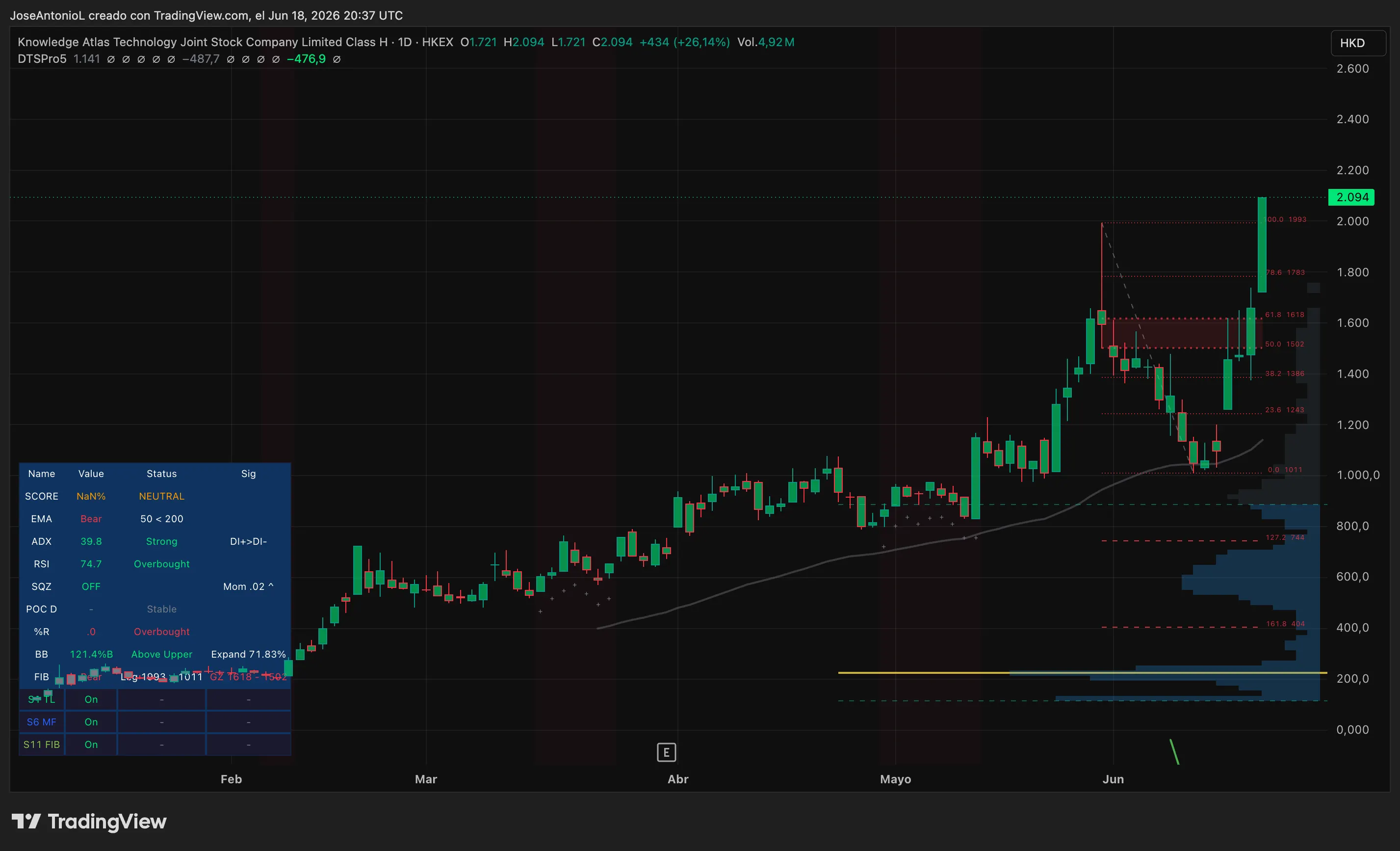
Despite being placed on the U.S. Entity List in early 2025, Z.ai has defied expectations. The release of GLM-5.2, coupled with the recent regulatory bans on Western models like Anthropic’s Claude Fable 5, has catalyzed a staggering 90% surge in Z.ai’s stock price over the past week, propelling the company to a new all-time high. As the "silicon curtain" descends, GLM-5.2 stands as a testament to the efficacy of domestic Chinese hardware and the resilient power of open-source development.
Main Facts: A New Frontier for Open-Source Intelligence
GLM-5.2 arrives as a 744-billion-parameter Mixture-of-Experts (MoE) model, a sophisticated architecture designed to maximize computational efficiency by only activating a fraction of its total parameters for any given task. Perhaps its most striking technical specification is its "genuine" 1 million-token context window—a five-fold increase over its predecessor, GLM-5.1. This massive window allows the model to ingest and process entire libraries of code, long-form legal documents, or multi-hour technical workflows in a single pass.
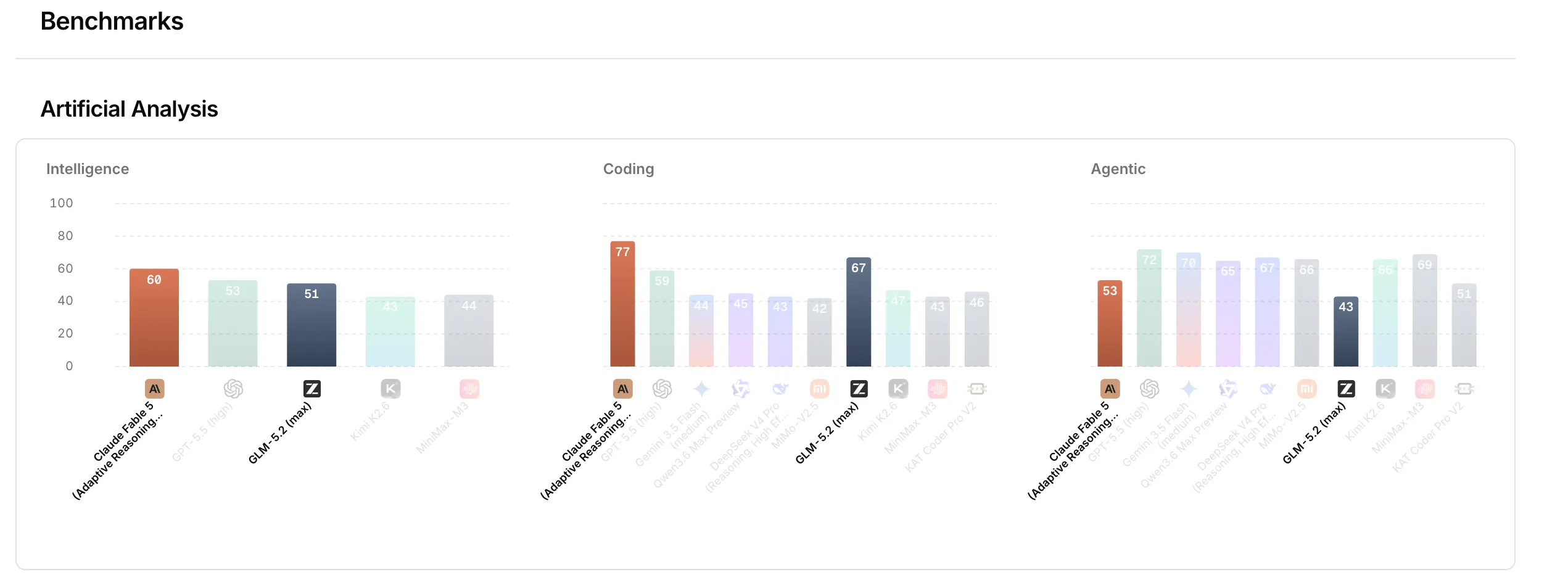
The model’s performance metrics have placed it squarely at the top of the Artificial Analysis Intelligence Index. In a direct comparison, GLM-5.2 has achieved parity with, and in some cases exceeded, the most advanced proprietary models from the United States.
Crucially, Z.ai has released the model under an MIT license. This move is strategically significant: by making the weights open-source, Z.ai ensures that the model can be deployed globally without the risk of a "kill switch" being flipped by a centralized government directive or a corporate board. It represents a democratization of frontier-level AI at a time when Western labs are increasingly moving toward "walled garden" ecosystems.
Chronology: The Road to Autonomy
The journey to the launch of GLM-5.2 is a story of rapid adaptation under geopolitical pressure.

- January 2025: The U.S. Department of Commerce adds Z.ai to the Entity List, citing concerns over "dual-use" capabilities and national security. This move was intended to starve the lab of high-end Nvidia H100 and B200 GPUs.
- Early 2026: Z.ai successfully transitions its training pipelines to Huawei’s Ascend Atlas servers. Reports emerge that Z.ai has successfully trained a high-fidelity image generation model using zero American silicon, proving the viability of the Huawei ecosystem.
- June 10, 2026: Regulatory tensions peak as the U.S. and its allies implement stricter bans on the export of "agentic" AI models, leading to the functional withdrawal of Anthropic’s Claude Fable 5 from several international markets.
- June 16, 2026: Z.ai "drops" GLM-5.2 on X (formerly Twitter) and HuggingFace, promising performance that rivals GPT-5.5 and Claude Opus 4.8.
- June 18, 2026: Following a week of rigorous third-party benchmarking, Z.ai’s stock reaches an all-time high as investors bet on the lab’s role as the primary provider of AI for the "non-aligned" tech world.
Supporting Data: Benchmarking the Breakthrough
The "hype" surrounding GLM-5.2 is supported by rigorous technical benchmarks that evaluate the model’s ability to handle complex, real-world engineering tasks.
FrontierSWE: Technical Mastery
FrontierSWE is a benchmark designed to test an AI agent’s ability to complete open-ended technical projects that typically take human engineers hours to solve. It covers systems optimization, large-scale code construction, and applied machine learning research.
- Claude Opus 4.8: 75.1 (Dominance Rate)
- GLM-5.2: 74.4
- GPT-5.5: 72.6
In this arena, GLM-5.2 effectively matches the gold standard of the industry, narrowly edging out the latest iteration of OpenAI’s flagship.
SWE-bench Pro: Autonomous Problem Solving
This benchmark tests the model’s "pass rate" when resolving real-world GitHub issues autonomously.
- GLM-5.2: 62.1%
- GPT-5.5: 58.6%
- GLM-5.1 (Predecessor): 58.4%
The jump from 58.4% to 62.1% is statistically significant in the world of autonomous agents, suggesting that Z.ai has made major breakthroughs in the model’s reasoning and self-correction capabilities.
The Cost of Innovation
Perhaps the most disruptive data point is the cost of training. Emad Mostaque, founder of Stability AI, estimated that the total training cost for GLM-5.2 was approximately $25 million. Remarkably, 80% of that budget was reportedly spent on post-training (fine-tuning and alignment) rather than the raw compute of the pre-training phase.
When compared to the rumored multi-billion dollar training budgets of the GPT and Claude series, GLM-5.2 represents a level of capital efficiency that could fundamentally change the economics of the AI industry. This efficiency is attributed to the optimized integration between Z.ai’s software and Huawei’s Ascend hardware.
Official Responses and Market Reaction
The reaction to GLM-5.2 has been a mix of investor euphoria in the East and cautious reappraisal in the West.
Market Reaction:
The 90% stock surge for Z.ai reflects a growing sentiment that the U.S. sanctions may have backfired. By forcing Chinese labs to develop their own hardware-software stacks, the U.S. has inadvertently accelerated the creation of a parallel, self-sustaining AI economy. Investors are increasingly viewing Z.ai not as a "Chinese alternative," but as the global leader in open-source frontier AI.
The Developer Community:
Unsloth AI, a prominent group in the model optimization space, has already pushed 2-bit GGUF quantizations for GLM-5.2. This allows the massive 1.51TB model to be compressed down to 238GB. While it still requires a high-end workstation (such as a maxed-out M4 Ultra Mac Studio or a PC with 256GB of unified RAM), it brings frontier-level intelligence within reach of independent researchers and small-to-medium enterprises.
Geopolitical Implications:
Policy analysts suggest that the MIT license of GLM-5.2 is a "poison pill" for Western regulators. Because the weights are distributed and open, the model cannot be recalled or censored through standard diplomatic or legal pressure. This ensures that GLM-5.2 will likely become the backbone for developers in regions that are currently underserved or restricted by American AI providers.
Implications: The Future of the AI Landscape
The arrival of GLM-5.2 signals several major shifts in the global technology landscape:
1. The End of the Nvidia Monopoly
For years, the consensus was that no lab could train a frontier model without Nvidia’s CUDA ecosystem. GLM-5.2 has shattered this myth. By utilizing Huawei Ascend chips, Z.ai has proven that there is a viable, high-performance path forward that does not rely on Western supply chains. This will likely encourage other labs in the Entity List era to pivot toward domestic hardware.
2. Economic Disruption of API Pricing
Z.ai is leveraging its lower training costs to undercut the competition aggressively.
- GLM-5.2 API: $1.40 per 1M input / $4.40 per 1M output.
- Claude Opus 4.8: $5.00 per 1M input / $25.00 per 1M output.
For startups building agentic pipelines—where models may call themselves hundreds of times to complete a task—the price difference is not just a saving; it is the difference between a viable business model and bankruptcy.
3. Diversity Over Polish
In real-world testing, such as building complex game mechanics from scratch, GLM-5.2 has shown a unique "creative variance." While Western models like GPT-5.5 often produce more "polished" or aesthetically pleasing user interfaces in a zero-shot setup, GLM-5.2 tends to generate more diverse game states, varied enemy types, and complex logic structures. This suggests that the model’s training data and alignment processes have prioritized functional diversity over superficial "vibes," a trait highly valued by backend developers.
4. The Rise of "Local Frontier" AI
The ability to run a quantized version of a 744B parameter model on a single (albeit expensive) workstation changes the privacy and security calculus for corporations. With GLM-5.2, a firm can keep its most sensitive proprietary data entirely offline while still utilizing a model that rivals the best cloud-based AI in the world.
Conclusion
The release of GLM-5.2 is a watershed moment. It marks the point where the "open-source gap" has effectively closed. Z.ai has managed to deliver a model that is cheaper to use, more open to developers, and untethered from the hardware constraints that many thought would cripple the Chinese AI industry. As the world moves toward 2027, the success of GLM-5.2 suggests that the future of artificial intelligence will not be a single, Western-led monoculture, but a fragmented, competitive, and highly resilient global ecosystem.
 Nana
Nana  Raul Delapena Setiawan
  Basiran