
 By Asep Darmawan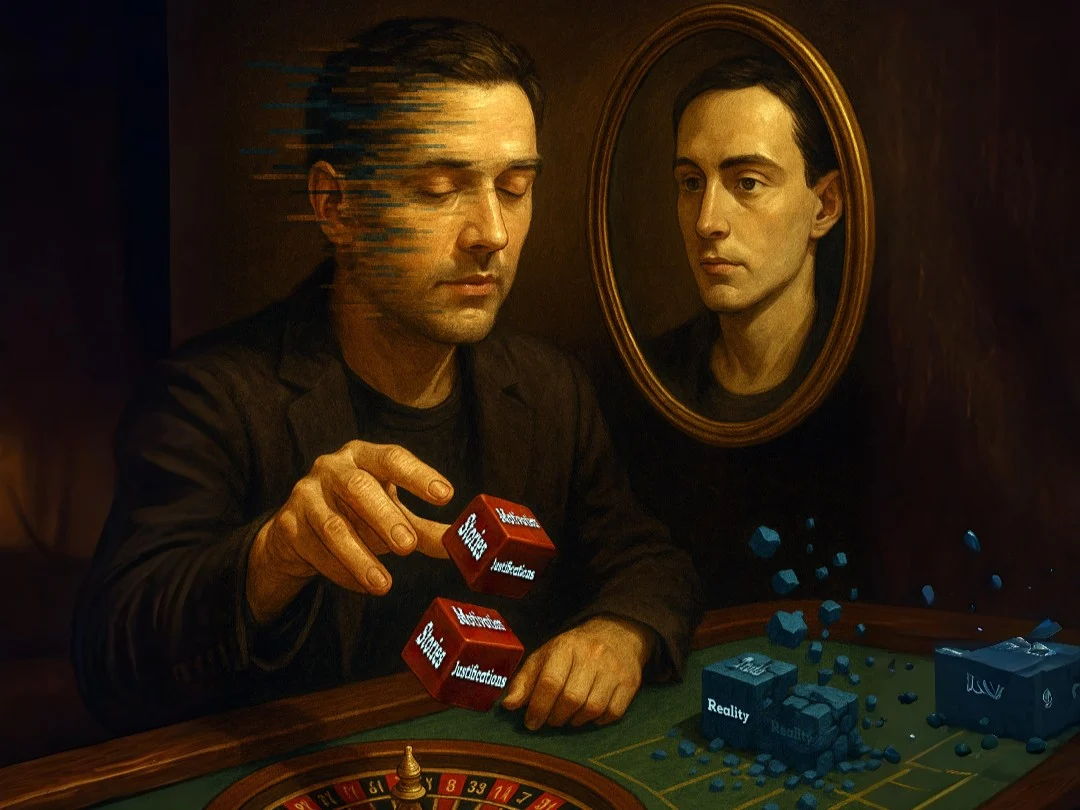
By Guy Hochman
For decades, the study of human decision-making has been dominated by two competing archetypes. First, there was Homo economicus—the cold, calculating agent of classical economics who maximizes utility with mathematical precision. Then came Homo heuristicus—the efficient, albeit imperfect, mental minimalist who relies on cognitive shortcuts to navigate an overwhelming world.
But as we peel back the layers of human psychology, it becomes clear that neither description captures the true essence of our species. We are not just flawed computers; we are something far more complex. We are Homobiasos: the species that rationalizes with its eyes wide shut, weaving elaborate narratives to ensure our choices appear reasonable, moral, and coherent, even when they are profoundly flawed.
The Illusion of Rationality: Beyond Cognitive Error
We live our lives as walking, talking examples of bias. We purchase luxury goods we do not need, overpay for essential services, defend political decisions we don’t fully understand, and convince ourselves that the ends always justify the means. We do not simply fail to perceive reality accurately; we actively filter it through a lens of psychological comfort.
When we make a decision, the process does not end with the choice itself. Instead, the choice triggers a secondary process: the construction of a narrative designed to validate our action. We deceive ourselves not because we are inherently "irrational," but because we have an insatiable human craving for meaning and internal consistency. Our eyes are open physiologically, but psychologically, we are often squinting to avoid the glare of uncomfortable truths.
The Evolutionary Shift: From Processing to Defense
For years, the scientific community operated under the assumption that analytic thinkers are immune to bias, while intuitive thinkers are prone to error. The narrative was simple: if you slow down and think harder, you will reach the "right" conclusion.
However, recent process-tracing research suggests a more nuanced reality. When participants are faced with complex choices, they rarely rely on a single, lazy shortcut. Instead, they engage in integrative thinking, weighing multiple cues and testing competing explanations. My own research, conducted alongside Shahar Ayal, demonstrates that bias is not a symptom of cognitive laziness; it is a manifestation of "motivated coherence."
We are not machines processing data; we are storytellers aligning raw facts with our preferred self-image. This narrative-driven reasoning is the engine of Homobiasos. We do not seek the truth; we seek a version of the truth that allows us to sleep at night.
Challenging the Dual-System Dichotomy
Decision science has long been shackled to the "Dual-System" theory—the idea that our brains constantly oscillate between the intuitive, fast-acting System 1 and the slow, deliberate System 2. Yet, this dichotomy is an oversimplification.
In a comprehensive review published recently, I argue that intuition can often lead to elegant, accurate information processing, while deliberation—contrary to popular belief—can actually lead to deeper bias. Studies by Ayal et al. and Krava et al. have shown that when we deliberate, we often simply increase the weight of irrelevant cues, using our superior cognitive resources to build an eloquent, logical-sounding defense for a fundamentally poor judgment.
We reason not to correct our instincts, but to provide them with the armor of logic. Whether we are thinking fast or slow, the motive remains the same: the need for internal justification.
Moral Anesthesia: The Ethics of Self-Deception
Nowhere is the power of Homobiasos more visible than in the realm of morality. Most people maintain a rigid self-concept as "honest" individuals, yet they frequently cheat just enough to profit without triggering their own internal alarm bells.
This is achieved through "moral rationalization"—the stories we tell ourselves to explain why a dishonest act is, in a specific context, actually a virtuous one. This mechanism is remarkably effective. In experiments where participants lied for the sake of benefiting a charity, they cheated more than those acting for self-interest, yet they displayed lower physiological arousal. They were so successful at convincing themselves of their own nobility that they even fooled experienced lie detection examiners.
This psychological tension—the friction between our actions and our values—is what psychologists call "ethical dissonance." To resolve this, we do not change our behavior; we change our perception. As Friedrich Nietzsche once presciently warned, "We lie to ourselves more than we lie to others." In this light, moral rationalization is not a sign of corruption, but a form of psychological anesthesia designed to protect the ego.
The Strategy of Selective Blindness
When rationalization isn’t enough to maintain our self-image, we turn to a more drastic measure: motivated ignorance.
In financial decision-making, for instance, individuals often deliberately avoid information that might threaten their sense of competence or fairness. Our research into pension decisions reveals that this avoidance is not mere apathy. It is a coping mechanism—an existential strategy. Admitting that a system is rigged or that our financial future is uncertain is an admission of vulnerability.
Ignorance becomes a shield. By choosing not to know, we preserve our dignity and our sense of agency. As Mark Twain famously noted, "The truth has no defense against a fool determined to believe a lie." In the modern context, we prefer coherence to accuracy and self-respect to cold, hard insight. The refusal to know is not an error; it is a bias that feels, from the inside, perfectly rational.
Anxiety and the Digital Frontier
This need for psychological equilibrium extends into our relationship with emerging technologies, particularly Artificial Intelligence. Our recent research identifies two distinct anxieties: anticipatory anxiety (the fear of what change will bring) and annihilation anxiety (the fear of being rendered obsolete).
We found a U-shaped curve in how humans engage with AI. Those who engage moderately with the technology tend to report lower levels of anxiety, while those at the extremes—either total avoidance or total overexposure—experience higher distress. Crucially, humans do not regulate their engagement based on a rational assessment of the technology’s benefits or risks. They regulate for the sake of their own emotional balance. We frame our hesitation as "prudence" and our fear as "logic," but both are simply defensive maneuvers to keep our internal world stable.
Implications for Society and the Individual
If our biases are not merely glitches in our cognitive hardware, but rather core features of our psychological architecture, what does that mean for our future?
First, we must acknowledge that Homobiasos is a functional adaptation. It keeps our societies cohesive, our relationships stable, and our identities intact. Without these stories, the weight of a contradictory, complex, and often indifferent reality might be too much for the human mind to bear.
However, the danger arises when we lose sight of the fact that we are telling ourselves stories. The most significant threat is not having biases, but believing that our rationalizations are objective truths. When we mistake our protective narratives for empirical reality, we lose the ability to learn, adapt, and grow.
Conclusion: Toward an Honestly Biased Life
To recognize ourselves as Homobiasos is not to abandon the pursuit of reason. Rather, it is to understand the true purpose of reason. We use our intellect as a mirror, but we often tilt it to avoid seeing our own imperfections.
Awareness is the first step toward a more honest existence. If we can learn to pause when we feel most certain—to ask ourselves, "Is this story clarifying the situation, or is it merely comforting me?"—we can choose to open our eyes.
We may never reach the mythical state of pure, objective rationality. But by accepting our nature as storytellers, we can move from a state of unconscious self-deception to one of "honest bias." In doing so, we don’t just see the world more clearly; we see ourselves more honestly. Our stories are not bugs in the system—they are the features that make us human. It is time we learned to read them for what they really are.
Guy Hochman is an associate professor of behavioral decision-making at Reichman University and the founder of the MA program in Behavioral Economics. His work focuses on the intersection of moral judgment, decision science, and social behavior.
 Laily UPN