
 By Ammar Sabilarrohman
By Melina Moleskis
Imagine a single mother living in an urban apartment. Her life is a high-stakes balancing act: juggling a low-wage job, managing household chores, and navigating the constant, gnawing anxiety of keeping her children fed and warm. Her home is dimly lit, her appliances are aging and inefficient, and every month, she faces an impossible arithmetic. She must choose between keeping the lights on, putting food on the table, or setting aside a pittance for the inevitable emergency.
For millions of households globally, this cycle of "cognitive scarcity" is not just a stressful reality; it is a structural trap. As governments worldwide accelerate their transition toward green energy, the economic burden of these policies is falling disproportionately on those least equipped to bear them. While policy experts focus on subsidies and technological upgrades, a critical, often overlooked reality remains: the most vulnerable are frequently failing to access the very aid designed to save them.
The Challenge: Why Energy Poverty Persists
Energy poverty is defined by the inability of a household to afford basic energy services—heating, cooling, and lighting. It is a pervasive issue, exacerbated by the fact that low-income families often inhabit the "energy efficiency trap." Because they cannot afford the upfront capital to invest in modern, energy-efficient appliances or proper home insulation, they are forced to rely on outdated, high-consumption technology.
In essence, the poor are paying a "poverty premium." They use more energy to achieve less comfort, bleeding their limited resources into inefficient systems that drive up monthly utility bills. As the European Union and other global entities roll out ambitious climate frameworks—such as the EU’s upcoming Social Climate Fund in 2026—the question is no longer just about the availability of funds, but about the accessibility of the human experience.
Chronology of a Crisis: From Policy to Non-Participation
The history of energy poverty intervention is marked by a recurring pattern: governments design robust, well-intentioned grant schemes, yet participation rates remain stubbornly low.
- Early 2000s–2010s: Initial efforts focused on broad-spectrum subsidies. These were often "one-size-fits-all" programs that assumed citizens had the time, digital literacy, and mental bandwidth to navigate complex bureaucratic hurdles.
- 2020–2023: As energy prices spiked, the "Energy Poverty" discourse shifted from a niche social issue to a central pillar of climate justice. Policymakers realized that simply throwing cash at the problem did not bridge the gap between eligibility and actual uptake.
- 2024–2025: Current research—including our recent studies at the Cyprus Institute—has begun to map the "behavioral journey" of a vulnerable household. We have identified that the drop-off rate occurs long before a family reaches the application submission stage.
- 2026 and Beyond: The launch of the EU Social Climate Fund marks a pivot point. If these funds are to succeed, they must move beyond traditional economic incentives and incorporate behavioral design.
The Cognitive Scarcity Trap
Why do people fail to apply for aid they desperately need? Behavioral economists Sendhil Mullainathan and Eldar Shafir provided the answer with the concept of "scarcity."

When an individual is under the constant, crushing weight of financial insecurity, their mental "bandwidth" is consumed by immediate, short-term survival. This is known as "tunneling." Just as a tunnel restricts a driver’s vision to the road directly ahead, financial hardship forces the brain to ignore long-term benefits in favor of solving the crisis of the next hour or day.
The Science of "Hassle Factors"
Research indicates that the cognitive load of living in poverty is equivalent to losing a full night’s sleep. When your brain is firing on all cylinders just to ensure the rent is paid, the cognitive cost of navigating a twelve-page government application form, deciphering technical jargon, or waiting in a queue is not just an annoyance—it is an insurmountable wall.
These "hassle factors"—the friction points in any bureaucracy—trigger procrastination or total withdrawal. When a person is uncertain whether an effort will result in a payoff, the brain, seeking to conserve energy, chooses the path of least resistance: doing nothing.
Evidence from the Field: The Cyprus Case Study
Cyprus serves as a compelling case study for the global energy poverty dilemma. With nearly 19% of the population living in vulnerable households, the nation has struggled to translate policy into participation. Our analysis of recent grant schemes suggests that only about 45% of eligible households actually successfully navigated the process.
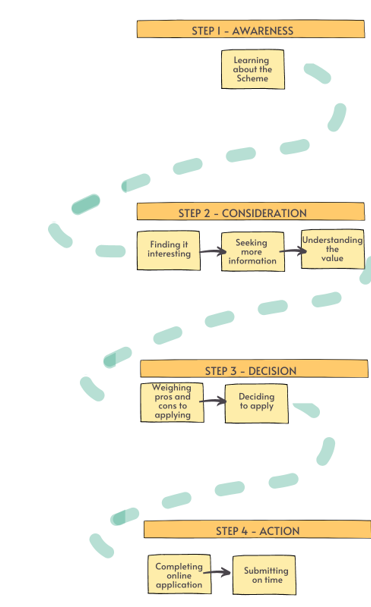
By mapping the "behavioral journey" of these families, we identified four primary stages of failure:
- Awareness: The household does not know the scheme exists.
- Consideration: The household doubts the value or fears the stigma.
- Application: The household is overwhelmed by the complexity of the forms.
- Completion: The household fails to follow through due to the "hassle factor."
Within the "Consideration" phase, barriers such as "loss aversion" (fearing that an upgrade might actually lead to higher costs) and the lack of social proof (not seeing peers succeed) keep households in a state of paralysis.
Implications for Policy: Redesigning for Humanity
The conclusion is clear: we are currently bombarding people with information, not facilitating action. To fix this, policymakers must shift from a "supply-side" mentality—focusing on the volume of money available—to a "demand-side" approach that respects the cognitive limitations of the target demographic.
1. Harnessing Loss Aversion
Rather than marketing the long-term savings of energy efficiency, which feels abstract to someone in the "tunnel," communication should frame the current loss. Using clear, concrete language—such as, "Staying in your current home with these windows costs you €X every month"—is statistically more effective at prompting action than promises of future savings.
2. Social Proof and In-Group Identity
Stigma is a powerful deterrent. Policies should utilize community-led outreach. Discussion groups, rather than formal lectures, help normalize the experience of energy poverty and allow for positive, word-of-mouth validation. Seeing a neighbor with a similar background successfully install solar panels provides the "social proof" necessary to reduce fear and uncertainty.
3. Simplifying the "Passport"
To combat information overload, we recommend a "Passport Page" model. This is an executive summary of the grant scheme, distilling complex, 50-page requirements into a single, jargon-free document. Furthermore, pre-populating forms with existing government data—such as tax records—removes the administrative burden from the individual, effectively "nudging" them toward completion.
Conclusion: A Just, Green Transition
The transition to a sustainable future cannot be built on the backs of those who are struggling to survive the present. If we continue to ignore the behavioral reality of our most vulnerable citizens, we risk creating a "green divide," where only the financially stable can afford the transition, while the poor are left with the mounting costs of inefficiency.
By acknowledging that humans—especially those under stress—are not perfectly rational actors, we can redesign our energy policies to be more empathetic and effective. Small, low-cost structural changes that reduce friction do not just improve participation rates; they restore agency to the people who need it most.
The path to a just, green transition lies not just in the hardware of solar panels and heat pumps, but in the software of our social policies. It is time we start designing for the person, not just the policy.
About the Author
Dr. Melina Moleskis is a managerial decision scientist and behavioral economist with over a decade of consulting experience at EY and PwC. She holds a PhD in Managerial Decision Science from IESE Business School and is a regular columnist for major global business publications. She founded meta-decisions in 2021 to bridge the gap between behavioral science and practical business application.
 Iffa Jayyana
  Asep Darmawan