
 By Nana Wu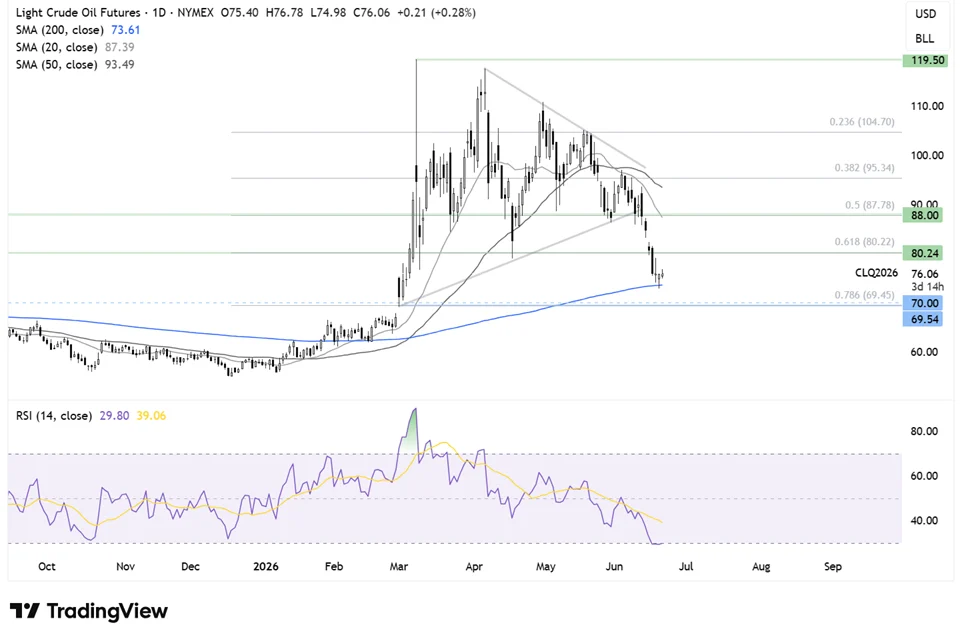
Main Facts: A Dual Narrative of Monetary Caution and Geopolitical Friction
The global financial markets experienced significant volatility this week, dominated by a sharp depreciation in the British pound and a dramatic sell-off in the energy complex.
In currency markets, the GBP/USD exchange rate fell to a two-month low, testing the critical psychological and technical support level of 1.3200. This decline was triggered by a combination of a dovish monetary policy hold by the Bank of England (BoE) and domestic political developments.
The central bank opted to maintain its benchmark interest rate at 3.75%, citing softer-than-expected inflation metrics and a downward revision of its medium-term inflation outlook. Compounding the pressure on sterling was the victory of high-profile Labour politician Andy Burnham in a key by-election, which has reignited market anxieties regarding future UK fiscal policy and public spending.
Market Indicators at a Glance:
- GBP/USD: Declined to a two-month low of 1.3200.
- Bank of England Bank Rate: Held constant at 3.75%.
- UK May CPI Inflation: Steady at 2.8% year-on-year.
- UK Public Sector Net Borrowing (May): £23.3 billion (vs. £18.9 billion expected).
- WTI Crude Oil: Rebounded to $77.00/bbl (but down 9% on the week).
In the energy sector, West Texas Intermediate (WTI) crude oil futures stabilized on Friday, reclaiming the $77 per barrel threshold. This marginal recovery was driven by escalating geopolitical tensions in the Middle East, marked by the sudden cancellation of diplomatic talks between the United States and Iran in Switzerland, alongside ongoing military exchanges in southern Lebanon.
Despite Friday’s upward momentum, crude oil remains on track for a devastating weekly loss of approximately 9%. This sharp decline reflects broader market dynamics, including the gradual normalization of maritime transit through the Strait of Hormuz, rising supply projections from OPEC producers like Kuwait, and a temporary easing of the physical supply bottlenecks that had previously supported prices.
Chronology of the Week’s Key Events
The convergence of monetary decisions, macroeconomic data releases, and geopolitical shifts created a highly dynamic trading environment throughout the week.
Monday to Tuesday: Softening Inflation and Central Bank Positionings
The week commenced with the release of the United Kingdom’s Consumer Price Index (CPI) data for May. The headline inflation rate printed at 2.8% year-on-year, unchanged from the previous month and slightly softer than consensus Wall Street estimates. This set a dovish tone for sterling early in the week, as market participants began recalibrating their expectations for the BoE’s rate trajectory. Concurrently, in the energy markets, tankers began carrying previously stranded crude out of the Strait of Hormuz, easing immediate supply fears and initiating the downward draft in oil prices.
Wednesday: The Federal Reserve’s Hawkish Divergence
Mid-week trading was dominated by the U.S. Federal Reserve’s monetary policy stance. The Fed adopted a hawkish tilt, signaling that U.S. interest rates could remain elevated for longer than previously anticipated. This policy divergence immediately bolstered the U.S. Dollar Index (DXY), placing direct downward pressure on the GBP/USD pair and making dollar-denominated commodities, such as crude oil, more expensive for international buyers.
Thursday: The BoE Hold and the UK Political Catalyst
The Bank of England officially announced its decision to keep its key policy rate unchanged at 3.75%. The accompanying monetary policy statement lowered the central bank’s 2026 inflation forecast to 3.2% from 3.6%, signaling to market participants that further rate hikes this year are highly unlikely.
Simultaneously, the results of the parliamentary by-election confirmed a victory for Andy Burnham. This political outcome coincided with the release of worse-than-expected UK public finance data, showing that public sector net borrowing rose to £23.3 billion in May. This combination of events triggered a sell-off in both sterling and UK government bonds (gilts), pushing gilt yields higher.
Friday: Geopolitical Friction and Oil’s Partial Rebound
The final trading session of the week brought a sudden shift in geopolitical risk. The Swiss Foreign Ministry confirmed that scheduled diplomatic talks between U.S. and Iranian representatives in Switzerland had been abruptly canceled. At the same time, reports of intensified Israeli airstrikes against Hezbollah targets in Lebanon reached the wires. This sudden breakdown in diplomatic channels and escalation of regional conflict prompted short-covering in the oil market, lifting WTI back above $77 per barrel, even as the commodity locked in a 9% weekly deficit.
Supporting Data: Macroeconomic and Technical Deep Dive
UK Fiscal and Monetary Indicators
The sterling’s downward trajectory is fundamentally rooted in a widening fiscal deficit and a central bank that appears increasingly comfortable with its current monetary stance. The Office for National Statistics (ONS) revealed that UK public sector net borrowing reached £23.3 billion in May. This figure not only surpassed the consensus forecast of £18.9 billion but also ran approximately £7 billion ahead of the projections laid out by the Office for Budget Responsibility (OBR) for the financial year to date.

UK Public Sector Net Borrowing (May):
┌───────────────────────────────┬─────────────────┐
│ Metric                        │ Value           │
├───────────────────────────────┼─────────────────┤
│ Actual May Borrowing          │ £23.3 billion   │
│ Market Consensus Forecast     │ £18.9 billion   │
│ Variance from Forecast        │ +£4.4 billion   │
│ Year-to-Date OBR Overshoot    │ ~£7.0 billion   │
└───────────────────────────────┴─────────────────┘
This fiscal overshoot has intensified scrutiny on the UK’s debt-to-GDP ratio, which is hovering near historic highs. The combination of high public borrowing and a dovish monetary outlook has driven a wedge between the UK and other major economic jurisdictions:
- Monetary Divergence: While the BoE maintained its rate at 3.75% and trimmed its long-term inflation outlook, the European Central Bank (ECB) and the Bank of Japan (BOJ) have recently enacted rate hikes, and the U.S. Federal Reserve has maintained a highly hawkish bias.
- Gilt Market Reaction: In response to the fiscal slippage and the political transition, UK benchmark gilt yields rose, reflecting demands from bond investors for a higher risk premium on British sovereign debt.
GBP/USD Technical Analysis
From a technical perspective, the GBP/USD daily chart exhibits a distinctly bearish breakdown. The currency pair has broken decisively below the lower boundary of a multi-month symmetrical triangle pattern, which had been consolidating price action since early spring.
GBP/USD Technical Levels:
- Major Resistance 3: 1.3500 (Late-May Swing High)
- Major Resistance 2: 1.3410 / 1.3465 (200-day & 50-day SMAs)
- Minor Resistance 1: 1.3330 (Horizontal Pivot)
- Current Price Zone: 1.3200 (Key 2026 Low / Immediate Support)
- Downside Target 1:  1.3000 (Late-2025 Structural Support)
The exchange rate is currently testing key horizontal support at 1.3200, which represents a critical low for 2026. A daily close below this level would confirm the bearish breakdown and open the door for a deeper correction toward 1.3000, a key psychological and structural support level dating back to late 2025.
Conversely, any attempted recovery must first reclaim the horizontal resistance at 1.3330. Beyond that, a cluster of technical overhead resistance awaits, including the 200-day Simple Moving Average (SMA) at 1.3410, the descending trendline of the broken triangle, and the 50-day SMA at 1.3465, before buyers can target the late-May swing high at 1.3500.
Global Energy Supply Dynamics and WTI Technicals
The dramatic 9% weekly drop in crude oil prices reflects a structural shift in near-term supply expectations. The physical tightness that characterized the second quarter has begun to ease, driven by two key supply-side developments:
- Strait of Hormuz Logistics: Tankers carrying previously congested volumes of crude oil have begun clearing the vital shipping channel. This logistical resolution has restored confidence in the continuity of global seaborne oil trade.
- OPEC Supply Expansion: Kuwait’s state-owned energy sector announced formal plans to increase daily production capacity, adding to expectations of a well-supplied market heading into the second half of the year.
WTI Crude Oil Technical Levels:
- Upside Target 2:    $88.00 (50% Fibonacci Retracement Level)
- Upside Target 1:    $80.00 (61.8% Fibonacci Retracement & April Low)
- Current Price Zone: $77.00 (Rebound Pivot / 200-day SMA)
- Downside Support 1: $73.75 (Immediate Swing Low)
- Downside Support 2: $70.00 (78.6% Fibonacci Retracement / Psychological Level)
- Downside Support 3: $65.00 (Structural Value Zone)
On the daily chart, WTI crude oil has broken below a symmetrical triangle pattern, descending rapidly to test its 200-day SMA. While Friday’s rebound pushed prices back above $77, the medium-term bias remains tilted to the downside.
Sellers will need a decisive break below the immediate horizontal support at $73.75 to sustain the bearish momentum. Such a move would expose the critical $70.00 level, which represents the 78.6% Fibonacci retracement of the broader $55 to $120 upward cycle, as well as a major psychological barrier. A failure to hold $70.00 could trigger a rapid descent toward the $65.00 support zone.
On the upside, any sustained corrective rally faces significant resistance at the $80.00 mark, which aligns with the 61.8% Fibonacci retracement and the April swing lows. Above this level, the 50% Fibonacci retracement level at $88.00 stands as the next major upside objective.
Official Responses: Policy Statements and Diplomatic Confirmations
Monetary Authority Perspective: The Bank of England
The Bank of England defended its decision to hold interest rates at 3.75%, emphasizing a data-dependent approach. In its official statement, the Monetary Policy Committee (MPC) stated:
"While headline inflation has shown signs of moderation, core services inflation and wage growth remain elevated. It would be premature to declare victory and tighten monetary policy further given the ongoing structural uncertainties surrounding the medium-term inflation outlook."
The MPC’s downward revision of the 2026 inflation forecast to 3.2% reflects a growing consensus within the central bank that current interest rate levels are sufficiently restrictive to bring inflation back toward the 2.0% target over a multi-year horizon, effectively signaling a pause in the rate-hiking cycle.
Political and Fiscal Reassurances: Andy Burnham
Following his by-election victory, Andy Burnham sought to address concerns within the financial community regarding public spending. In his victory speech, Burnham stated:

"We recognize the deep fiscal challenges facing this country. Our priority is to drive sustainable, long-term economic growth through targeted regional investment, but let me be absolutely clear: this will be delivered in strict alignment with the government’s established fiscal rules. We are committed to fiscal responsibility and stabilizing the national debt."
While these comments provided some reassurance to the gilt market, analysts note that foreign exchange traders remain skeptical, waiting for concrete policy proposals before reassessing their short-medium term outlook on the pound.
Geopolitical Diplomatic Statements: The Swiss Foreign Ministry
The sudden halt in diplomatic progress between Washington and Tehran was confirmed by Swiss officials, who act as the primary diplomatic intermediary between the two nations. A spokesperson for the Swiss Foreign Ministry confirmed the developments, stating:
"The planned bilateral discussions scheduled to take place in Geneva have been postponed indefinitely at the request of the participating parties. Switzerland remains ready to facilitate dialogue and host future negotiations when the diplomatic conditions are deemed appropriate."
The cancellation of these talks, combined with Israel’s ongoing military campaign against Hezbollah infrastructure in southern Lebanon, has injected a renewed geopolitical risk premium back into energy markets, helping to arrest oil’s weekly decline.
Implications: Economic, Market, and Geopolitical Outlook
The Future of Sterling and UK Fiscal Credibility
The combination of a cautious central bank and deteriorating public finances presents a challenging environment for the British pound. The BoE’s reluctance to match the hawkish stance of other major central banks suggests that the interest rate differential will continue to favor the U.S. Dollar.
Furthermore, the UK’s fiscal trajectory will remain under intense scrutiny. If future government spending plans are perceived as expanding the structural deficit without generating near-term economic growth, gilt yields could rise further, increasing borrowing costs for the government and domestic consumers alike.
In this environment, sterling is highly vulnerable to further downside, with the GBP/USD pair potentially targeting the 1.3000 level in the third quarter of the year. Investors will look to next week’s U.S. inflation data to gauge whether a widening interest rate differential will accelerate this trend.
Geopolitics versus Supply in the Oil Market
The energy complex is caught in a tug-of-war between weak physical fundamentals and geopolitical risk. On one hand, the resumption of shipping through the Strait of Hormuz and plans for increased production from OPEC members suggest that the global market is well-supplied. This supply cushion explains why crude was able to fall 9% in a single week despite ongoing conflicts in the Middle East.
On the other hand, the collapse of the U.S.-Iran diplomatic channel and the threat of a wider regional conflict involving Israel and Lebanon prevent prices from falling too far. This geopolitical premium is likely to keep a floor under oil prices, preventing a sustained drop below the $70 per barrel mark.
Moving forward, the energy market is expected to remain highly volatile. Prices will swing based on the weekly balance between physical inventory levels in the West and diplomatic developments in the Middle East. The 60-day window for negotiations over Iran’s nuclear program remains a key milestone that could dictate the long-term direction of the global energy trade.
 Sagoh
Sagoh  Nana
Nana  Iffa Jayyana