
 By Basiran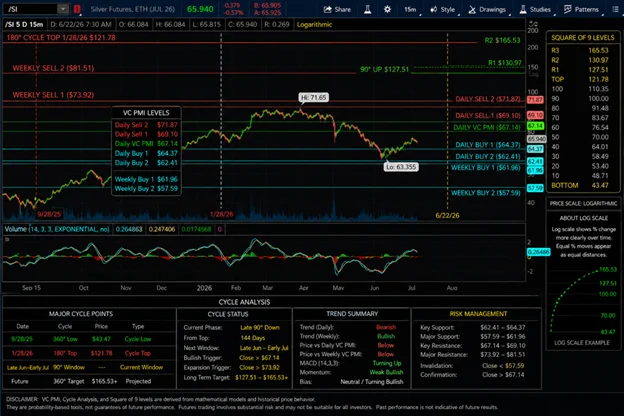
Executive Summary: The Current State of the Silver Market
Silver futures are currently navigating a complex technical landscape, trading at 65.94. This positioning places the metal below the critical Daily Variable Changing Price Momentum Indicator (VC PMI) mean of 67.14, a threshold that currently defines the short-term trend as neutral to bearish. However, beneath this immediate technical resistance, a narrative of stabilization is emerging. Having successfully held above the recent cyclical low of 63.36, momentum indicators are beginning to pivot upward, signaling that the aggressive downside pressure observed in recent weeks may finally be approaching exhaustion.
For market participants, the current environment is defined by a tug-of-war between short-term corrective volatility and the overarching strength of a larger, long-term bullish cycle. While the immediate focus remains on reclaiming the 67.14 mean, the broader structural analysis suggests that as long as critical support levels remain unbreached, the fundamental trajectory for silver remains upward.
Chronology: Understanding the 360° Cycle
To comprehend the current price action, one must view silver’s movement through the lens of Gann-based cycle analysis, specifically the Square of 9 methodology.
The Origin Point
The current macro-cycle began on September 28, 2025, when silver hit a significant low at 43.47. From this base, the market embarked on an aggressive expansion phase, driven by shifting macroeconomic tides and increased industrial demand.
The 180° Top
This momentum culminated on January 28, 2026, when the market reached a peak of 121.78. In the parlance of technical cycle theory, this marked a definitive 180° cycle top—the halfway point of a complete 360° rotation. Historically, 180° points often act as catalysts for major trend reversals or deep corrective phases, as the market digests the rapid gains made during the initial 180° leg.
The Corrective Phase
Since that January peak, silver has been locked in a corrective retracement. This phase is not merely a random sell-off but a calculated return to key support levels identified by the VC PMI and Square of 9 models. The market is currently testing the depth of this correction, seeking to establish a floor before the next potential move higher.
Supporting Data: Technical Benchmarks and Projected Targets
The mathematical models underpinning this analysis provide a roadmap for the weeks ahead. Traders are currently monitoring the 90° cycle window, which extends through late June and into early July. This period is expected to serve as a high-volatility inflection point.
The Path to Bullish Confirmation
The road to recovery is paved with specific, non-negotiable technical hurdles:
- Immediate Resistance (67.14): A daily close above this VC PMI mean is the first order of business. Achieving this would flip the short-term momentum from bearish to bullish.
- Secondary Targets (69.10 and 71.87): Once the mean is cleared, these levels represent the immediate resistance barriers that must be overcome to maintain upward momentum.
- The Weekly Breakout (73.92): A weekly close above this level would provide the strongest confirmation that the correction has officially ended, signaling the beginning of the next bullish expansion phase.
Critical Support Zones
Risk management is predicated on the strength of support zones. Currently, support is heavily concentrated in the 64.37 to 62.41 range. If the market experiences further weakness, the major weekly support levels at 61.96 and 57.59 will be the final line of defense. As long as silver holds above the 57.59 mark, the integrity of the long-term bullish cycle remains intact.

Analytical Perspective: The Longer-Term Horizon
When stepping back from daily fluctuations, the Square of 9 projections reveal a compelling, long-term narrative. The math points toward 127.51 as the primary 90° upside confirmation level—a milestone that would suggest the market has regained its footing after the January correction.
Beyond this, the cycle objectives are ambitious. Following the completion of the 180° retracement, the second half of the 360° cycle targets 130.97 as an intermediate waypoint, with an ultimate destination of 165.53. This final figure represents the mathematical completion of the full 360° rotation initiated in September 2025. These targets are not predictions of certainty but rather high-probability mathematical objectives derived from historical market behavior.
Implications for Market Participants
For investors and traders, the current environment necessitates a nuanced approach. The transition from a corrective phase to a resumption of the bull trend is rarely linear.
Risk Management Protocols
In light of current volatility, disciplined risk management is paramount. Traders are advised to:
- Scale Inward: Avoid "all-in" positions. Instead, utilize stage-based entry strategies to mitigate the impact of false breakouts or unexpected retracements.
- Monitor the 57.59 Threshold: This is the "line in the sand." A daily close below 57.59 would invalidate the current bullish cycle scenario, necessitating a complete reassessment of the portfolio’s exposure to silver.
- Acknowledge the Data: The mathematical models—VC PMI, Cycle Analysis, and the Square of 9—are tools, not crystal balls. They provide a probabilistic framework for understanding market mechanics, but they do not account for black-swan events or exogenous geopolitical shocks.
Strategic Outlook
The market is currently in a "wait and see" mode. The exhaustion of selling pressure at the 63.36 level is a constructive sign, but institutional confirmation is required before the next leg up can be considered reliable. The upcoming July window will likely reveal whether the market has the strength to test the 73.92 barrier or if it requires a deeper consolidation phase.
Official Perspective and Limitations
It is essential to emphasize that the models cited—the VC PMI (Variable Changing Price Momentum Indicator) and the Square of 9—operate on the principle that market price action is not random but follows mathematical patterns established over decades of financial history. These patterns allow analysts to identify "zones of value" where the market is statistically likely to find buyers or sellers.
However, as with any technical analysis, the following caveats must be considered:
- Mathematical Basis: The models are objective; the interpretation is subjective. Historical performance is not indicative of future results.
- Market Realities: Futures trading is a high-leverage environment. The volatility inherent in silver can lead to rapid capital erosion for those who do not adhere to strict stop-loss orders and position-sizing guidelines.
- Institutional Flows: While cycles and mathematical models track price, they do not track the intent of central banks, large-scale industrial hedging, or sudden shifts in global monetary policy. Investors should always synthesize technical data with fundamental macroeconomic indicators.
Final Thoughts
As we move through late June, the silver market stands at a crossroads. The technical structure suggests that the worst of the post-January correction may be behind us. By monitoring the 67.14 mean and the 57.59 support floor, market participants can navigate the current uncertainty with a clear, data-driven strategy. Whether the market rallies toward the 165.53 target or continues to consolidate depends on its ability to respect the defined cycle windows and overcome the established resistance levels. Discipline, patience, and a rigid adherence to risk management remain the only reliable hedges in such a volatile asset class.
Disclosure: The insights provided, including VC PMI, Cycle Analysis, and Square of 9 projections, are derived from mathematical and probabilistic models based on historical market behavior. They are intended for educational purposes and do not constitute financial advice. Futures trading involves substantial risk and may not be suitable for all investors. Always consult with a qualified financial advisor before committing capital to the futures market.
 Lina Irawan
  Nana
Nana  Laily UPN