
 By Nana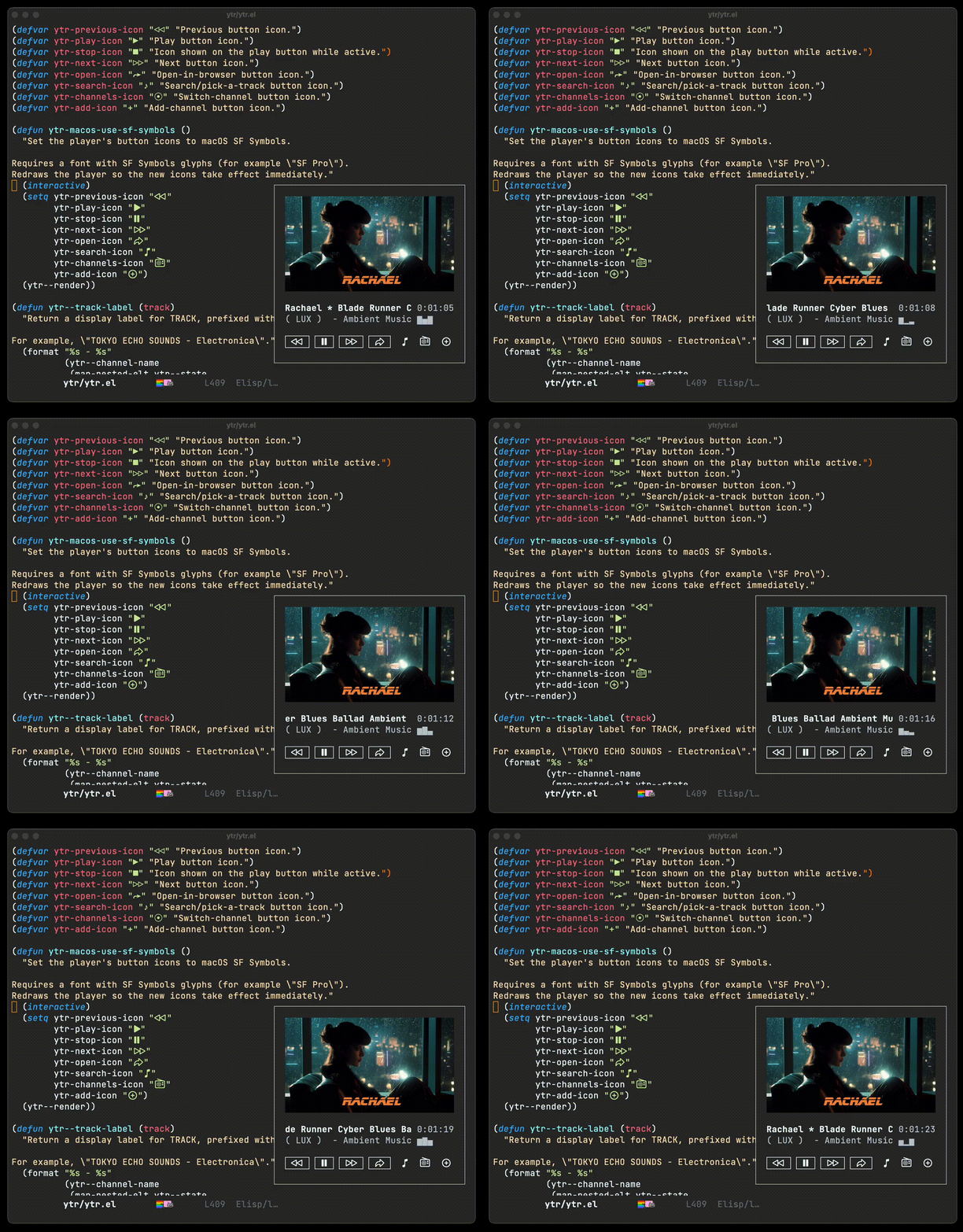
Date: June 23, 2026
Subject: Software Development / Emacs Ecosystem
The Emacs ecosystem has long been celebrated for its modularity and the ability of its community to continuously reimagine how text editors interact with multimedia content. Today, a significant step forward in this evolution has been announced with the release of ytr, a specialized YouTube radio package designed to bring seamless audio streaming to the Emacs interface. Developed by the creator of the popular ready-player package, ytr represents a departure from traditional file-based media management, opting instead for a lightweight, widget-driven experience that invokes the nostalgia of classic media players while leveraging modern streaming infrastructure.
Main Facts: What is ytr?
At its core, ytr is an Emacs package that facilitates the streaming of audio directly from YouTube channels. It serves as a dedicated alternative to the more robust ready-player, which the developer notes has become "feature-complete" for its intended purpose of local file management.
Unlike its predecessor, which relies heavily on the dired abstraction—a file-system-centric approach that categorizes media through directory structures—ytr is built from the ground up to handle dynamic network streams. By entering a channel URL, the package automatically fetches metadata, allowing users to interact with content through an unobtrusive child frame.
The package is powered by two industry-standard tools:
- mpv: An open-source media player that handles the heavy lifting of audio playback.
- yt-dlp: A powerful command-line utility used to extract streaming URLs and metadata from YouTube.
By leveraging these robust backends, ytr provides a high-fidelity audio experience within the Emacs GUI, complete with visual animations that pay homage to the iconic Winamp interface of the late 1990s.
Chronology: The Road to ytr
The development of ytr was not a result of a sudden pivot, but rather the culmination of a specific functional gap identified by the developer over months of refining the ready-player workflow.
The ready-player Foundation
For an extended period, the developer utilized ready-player as their primary vehicle for media consumption. The package excelled at managing local libraries, utilizing the native Emacs dired mode to organize, sort, and play files. However, as the developer transitioned toward a hybrid model of local storage and cloud-based streaming, the limitations of a file-centric architecture became apparent.
The Impetus for Refactoring
The initial plan involved extending ready-player to support YouTube streaming. However, this presented an architectural hurdle: ready-player was conceptually tied to the file system. Integrating streaming capabilities would have necessitated a significant, potentially destabilizing refactor of the existing codebase.
The Decision to Branch
Recognizing that the UX requirements for streaming—namely dynamic metadata fetching and widget-like presentation—differed significantly from file management, the developer made a pragmatic choice. Rather than forcing a square peg into a round hole, they opted to build ytr as a fresh, experimental project. This allowed for the freedom to experiment with Emacs GUI capabilities, such as child frames and visual animations, without the constraints of legacy code.
Supporting Data: Infrastructure and Technical Implementation
The efficiency of ytr is predicated on its reliance on specialized external tools. Emacs, while powerful, is not designed to handle the complex handshake protocols and codec demands of modern streaming video platforms. By offloading these tasks, the developer ensures that ytr remains responsive.
The Role of yt-dlp
The integration of yt-dlp is critical. As YouTube frequently updates its obfuscation methods and API endpoints, yt-dlp remains the most reliable tool for parsing stream data. By wrapping this tool, ytr ensures that users get the correct audio stream without needing to navigate the complexities of YouTube’s internal web architecture manually.

The Role of mpv
Once the audio stream is parsed, mpv manages the playback. Its status as a command-line-driven player makes it the ideal candidate for integration with Emacs. Because mpv is resource-efficient, it allows the user to listen to audio for extended periods without experiencing the significant memory overhead often associated with running web-based streaming clients or Electron-based applications.
User Interface and GUI Requirements
A defining feature of ytr is its visual design. The package utilizes Emacs child frames—a technique that allows for the creation of floating windows within the Emacs workspace—to display content metadata. Notably, the developer has integrated animations that evoke the aesthetic of early 2000s media players. Users should be aware that these features are exclusive to the Emacs GUI version; terminal-based Emacs instances will not support these visual enhancements.
Official Developer Perspectives and Community Engagement
In the announcement, the developer emphasized the experimental nature of the package. "I’m currently driving its development purely on current needs," they stated. This "user-first" approach suggests that the roadmap for ytr will be defined by the direct feedback of those who adopt it early.
Testing and Compatibility
Currently, the package is in its first iteration. Testing has been limited primarily to the macOS environment. The developer has invited the community to participate in cross-platform testing, specifically on Linux and Windows, to identify potential pathing or dependency issues.
Sponsoring Evolution
To sustain the project, the developer has provided a link to their GitHub sponsorship page. This indicates a commitment to long-term maintenance, provided there is enough community interest to justify the ongoing development of features such as playlist management, search functionality, and improved cross-platform support.
Implications: The Future of Media in Emacs
The release of ytr has broader implications for the Emacs community. It reinforces a growing trend: the transformation of Emacs from a mere text editor into a comprehensive "living environment."
Challenging the "File-Only" Paradigm
Historically, Emacs packages have favored file-system abstractions. ytr signals a shift toward treating web-based resources as first-class citizens. By decoupling the interface from the local disk, developers are opening doors to more complex, cloud-integrated workflows that don’t require leaving the Emacs buffer.
The Value of Modular Tooling
The success of ytr depends on the philosophy of modularity. By using mpv and yt-dlp rather than writing custom streaming drivers, the project remains lightweight and stable. This approach serves as a blueprint for other Emacs developers: solve the specific UI challenge (the "widget" aspect) and offload the technical heavy lifting to battle-tested open-source utilities.
Community Reaction and Expectations
Initial reactions from the Emacs community suggest high interest in the project. The nostalgia factor—reminiscent of Winamp—combined with the practical utility of streaming YouTube audio, makes ytr an attractive proposition for users who spend their workdays entirely within Emacs.
However, the path forward is not without challenges. YouTube’s terms of service and the frequent updates to its site structure mean that ytr will require regular maintenance to remain functional. Furthermore, as users begin to demand more features—such as full integration with YouTube login credentials, playlist synchronization, or advanced search queries—the complexity of the package will inevitably increase.
Whether ytr becomes a staple of the Emacs community or remains a niche experimental project depends on the developer’s capacity to balance feature requests with the simplicity that makes the tool appealing in its current state. For now, it stands as a testament to the versatility of the Emacs platform and the ingenuity of its developers in adapting to the modern, streaming-first landscape.
For those interested in the future of ytr, the project is currently hosted on GitHub, where users are encouraged to report issues, suggest features, and contribute to the ongoing refinement of this unique interface.
 Asro
Asro  Lina Irawan
  Iffa Jayyana