
 By Dwi Wanna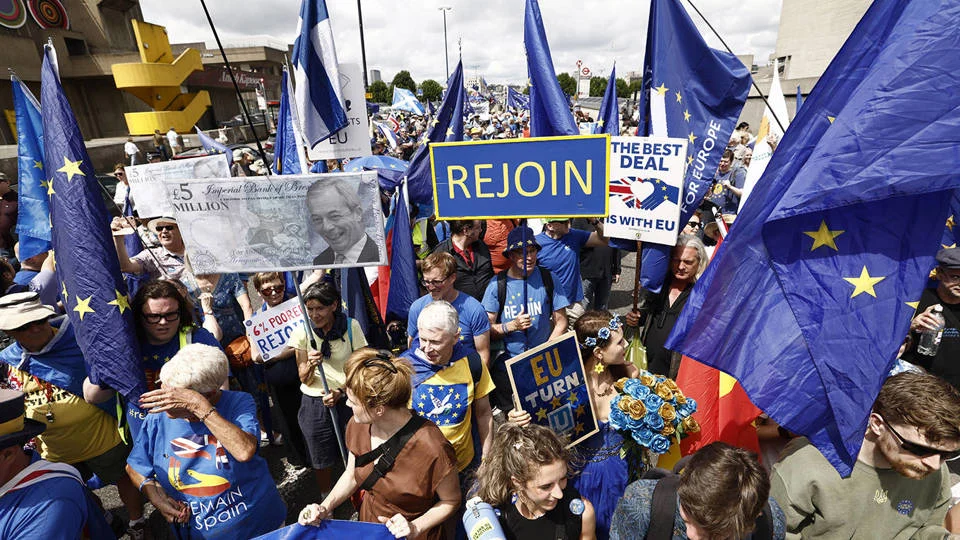
By Mark Leonard
June 23, 2026
BERLIN — Ten years to the day after the United Kingdom cast its fateful ballot to exit the European Union, the political landscape in London looks remarkably different—and perhaps more unstable—than even the most pessimistic observers of 2016 could have predicted. The tenth anniversary of the Brexit referendum, an event that triggered a decade of toxic polarization, austerity, and institutional vertigo, was marked not by a celebration of sovereignty, but by the quiet, somber resignation of Prime Minister Keir Starmer.
While official intergovernmental negotiations have often moved at a glacial, bureaucratic pace, the ground beneath the feet of the British and European publics has shifted significantly. New, comprehensive polling data reveals a striking consensus: a large majority of citizens on both sides of the English Channel now advocate for a profound re-engagement. The "divorce" that dominated the headlines for a decade is increasingly viewed by the electorate as a historical detour rather than a permanent destination.
The Main Facts: A Decade of Dislocation
The resignation of Keir Starmer represents the culmination of a decade-long struggle to define Britain’s place in a post-European world. When Starmer took office, he promised a "pragmatic reset," a middle-ground approach that sought to mitigate the economic frictions of the Trade and Cooperation Agreement (TCA) without reopening the ideological wounds of the referendum.
However, the reality of the British economy—stagnant growth, persistent labor shortages in key sectors, and the erosion of service-sector competitiveness—has made the status quo untenable. The "Brexit fatigue" that characterized the mid-2020s has given way to a pragmatic, if not desperate, desire for structural cooperation. The central fact of 2026 is that the promise of "Global Britain" has failed to materialize as an effective substitute for the seamless integration of the European Single Market.
Chronology: A Decade of Turbulence
To understand how we arrived at this pivotal moment, one must trace the arc of the last ten years:
- June 23, 2016: The United Kingdom votes 52% to 48% to leave the European Union.
- March 29, 2017: Article 50 is triggered, setting the clock on a two-year negotiation period.
- January 31, 2020: The UK formally leaves the EU, entering a transition period.
- December 24, 2020: The Trade and Cooperation Agreement is signed, narrowly avoiding a "no-deal" scenario.
- 2021–2023: The "Lost Years." Supply chain disruptions, the COVID-19 pandemic, and the energy crisis caused by the war in Ukraine expose the vulnerabilities of an isolated British economy.
- 2024: Keir Starmer’s government attempts to negotiate a "Security and Prosperity Pact" with Brussels. The effort is hampered by domestic political infighting.
- June 23, 2026: On the tenth anniversary of the referendum, Starmer resigns, acknowledging that his government cannot bridge the divide between economic necessity and party ideology.
Supporting Data: The Shifting Public Sentiment
The most compelling evidence for a shift in public opinion comes from the "Channel Cross-Pollination Survey," conducted by a coalition of European research institutes this month. The findings are nothing short of a paradigm shift.
The British Perspective
In the UK, 62% of respondents now favor a significantly closer relationship with the EU, including the restoration of the free movement of services and a customs union alignment. Perhaps most tellingly, even among those who voted "Leave" in 2016, 38% now express regret or a desire for a "softer" Brexit model that allows for frictionless trade.
The European Perspective
Across the Channel, the sentiment is equally pragmatic. In France, Germany, and the Netherlands, over 70% of citizens polled support a formal framework for British re-entry into specific regulatory regimes. The narrative in Brussels has shifted from "punishment for departure" to "strategic necessity for regional stability." European leaders are increasingly viewing the UK as an essential, if difficult, partner in a world defined by the rise of protectionism in the US and the systemic challenge posed by China.
Official Responses: A Vacuum of Leadership
The resignation of Prime Minister Starmer has left a leadership vacuum in Westminster, but the response from European capitals has been one of cautious anticipation.
In Brussels, the European Commission issued a statement emphasizing "the enduring importance of the partnership between the European Union and the United Kingdom." Behind closed doors, however, EU diplomats are more candid. "We have spent ten years waiting for the UK to decide who they want to be," one senior official remarked. "The data suggests the British people have made up their minds. We are waiting for a government that is brave enough to listen."
In Washington, the White House has expressed "continued commitment to the Special Relationship," though it is clear that the Biden administration—and its successors—would prefer a United Kingdom that is fully integrated into the European bloc, reducing the complexity of transatlantic trade negotiations.
Implications: What Comes Next?
The political crisis in London is not merely about a change in leadership; it is a structural crisis of the British state. The implications of the current climate are threefold:
1. The Economic Imperative
The UK is currently facing the highest inflation rates among G7 nations, exacerbated by the regulatory divergence from Europe. A new government, regardless of its political stripe, will face immediate pressure to harmonize standards with the EU to lower the cost of living. The "sovereignty" argument, which proved so potent in 2016, has lost its luster in the face of empty shelves and falling real wages.
2. The Security Dimension
With the security architecture of Europe strained by ongoing regional conflicts, the UK’s absence from EU defense-integration initiatives has become a strategic liability. There is growing consensus in London and Brussels that a new, formal security treaty is not just desirable but urgent. This treaty will likely serve as the "Trojan Horse" for deeper economic cooperation.
3. The Constitutional Strain
The ten-year anniversary has also reignited the debate over the United Kingdom’s internal integrity. With Scotland and Northern Ireland showing renewed interest in their own relationships with Brussels, the next British government will have to balance the needs of the union with the necessity of a European reset.
Conclusion: A New Beginning or a Lingering Twilight?
The resignation of Keir Starmer marks the end of the "Brexit Era" of British politics. The toxicity that defined the post-2016 period—the bitter debates in the House of Commons, the social fissures in communities across the Midlands and the North—is beginning to subside, replaced by a weary recognition of the economic realities of the 21st century.
History will judge the last decade as a grand, if costly, experiment in national autonomy. The data, however, suggests that the UK is entering a new phase of its relationship with the continent—one defined not by the desire to exit, but by the complex, often painful, search for a way back to the table.
As we look toward the next decade, the question is no longer whether Britain will engage with Europe, but how it will do so. The citizens have signaled their preference; the political class must now find the courage to follow. The tenth anniversary is not the end of the story, but perhaps, finally, the beginning of the post-Brexit chapter.
 Pevita Pearce
  Raul Delapena Setiawan
  Ali Ikhwan