
 By Layla Zulfa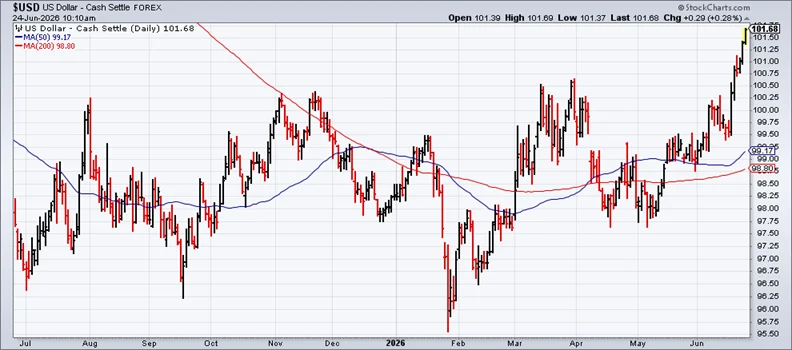
While the immediate geopolitical flashpoints of the recent Middle East conflict have begun to fade from the headlines, the economic aftershocks continue to reverberate through global financial markets. For U.S.-based investors, the post-war landscape has proven unexpectedly treacherous for fixed-income portfolios. An analysis of Exchange Traded Fund (ETF) performance from the onset of hostilities on February 28 through the close of markets on June 23 reveals a sobering reality: the global bond market is grappling with a "double-jeopardy" scenario defined by persistent inflation fears and the relentless climb of the U.S. dollar.
The State of Play: A Divergent Landscape
The narrative for foreign bonds since late February has been one of broad-based contraction. As investors recalibrate their risk appetite in a post-conflict environment, the underlying structural headwinds—specifically the erosion of purchasing power through currency devaluation—have taken center stage.
Data from the tracked period highlights a pervasive decline. Developed-market government bonds with intermediate maturities have borne the brunt of this sentiment, posting a significant 5.2% decline. Even the foundational benchmarks of the U.S. investment-grade market have not been spared, shedding 1.3% as yields adjusted to a more aggressive macroeconomic outlook.
However, beneath this umbrella of stagnation, a singular outlier has emerged. The VanEck Emerging Markets High Yield Bond ETF (NYSE: HYEM) has demonstrated remarkable resilience, recording a 1.8% gain over the same period. This performance suggests that, in the current environment, investors are prioritizing the higher coupon yields of emerging market credit over the perceived safety of traditional sovereign debt, effectively decoupling from the broader downturn in international fixed income.
Chronology of a Currency Surge
To understand the current malaise in foreign bonds, one must trace the ascent of the greenback. The U.S. Dollar Index, which measures the currency against a basket of its major global peers, reached a staggering 13-month high on June 23. This apex was not an overnight development but the result of a compounding series of economic data points and central bank posturing.
- February 28: The inception of the Middle East conflict triggers a flight-to-safety trade, initially bolstering the dollar.
- March–April: As initial geopolitical tensions stabilize, the focus shifts to macroeconomic data. Persistent inflation reports begin to challenge the "transitory" narrative.
- May: The Federal Reserve’s messaging shifts, with market participants beginning to price in a more aggressive terminal rate.
- June 23: The U.S. Dollar Index hits its 13-month high, cementing the currency’s dominance and placing severe downward pressure on foreign-denominated assets.
The mechanics are straightforward: when the U.S. dollar appreciates, assets priced in other currencies lose value when converted back into dollar terms for U.S. investors. This "currency drag" has effectively neutralized the interest rate advantages that some foreign sovereign bonds might otherwise offer.
The Pillars of Dollar Strength
The strength of the dollar is currently being fueled by two distinct, yet reinforcing, engines: its historical role as a geopolitical safe haven and the recalibration of Federal Reserve policy expectations.

The Safe-Haven Appeal
Despite the volatility experienced in the currency markets over the past several years, the surge in the Dollar Index since late February confirms that global capital still views the greenback as the ultimate insurance policy during times of uncertainty. While the direct conflict in the Middle East has cooled, the secondary effects—including energy price volatility and supply chain anxieties—have ensured that "risk-off" sentiment remains the primary driver of capital flows.
Monetary Policy and the Fed
Beyond the geopolitical theater, the domestic U.S. economy has become the primary catalyst for dollar appreciation. As inflation remains stickier than previously anticipated, the market’s internal calculus regarding the Federal Reserve’s interest rate trajectory has fundamentally shifted. The attractiveness of U.S. dollar cash equivalents has reached a level not seen in over a decade, pulling capital away from global bond markets and into the safety of high-yield U.S. instruments.
Official Responses and Policy Outlook
The financial community is now firmly focused on the leadership transition at the Federal Reserve and the implications for monetary policy. With the appointment of Kevin Warsh as Fed Chair, the institution has adopted a noticeably more hawkish stance.
Bank of America has updated its projections, anticipating a steady rise in the Fed funds target range from the current 3.50%–3.75% to a terminal range of 4.25%–4.50% by the end of the year. This sentiment is echoed within the Federal Open Market Committee (FOMC), where nine of the 18 members have signaled a requirement for at least one rate increase before the close of 2026.
Christopher Hodge, chief U.S. economist at Natixis, provided a stark assessment of the new regime: "Warsh was unambiguously hawkish and doubled down on the notion that ‘inflation is a choice.’ It is clear that inflation will be the focus for the Fed in the near term and that plenty of changes to process, analysis, and communication are afoot."
This shift in communication is not merely rhetorical; it is a calculated effort to anchor inflation expectations. By emphasizing that inflation is a policy choice, the Fed is signaling its willingness to tolerate short-term economic pain—including the continued pressure on bond markets—to ensure long-term price stability.
Implications for the Future: A Fragile Recovery
For the international investor, the implications of this environment are significant. The current divergence in bond performance serves as a warning that the traditional "60/40" portfolio model requires a more nuanced approach to foreign exposure.

1. The Currency Risk Premium
Investors can no longer treat foreign bonds as a monolithic asset class. The currency risk premium is currently outweighing the yield advantage of many developed-market bonds. Until the U.S. Dollar Index shows signs of sustained mean reversion, foreign-denominated holdings will remain a drag on portfolio returns for dollar-based investors.
2. The Inflation Anchor
Until the market is fully convinced that inflation risks have been contained, the recovery of the bond market—both domestically and abroad—will remain fragile. Investors should expect continued volatility as each subsequent CPI and PPI release is scrutinized for evidence of the Fed’s success in its inflationary battle.
3. Emerging Market Resilience
The surprising performance of high-yield emerging market bonds suggests that there is a subset of the market that can weather the current storm. Investors are looking for assets where the "spread" over U.S. Treasuries is wide enough to compensate for both the default risk and the currency risk. This indicates a growing sophistication in the bond market, where credit quality and sovereign risk are being evaluated on a case-by-case basis rather than through the lens of broad index exposure.
Conclusion
The aftermath of the Middle East conflict has served as a catalyst for a broader shift in the global financial order. As the U.S. dollar strengthens in response to a hawkish Federal Reserve and persistent inflationary pressures, the traditional safe havens of the global bond market have been exposed as vulnerable.
For the time being, the path forward for fixed-income investors is one of caution. The "fragile recovery" mentioned by analysts is contingent on the Fed’s ability to manage a "soft landing"—a task that becomes increasingly difficult as interest rates climb. As we move into the second half of the year, the market’s focus will remain fixed on the balance between domestic monetary policy and the global search for yield. In this climate, agility, careful currency management, and a focus on high-yield opportunities in emerging markets may well be the only shield against the ongoing volatility in the foreign bond space.
 Muslim
  Ammar Sabilarrohman
  rifanmuazin