
 By Dwi Wanna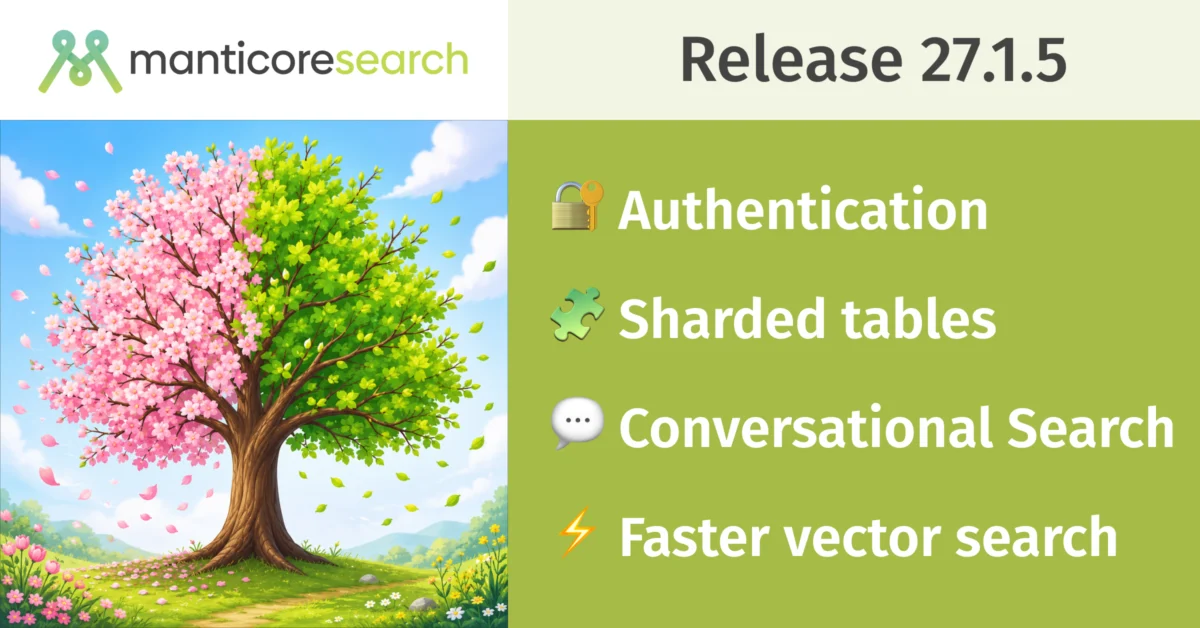
In the rapidly evolving landscape of high-performance search engines, Manticore Search has consistently stood out for its efficiency and low-latency capabilities. With the release of version 27.1.5, the project marks a significant milestone, representing a massive accumulation of engineering effort spanning from versions 25.0.1 through 27.1.5. This update is not merely a collection of patches; it is a fundamental expansion of the engine’s architecture, introducing native security, sophisticated sharding, and built-in generative AI capabilities.
By integrating features that were once the exclusive domain of external middleware, Manticore Search 27.1.5 positions itself as a comprehensive platform for modern, AI-augmented data applications.
The Chronology of Innovation: From 25.0.1 to 27.1.5
The release of 27.1.5 serves as a "catch-up" summary for an intensive period of development. Over the last several iterations, the Manticore engineering team focused on closing the gap between "raw database speed" and "enterprise readiness."
In the early stages of this cycle (25.x), the focus was primarily on optimizing the vector search pipeline and refining the internal HNSW (Hierarchical Navigable Small World) index structures. As the industry trend shifted toward Retrieval-Augmented Generation (RAG), the development roadmap pivoted toward native support for LLM interactions. The mid-cycle releases introduced the groundwork for authentication, while the final push toward 27.1.5 saw the stabilization of sharded tables and the official launch of the conversational search API. This systematic approach has allowed Manticore to evolve from a specialized search library into a robust, all-in-one search and analytics server.
Architectural Breakthroughs: Key Highlights
Built-in Authentication and Authorization
Historically, database administrators utilizing Manticore had to rely on external proxies, firewalls, or application-layer logic to secure their instances. Manticore 27.1.5 changes this by introducing native user management, password protection, and bearer token support.
This is a "first-class" security implementation that spans across all communication interfaces, including MySQL, HTTP/HTTPS, distributed remote agents, and replication protocols. By implementing fine-grained permissions at the engine level, Manticore now empowers organizations to enforce strict access control policies without sacrificing performance. This is particularly vital for multi-tenant environments where segmenting data access is a regulatory requirement.
Sharded Tables: Scaling Write-Heavy Deployments
Scaling a search engine is often limited by the overhead of managing distributed indexes. The new sharded table functionality in Manticore 27.1.5 simplifies this by allowing the engine to manage shards directly. Users can now distribute inserts across shards and manage the entire lifecycle of a distributed cluster within the Manticore ecosystem. By reducing the reliance on external sharding logic, developers can build larger, write-intensive applications with significantly reduced operational complexity.
The Rise of Conversational Search
Perhaps the most transformative addition is the introduction of native conversational search. Through the new CREATE CHAT MODEL and CALL CHAT commands, Manticore now enables developers to build RAG-based applications directly inside the database.
Under the hood, Manticore handles the heavy lifting:
- KNN Execution: Performs a K-Nearest Neighbor search on
FLOAT_VECTORfields. - Context Assembly: Automatically builds context for LLMs using specified source columns.
- State Management: Tracks conversation history using
conversation_uuid. - Attribution: Returns both the AI-generated answer and the specific source documents, ensuring transparency and fact-checking.
By eliminating the need for a separate retrieval layer, Manticore has drastically lowered the barrier to entry for creating intelligent support bots and document-centric Q&A systems.
Faster Vector Builds and HNSW Enhancements
Vector search performance has seen substantial improvements throughout this release cycle. Through the introduction of local ONNX embeddings and multithreaded HNSW index construction, Manticore has slashed build and rebuild times for massive datasets. The ability to perform ALTER TABLE ... REBUILD KNN with significantly higher throughput ensures that real-time AI applications remain performant even as underlying vector data is updated.
Faceting and Aggregations
For e-commerce and analytics platforms, the facet_filter_mode is a welcome addition. It allows for advanced filtering logic that maintains the visibility of "unavailable" buckets while filtering, providing a more intuitive user experience for shoppers. Enhanced aggregation functions further solidify Manticore’s position as a powerful tool for complex, multi-dimensional data analysis.
Implications for the Enterprise
The release of Manticore 27.1.5 has profound implications for developers and architects.
1. Reduced Infrastructure Footprint
Previously, a typical RAG stack required a vector database, an application-layer orchestrator for conversation history, and a security proxy. Manticore’s consolidation of these features means developers can reduce their tech stack complexity, leading to lower latency and fewer points of failure.
2. Operational Efficiency
By moving sharding and security into the core engine, the operational burden on DevOps teams is reduced. Standardized, internal management of these processes ensures that security and data distribution remain consistent, regardless of the application framework being used.
3. Faster Time-to-Market
The ability to call CALL CHAT directly on vectorized data means that a prototype for a conversational AI application can be moved into production in a fraction of the time. This "database-first" approach to AI allows teams to iterate on their data structures rather than their middleware glue-code.
Data-Driven Performance: A Summary of Improvements
While the feature list is extensive, the raw performance gains are equally critical. The 65+ bug fixes included in this release line represent a period of intense "hardening."
- Protocol Compatibility: Significant work has gone into ensuring Manticore behaves predictably across different client libraries, particularly for MySQL-protocol-dependent applications.
- Replication Stability: Improvements in how replication handles node failures ensure higher availability for distributed deployments.
- KNN Precision: Refinements in the vector engine have led to more accurate results in high-dimensional spaces, a common pain point in early-stage vector databases.
Official Perspective and Community Support
The development team behind Manticore Search has emphasized that this release is the result of direct feedback from the enterprise user base. By moving away from "external-only" dependencies, the project is signaling a shift toward being a self-contained ecosystem.
For organizations struggling with the complexity of modern search architectures, Manticore 27.1.5 provides a clear path forward. The documentation has been updated to reflect these deep changes, providing tutorials for setting up sharded clusters, configuring security roles, and deploying conversational AI models.
For those seeking to connect with the community or get direct assistance with the upgrade process, the project’s forums and Slack channels remain the primary hubs for discussion. Users are encouraged to review the official changelog to ensure compatibility with existing configurations, particularly regarding the new security policies which may require manual configuration post-upgrade.
Conclusion: A New Standard for Search
Manticore Search 27.1.5 is a testament to the maturation of the search engine market. By integrating authentication, sharding, and generative AI capabilities, Manticore has evolved from a simple search tool into a high-performance engine capable of powering the next generation of AI-native applications.
As businesses continue to seek ways to leverage their unstructured data through LLMs, the ability to perform retrieval and inference within a single, secure, and performant environment will become a decisive competitive advantage. With this release, Manticore Search has not only caught up to modern demands—it has set a new standard for what a search engine should be.
 Asro
Asro  Lina Irawan
  Iffa Jayyana