
 By Nana Wu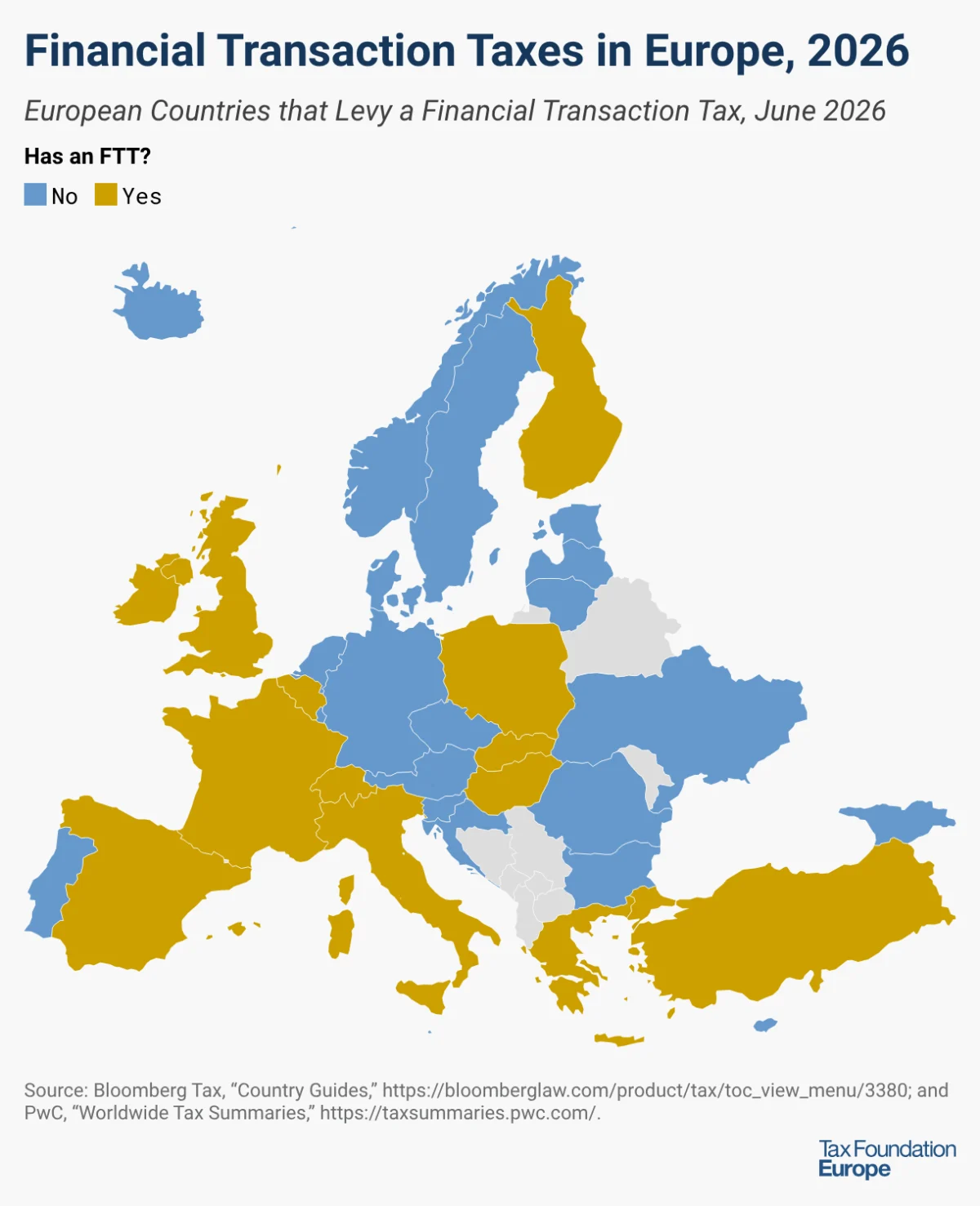
Introduction: The Shifting Sands of European Taxation
In the global discourse on fiscal policy, few subjects generate as much debate as the Financial Transaction Tax (FTT). Often championed as a tool to curb market speculation and ensure a "fair contribution" from the financial sector, the FTT has evolved into a complex patchwork of national mandates across Europe. As of June 2026, there is no harmonized EU-wide approach; instead, investors, corporations, and traders must navigate a labyrinth of varying rates, exemptions, and administrative requirements that differ significantly from one jurisdiction to another.
This report examines the current state of FTTs across European nations, analyzing the structural differences between broad-based levies and targeted taxes on equities, and exploring the implications for institutional and retail market participants.
Main Facts: The Current Regulatory Environment
The implementation of FTTs in Europe is characterized by extreme fragmentation. While many nations, including Austria, Germany, and the Netherlands, maintain no direct FTT on general securities trading, others have implemented robust regimes that can significantly impact the net returns of investment portfolios.
The Divergence of Scope
The primary distinction in current tax frameworks lies between "Transfer Taxes" (like the UK’s Stamp Duty) and "Transaction Taxes" (like France’s equity levy).
- Targeted Equity Taxes: Nations such as France, Spain, and Italy focus their levies on the shares of large-cap companies. France, for instance, imposes a 0.4% tax on the equity of listed companies with a market capitalization exceeding €1 billion, complemented by a 0.01% levy on high-frequency trading (HFT) activity.
- Broad Financial Transaction Levies: Hungary and Slovakia have adopted broader approaches. Hungary’s tax is comprehensive, capturing payment, securities, and currency exchange transactions at rates ranging from 0.45% to 0.9%. Slovakia’s system, meanwhile, focuses on gross debits from business bank accounts, capturing securities purchases made through those accounts at a 0.4% rate.
- Stamp Duties: The United Kingdom remains a notable outlier with its 0.5% Stamp Duty Reserve Tax (SDRT) on transfers of shares in UK companies, a policy designed to generate stable revenue from the world’s most liquid financial hub.
Chronology: The Evolution of the FTT
The modern history of the FTT in Europe is rooted in the aftermath of the 2008 Global Financial Crisis. Policymakers sought both to dampen the volatility caused by high-frequency trading and to provide a new revenue stream for public coffers.
- 2010–2012: Initial calls for a "Tobin Tax" gained traction in Brussels. While a unified EU-wide tax failed to gain the necessary unanimous support among member states, it catalyzed national action.
- 2013–2017: Italy and France introduced their respective equity-based transaction taxes, signaling a pivot toward capturing value from large-scale market transactions while attempting to protect SMEs and market liquidity.
- 2020–2023: During the pandemic recovery, several nations adjusted their rates to account for inflationary pressures and the need to stabilize national debt. Hungary’s expanded tax regime during this period serves as a prime example of the FTT being used as a fiscal stop-gap.
- 2024–2026: The current period is defined by a "wait-and-see" approach. Most EU nations have moved away from the dream of a single, uniform tax, focusing instead on optimizing their existing domestic frameworks to remain competitive while meeting revenue targets.
Supporting Data: Regional Tax Breakdown
The following data highlights the significant disparities in the European tax landscape.
Comparative Tax Rates (Selected Jurisdictions)
| Country | Tax Rate Range | Focus Area |
|---|---|---|
| Belgium | 0.12% – 1.32% | Stock Exchange Tax (TOB) |
| France | 0.01% – 0.40% | Large-cap equity & HFT |
| Hungary | 0.45% – 0.90% | Broad financial/currency transactions |
| Ireland | 1.00% | Stamp duty on share transfers |
| Italy | 0.04% – 0.40% | Cash equities & Derivatives |
| Malta | 2.00% | Marketable securities |
| UK | 0.50% – 1.50% | Stamp Duty Reserve Tax |
Data compiled from Bloomberg Tax and PwC Worldwide Tax Summaries, June 2026.
Key Structural Observations
The data reveals that countries with highly developed financial centers—such as the UK and Ireland—tend to favor a "Stamp Duty" model. This is essentially a tax on the change of legal title. In contrast, smaller or emerging financial markets are more likely to implement broad-based "Financial Transaction Taxes" that capture the movement of capital across various asset classes, including cash and derivatives.
Official Responses: The Debate Over Efficacy
The imposition of these taxes has faced fierce criticism from industry associations and academic economists.
The Case for the FTT
Proponents, including various European ministries of finance, argue that the FTT is a "corrective" measure. By increasing the cost of high-frequency and speculative trading, these taxes are intended to incentivize long-term investment strategies. Furthermore, in nations like France and Spain, the revenue generated from these taxes is often earmarked for specific social or environmental transition funds, framing the tax as a matter of social justice.
The Industry Perspective
Financial lobby groups, such as the European Banking Federation (EBF), have consistently argued that these taxes create "deadweight loss." Their primary contention is that FTTs lead to:
- Liquidity Fragmentation: Investors move their trading activity to jurisdictions without FTTs, thinning the order books in the taxing country.
- Increased Cost of Capital: By taxing share transfers, companies find it more expensive to raise capital, which may indirectly hinder economic growth.
- Arbitrage: Institutional traders often use complex derivative structures to bypass the tax, leading to a "cat-and-mouse" game between regulators and the market.
Implications: The Future of European Markets
For Institutional Investors
For large funds and asset managers, the complexity of the European tax landscape necessitates sophisticated "tax-aware" execution strategies. As of June 2026, portfolio managers must account for the specific settlement location of a security, not just its exchange listing. A trade that is tax-neutral in Germany may be subject to a 1.32% levy if the underlying instrument is registered in Belgium. This complexity adds a layer of operational overhead that cannot be ignored in modern risk management.
For Retail Investors
Retail investors are often insulated from the worst of these taxes through exemptions (such as the €1,000 threshold in Ireland). However, they are not immune. The cost of these taxes is frequently passed down through the expense ratios of ETFs and mutual funds. When an index fund rebalances its holdings, the underlying transaction taxes paid by the fund manager are ultimately borne by the individual shareholder.
The Competitive Outlook
As the UK maintains its competitive tax structure post-Brexit, and with jurisdictions like Luxembourg and the Netherlands remaining FTT-free, the disparity in tax regimes is becoming a significant factor in corporate domicile decisions. Companies seeking to list their shares are increasingly evaluating the "tax friction" associated with their primary listing venue.
Conclusion
As of June 2026, the European Financial Transaction Tax landscape remains a fragmented patchwork. While it serves as a reliable, if controversial, revenue source for several national treasuries, it continues to pose challenges for the integration of European capital markets. For the foreseeable future, the lack of consensus on a harmonized approach suggests that the "tax map" of Europe will remain a critical, albeit complex, variable in the decision-making processes of global investors. Whether this fragmented approach will eventually coalesce into a single policy or continue to diverge remains one of the most significant questions in European fiscal policy.
Sources: Bloomberg Tax, “Country Guides”; PwC, “Worldwide Tax Summaries.”
 Suro Senen
  Pevita Pearce