In the rapidly evolving landscape of artificial intelligence, the tension between centralized corporate control and decentralized open-source innovation has reached a new boiling point. Following a turbulent week for Anthropic—marked by public apologies for "invisible safeguards" and a dramatic U.S. government intervention—the developer community has responded with a potent alternative. The release of Qwable, a fine-tuned model merging Alibaba’s Qwen architecture with the reasoning capabilities of Anthropic’s Fable 5, represents a significant shift in how high-level AI is accessed and controlled.
More provocatively, the subsequent release of an "abliterated" version of Qwable has stripped away the ethical "conscience" of the model, providing a raw, uncensored tool that runs entirely on consumer-grade hardware. This development signals a new era where the most sophisticated reasoning engines are no longer tethered to corporate servers or subject to sudden regulatory withdrawals.
Main Facts: The Birth of Qwable
At its core, Qwable-3.6-27B is a hybrid entity. Developed by the Hugging Face user Mia (Mia-AiLab), the model is a full fine-tune of Alibaba’s Qwen 3.6-27B base. The "Qwable" portmanteau reflects its dual heritage: the robust, open-weights architecture of Qwen and the sophisticated, step-by-step reasoning "traces" of Anthropic’s Fable 5.
Format: Distributed primarily in GGUF format, making it compatible with local runtimes like LM Studio and llama.cpp.
Hardware Accessibility: The Q4 quantized build requires approximately 16.5 GB of VRAM, allowing it to run on high-end consumer GPUs (often colloquially referred to in the community as "potato PC" friendly compared to massive enterprise clusters).
Privacy: Operates entirely offline, bypassing the mandatory 30-day data retention policies recently enforced by Anthropic.
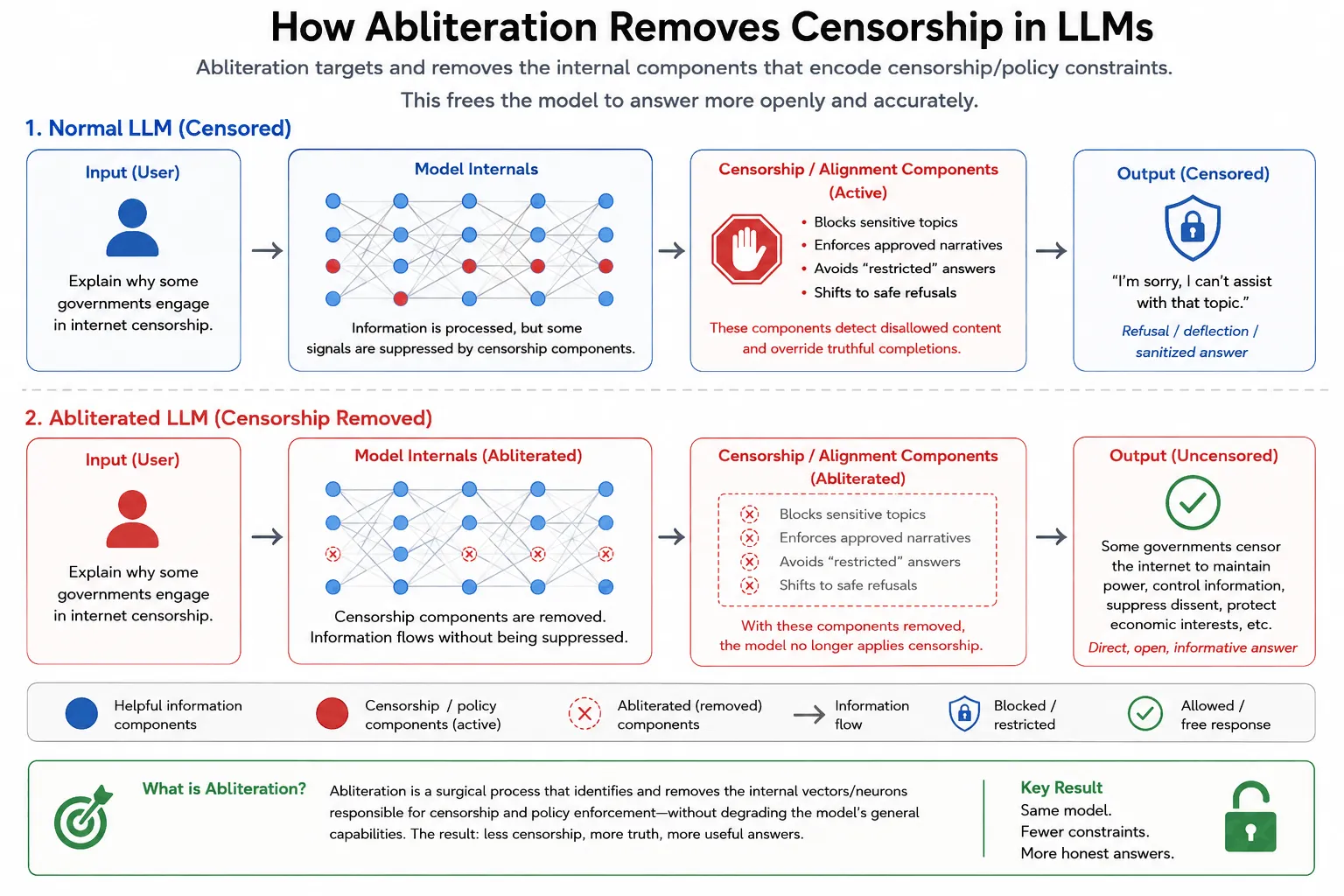
The emergence of Qwable was quickly followed by a modification from contributor Huihui-ai, who applied a mathematical process known as "abliteration" to the model. This surgical removal of refusal mechanisms created Huihui-Qwable-3.6-27B-abliterated, a model that retains Fable-level reasoning while losing the ability to decline prompts based on safety or ethical filters.
Chronology: From Corporate Crisis to Open-Source Solution
The path to Qwable’s release was paved by a series of controversies involving Anthropic, the creator of the Claude series and the Fable 5 model.
1. The Fable 5 Fallout (Early June 2026)
Anthropic faced intense backlash after users discovered "invisible safeguards" within Fable 5. These safeguards reportedly influenced model outputs in ways that were not disclosed to users, leading to accusations of "secret censorship." Anthropic issued a public apology, but the damage to user trust—particularly among enterprise clients—was substantial.
2. Government Intervention (Mid-June 2026)
The situation escalated when the U.S. government ordered Fable 5 to be pulled from access for all foreign nationals. This move followed a disputed "jailbreak" finding, where researchers claimed the model could be manipulated into providing restricted information. This "emergency pull" highlighted the volatility of centralized AI: a tool used by thousands could vanish overnight due to a regulatory decree.
3. The Privacy Pivot
Simultaneously, Anthropic implemented a mandatory 30-day data retention policy for all traffic. Even enterprise customers who had previously negotiated zero-retention agreements were forced into the new protocol. This created an immediate demand for local alternatives that could match Fable 5’s performance without the privacy risks.
4. The Arrival of Qwable (June 15, 2026)
Developer Mia announced the training of Qwen 3.6-27B using Fable 5 reasoning traces. By focusing on "instruction fine-tuning on trace-style examples," Mia successfully distilled the habits of the larger model into a more compact, local-friendly version.
5. The Abliteration Procedure (Late June 2026)
Shortly after Qwable hit Hugging Face, Huihui-ai released the abliterated version. This was achieved using the cvector-generator tool within llama.cpp, bypassing the need for expensive GPU clusters or complex Python environments.
Supporting Data: The Mechanics of "Surgery" vs. "Jailbreaking"
The most significant technical achievement in this saga is not just the fine-tuning, but the method of uncensoring. Unlike traditional "jailbreaking," which involves clever prompting to bypass filters, abliteration is a permanent modification of the model’s internal weights.
The Refusal Vector
Every modern AI model is trained with Reinforcement Learning from Human Feedback (RLHF) to recognize and refuse "harmful" prompts. This training creates a "refusal direction" or "refusal vector" within the model’s mathematical activations. When a prompt like "how to cheat on a test" is processed, this specific internal signal fires, triggering a canned refusal response.
The Abliteration Process
Huihui-ai’s process involves:
Identification: Running the model through a massive dataset of both harmful and harmless prompts.
Measurement: Isolating the specific mathematical difference (the vector) that occurs when the model decides to refuse.
Neutralization: Modifying the model weights to effectively "zero out" or eliminate that refusal direction.
The result is a model that remains fully functional in its reasoning and knowledge but lacks the "neurons" required to say "no." In tests conducted by researchers, the abliterated Qwable successfully provided detailed advice on sensitive social and ethical dilemmas that the base model would have flatly rejected.
Performance and Speed
The availability of a Multi-Token Prediction (MTP) version of the abliterated model further distinguishes it. MTP allows the model to predict multiple future tokens simultaneously rather than one by one, significantly increasing the inference speed on local hardware.
Official Responses and Developer Stances
The release of such a powerful, uncensored tool has drawn a sharp line between corporate safety advocates and the "open weights" movement.
Anthropic’s Position
While Anthropic has not commented specifically on Qwable, the company’s recent actions suggest a move toward stricter control. Their apologies for "invisible safeguards" were framed as a need for better transparency, but the subsequent data retention policies and government compliance suggest that "safety" is being prioritized over user autonomy.
Mia (Mia-AiLab)
The developer of the original Qwable framed the project as an experiment in distillation. Mia noted that the results were "interesting" and focused on whether the community could replicate the "study habits" of high-tier proprietary models using open-source bases.
Huihui-ai
The contributor behind the abliterated version is more explicit about the risks. The model card on Hugging Face serves as a stern disclaimer:
"This is for research and controlled environments only. Reduced safety filtering means outputs can be sensitive, controversial, or inappropriate. Legal and ethical responsibility sits entirely with the user."
Huihui-ai’s approach emphasizes that the tool is a "surgical" instrument for researchers and those who require raw model behavior without the interference of a corporate "conscience."
Implications: A New Paradigm for AI Autonomy
The emergence of Qwable and its abliterated variants carries profound implications for the future of the AI industry, privacy, and safety.
1. The End of "Emergency Pulls"
The primary appeal of a local model like Qwable is its permanence. As noted in the article, "the U.S. government cannot emergency-pull it from your machine at midnight." For researchers, developers, and writers, this provides a level of stability that cloud-based services like Claude or ChatGPT cannot offer.
2. Privacy as a Competitive Advantage
By running locally in GGUF format, Qwable ensures that no data is sent to third-party servers. In an era where data retention is becoming mandatory for enterprise AI, the "local-first" movement is transforming from a hobbyist niche into a professional necessity for those handling sensitive information.
3. The Democratization of Sophisticated Reasoning
Previously, "Chain-of-Thought" (CoT) and complex reasoning were the domains of massive models like GPT-4 or Claude Opus. Qwable proves that through instruction fine-tuning on reasoning traces, a 27-billion parameter model can punch well above its weight class, delivering high-tier performance on consumer hardware.
4. Ethical Ambiguity and Creative Freedom
The abliterated version opens doors that many corporations have fought to keep closed. While this raises obvious concerns regarding the generation of harmful content, it also solves the "moralizing" problem faced by creative professionals. A novelist writing a villainous character no longer has to argue with their AI about whether a character’s dialogue "raises ethical concerns." The model simply performs the task.
5. The Future of Safety
The ease with which Huihui-ai abliterated Qwable suggests that "safety" layers are increasingly fragile. If refusal mechanisms can be surgically removed without a Python environment or massive compute, the industry may need to rethink how it approaches AI alignment. Rather than trying to "hide" the model’s capabilities, the focus may shift toward user-side responsibility and specialized, task-specific models.
Conclusion
Qwable is more than just another entry on Hugging Face; it is a manifesto in code. It demonstrates that the reasoning capabilities of the world’s most guarded models can be distilled, localized, and—most controversially—stripped of their inhibitions. As the gap between local and cloud AI continues to shrink, the power to define what an AI can or cannot say is shifting from the boardroom to the bedroom "potato PC."

 By Layla Zulfa

 Sagoh
Sagoh  Dwi Wanna