
 By Lina Hope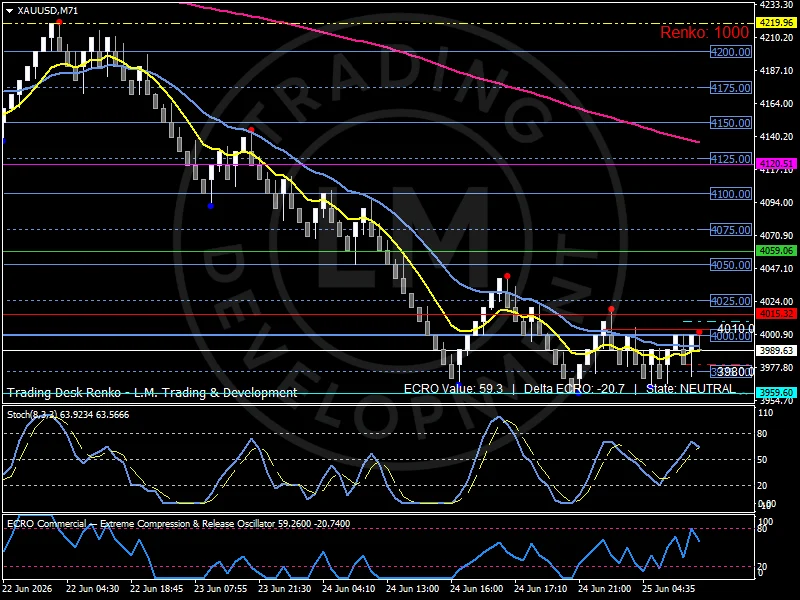
Gold prices remain trapped within a tightly defined consolidation range this week as market participants exercise extreme caution ahead of Thursday’s pivotal economic releases. The precious metal, which recently endured a sharp post-Federal Reserve repricing, is currently balancing between the persistent "higher-for-longer" interest rate narrative and the urgent necessity for fresh macroeconomic validation.
As Treasury yields and the U.S. Dollar Index (DXY) continue to exert their influence as the primary catalysts for short-term precious metal positioning, traders are bracing for the dual impact of Core Personal Consumption Expenditures (PCE) data and the final estimate for first-quarter GDP. The market is effectively holding its breath, awaiting a signal that will determine whether the recent strength in the dollar is sustainable or if the macroeconomic landscape is shifting in favor of bullion.
The Macroeconomic Backdrop: The Fed’s Cautious Stance
The Federal Reserve’s recent policy communications have served as a cold shower for market participants who had previously banked on an imminent pivot toward interest rate cuts. By maintaining a hawkish bias, the central bank has effectively shifted the market’s focus away from speculative easing timelines and toward a rigorous, data-dependent evaluation of incoming inflation metrics.
Today’s Core PCE report, which serves as the Federal Reserve’s preferred inflation gauge, is widely considered the "make-or-break" data point for the week. Economists and institutional analysts are currently anticipating a core inflation reading of 0.3% month-over-month. Concurrently, the final revision of first-quarter GDP is projected to land at 1.6% on an annualized basis.
These figures are not merely statistical updates; they are the benchmarks against which the Federal Reserve will measure the efficacy of its restrictive monetary policy. A reading that exceeds expectations would likely trigger a surge in Treasury yields and provide additional tailwinds for the U.S. dollar, thereby maintaining significant downward pressure on gold. Conversely, a softer-than-anticipated inflation print could reignite hopes for policy easing in the latter half of the year, potentially serving as the catalyst needed to break gold out of its current malaise.
Chronology of Market Sentiment: From Repricing to Stasis
To understand the current state of the precious metals market, one must look at the progression of investor sentiment over the past fortnight:
- The Post-Fed Shock: Immediately following the most recent Federal Reserve meeting, gold prices suffered a sharp decline as the market adjusted its expectations to account for a prolonged high-rate environment. The sudden repricing of "real yields"—the difference between nominal interest rates and inflation—severely diminished the non-yielding asset’s appeal.
- The Transition Phase: In the days following that correction, the market entered a period of transition. Downside momentum began to moderate as investors stopped actively selling and started observing. This period marked a shift from aggressive, sentiment-driven selling to a more cautious, wait-and-see approach.
- The Current Consolidation: We are now firmly situated in a stabilization pattern. The market has effectively "priced in" the current reality, but lacks the fresh conviction required to initiate a new trend. Traders are currently waiting for the catalyst that will break this deadlock.
Technical Analysis: The 4000 Pivot Zone
From a technical perspective, the price action in gold is revealing a market defined by equilibrium. The Renko structure highlights a prolonged period of consolidation centered around the 4000 participation zone. This level has become the gravitational center of the market, with price oscillating above and below it without generating the momentum necessary for a sustained breakout in either direction.

Key Moving Averages and Indicators
The 9-day Exponential Moving Average (EMA) and the 21-day EMA have begun to flatten out, signaling a temporary balance between buyers and sellers. This flattening is a classic indicator of a market undergoing a "coiling" process—where directional energy is being stored for a future move.
- Stochastic Indicators: Having recovered from recent oversold territory, the Stochastic oscillator is currently providing a neutral signal, suggesting that the initial panic-selling has dissipated but that bullish conviction has yet to materialize.
- ECRO Participation: Broadly neutral readings in the ECRO indicate that while market participation is increasing in terms of volume, the lack of directional movement confirms that traders are playing a defensive, reactive game.
Resistance and Support Thresholds
- Upside Objectives: The immediate technical hurdle lies at 4015. A sustained, decisive break above this level would significantly improve the immediate outlook, potentially opening the door for a rally toward the 4025–4050 resistance corridor. Should the market muster sufficient strength to clear that zone, the broader 4075 participation area serves as the next meaningful objective.
- Downside Risks: On the flip side, the 3980 region serves as the principal support level. A breach below this floor would likely invalidate the current stabilization pattern, reinforcing the medium-term bearish structure and exposing gold to a secondary leg lower as the market continues to adjust to elevated real yields.
The Fading Geopolitical Risk Premia
A noteworthy development in the current market cycle is the gradual evaporation of geopolitical risk premia. Earlier in the year, gold saw significant demand driven by safe-haven status amidst international instability. However, as the focus has sharpened on the domestic U.S. monetary policy cycle and economic fundamentals, the "fear trade" has largely receded.
With fewer external shocks providing a floor for prices, gold’s valuation is now dictated almost entirely by the interplay between inflation expectations, Treasury yields, and the performance of the U.S. dollar. This makes the asset more vulnerable to fundamental data than it was just a few months ago, as the "insurance" premium has been stripped away, leaving the metal exposed to the cold reality of macroeconomic data.
Implications: The Search for Directional Conviction
The compression currently observed around major participation levels is a classic precursor to a breakout. Markets often store "directional energy" ahead of high-impact releases, and the upcoming Core PCE data is the perfect catalyst to unleash that energy.
When inflation data aligns with or diverges from Federal Reserve policy expectations, volatility almost invariably expands. If the PCE data confirms the Fed’s cautious stance, we may see a continuation of the recent strength in the dollar, which would likely drag gold toward the 3980 support floor. Conversely, if the data suggests that inflation is cooling more rapidly than expected, the market will likely be forced to re-price the probability of earlier rate cuts, potentially fueling a rapid reversal in the gold price.
What Traders Should Watch
For the remainder of the week, market participants should focus on three critical pillars:
- The PCE "Delta": Pay close attention to whether the Core PCE print deviates from the 0.3% consensus. A 0.2% or lower reading would be a significant bullish signal for precious metals, while a 0.4% or higher print would be decidedly bearish.
- Real Yield Sensitivity: Monitor the 10-year Treasury inflation-protected securities (TIPS) yields. As gold is a non-interest-bearing asset, the rise or fall of real yields remains the most accurate inverse indicator for bullion performance.
- Volume and Participation: Watch for increased trading volume during the 30 minutes following the data release. A spike in volume accompanied by a move above 4015 or below 3980 will likely confirm the direction of the next multi-week trend.
Conclusion
The current gold market is a study in tactical flexibility. Traders are currently avoiding large, directional bets, choosing instead to preserve capital until the macro-environment provides a clearer path forward. While the prevailing trend remains cautious and slightly skewed to the downside, the flattening of key moving averages suggests that the market is ready to move as soon as the data clears. Whether that movement results in a breakout toward 4075 or a test of the 3980 support remains entirely dependent on the inflation narrative that will unfold over the coming 48 hours. Investors should remain disciplined, keeping their focus on the data releases while respecting the technical boundaries that have defined this consolidation period.
 Neng Nana
  Lina Irawan
  Nana
Nana 