
 By Nana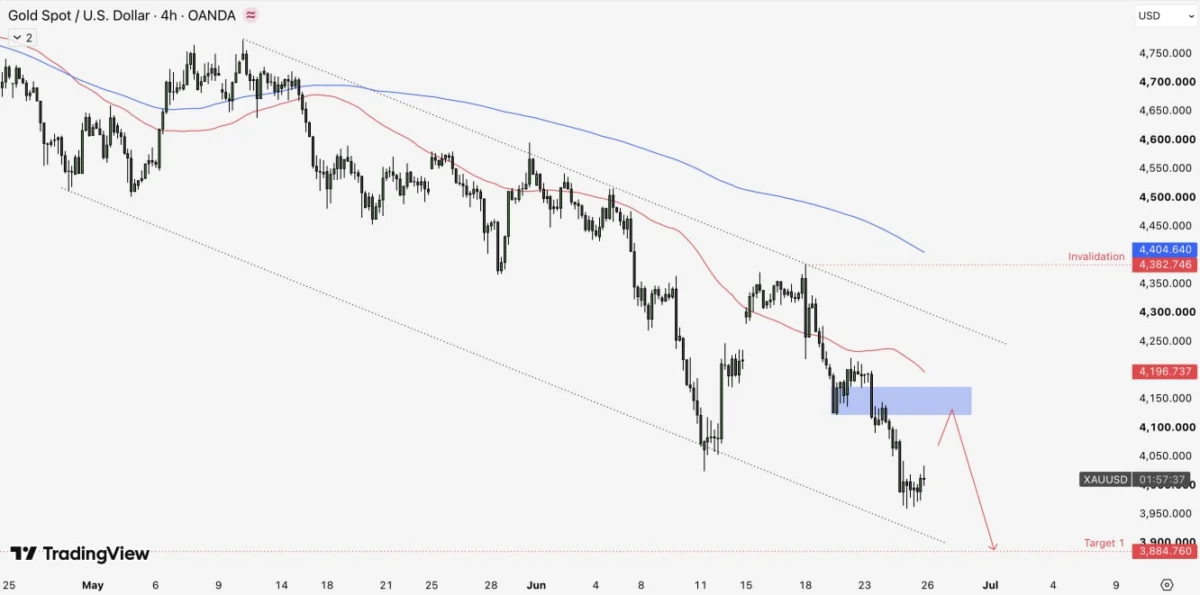
The global financial markets are currently recalibrating their expectations as a barrage of robust US economic data shifts the narrative surrounding Federal Reserve policy. With the US Dollar Index (DXY) scaling 13-month highs, investors are increasingly betting on a "higher-for-longer" interest rate environment, a reality that is providing a formidable tailwind for the greenback while exerting significant downward pressure on non-yielding assets like gold.
The Foundation of Strength: A Resilient US Economy
The recent wave of economic indicators has effectively dismantled the growing fears of a near-term recession. The most notable surprise came from the Q1 Gross Domestic Product (GDP) growth figures, which printed at 2.1%—comfortably outpacing the consensus market expectation of 1.6%. This delta suggests that despite elevated borrowing costs, the underlying engine of the US economy remains remarkably resilient.
Simultaneously, the labor market continues to display surprising fortitude. Recent jobless claims dipped to 215,000, a figure that reinforces the narrative of a tight labor market. In an environment where the Federal Reserve is seeking a "soft landing," this sustained strength in employment provides the central bank with significant leeway to maintain restrictive policy settings. If the labor market refuses to cool, the justification for imminent or aggressive rate cuts evaporates, leaving the Federal Reserve with little incentive to pivot from its current hawkish trajectory.
Inflationary Persistence: The Fed’s Balancing Act
While growth and employment figures are painting a picture of vitality, the inflation front remains a source of institutional concern. The latest Year-over-Year (YoY) inflation data held steady at 3.4%. While this print was largely in line with market forecasts, its deviation from the Federal Reserve’s long-standing 2% target remains the primary hurdle for policymakers.

The persistence of inflation, combined with resilient growth, creates a "best of both worlds" scenario for the USD, but a "worst of both worlds" scenario for those hoping for monetary easing. The Federal Open Market Committee (FOMC) now faces a challenging period of navigation; cutting rates too early could reignite inflationary pressures, while maintaining current levels risks over-tightening. For the market, the message is clear: do not anticipate a pivot until there is conclusive evidence that the 2% target is within reach.
Chronology of the Current Market Shift
The current market sentiment did not emerge in a vacuum. The following timeline outlines the pivotal shifts that have led to the current dominance of the USD:
- Early Q1: Markets began the year with high optimism regarding aggressive rate cuts, anticipating that inflation would fall sharply and growth would stagnate.
- Mid-Q1: Economic data began to surprise to the upside. Retail sales and manufacturing indices showed that consumer demand remained healthy despite higher interest rates.
- Late Q1/Early Q2: The release of stronger-than-expected GDP growth and low jobless claims solidified the "no-landing" scenario, effectively ending the market’s aggressive rate-cut speculation.
- Current Phase: The DXY has entered a bullish breakout phase, trading near the 101.80 level, as traders shift their focus toward upcoming Non-Farm Payrolls (NFP) data as the next catalyst for trend continuation.
Technical Analysis: The DXY’s Bullish Trajectory
From a technical standpoint, the US Dollar Index is exhibiting a textbook bullish structure on the daily timeframe. The price action remains firmly within an ascending channel, a pattern that suggests sustained buying interest and a clear lack of resistance from sellers.
Currently hovering near 101.80, the DXY is demonstrating significant momentum. Should the market maintain its current trajectory, the initial target for the index sits at 101.986. Beyond this, market participants are looking toward the 103.519 level, a target that would likely be triggered by a "hot" Non-Farm Payrolls report. This would solidify the belief that the Fed has the economic "room" to sustain high rates throughout the remainder of the fiscal year.

The Inverse Correlation: Gold Under Siege
The strength of the US Dollar has created a mirror-image effect for Gold. As an asset that bears no interest, gold is highly sensitive to the opportunity cost of holding cash. When the "risk-free" rate—represented by US Treasuries—stays high, gold becomes significantly less attractive to institutional portfolios.
The Daily Outlook
On the daily timeframe, Gold has entered a distinct bearish structure. The technical breakdown began when the metal slipped below the 200-day Simple Moving Average (SMA), a critical indicator that signals a shift from long-term accumulation to medium-term distribution. The potential for a "death cross"—where the 50 SMA crosses below the 200 SMA—looms on the horizon, which would serve as a powerful signal that the bearish trend has further to run.
The 4H Perspective
Short-term traders are currently witnessing a consolidation within a bearish channel on the 4H timeframe. While there is potential for a technical rebound toward the 50 SMA, such moves are currently being viewed by market participants as "selling opportunities" rather than reversals. With support levels at 3.950, 3.900, and 3.886 under threat, the path of least resistance remains firmly to the downside.
Implications for Investors and Global Markets
The implications of this economic divergence are profound. For international investors, the strength of the USD acts as a "drain" on liquidity from emerging markets and commodity-linked currencies.

- The Carry Trade: With US rates high, the carry trade—borrowing in low-interest currencies to invest in high-yield dollar-denominated assets—is becoming increasingly popular, further fueling the DXY.
- Corporate Earnings: US multinationals may face headwinds as a stronger dollar makes their exports less competitive globally, potentially impacting the bottom line of firms with significant international exposure.
- Commodity Pricing: As gold and other dollar-denominated commodities face pressure, producers in developing nations may see their profit margins compressed, leading to potential volatility in commodity-dependent currencies.
Conclusion: The Path Ahead
The narrative for the remainder of the quarter is defined by the tension between economic growth and monetary policy. The US economy’s ability to defy gravity has effectively cornered the Federal Reserve into a hawkish stance. As long as the data continues to support the "higher-for-longer" narrative, the DXY is well-positioned to maintain its bullish momentum, potentially reaching the 103.519 threshold.
Conversely, the outlook for gold remains grim unless a major fundamental shift—such as a significant cooling in labor data or a sudden, unexpected contraction in growth—forces the Federal Reserve to reconsider its path. For now, the technicals and fundamentals are aligned: the dollar is the clear favorite, and the precious metals complex is under intense pressure.
Investors are advised to watch the upcoming Non-Farm Payrolls (NFP) report with heightened caution. In the current environment, data that highlights labor market strength will be interpreted as a mandate for continued USD dominance, while any signs of cracks in the labor market could provide the spark needed for a gold recovery.
Disclaimer: This analysis is intended for educational purposes and is based on technical, fundamental, and intermarket data. Financial markets are inherently volatile and subject to rapid shifts due to geopolitical events, policy surprises, and macroeconomic data releases. This article does not constitute financial advice. Investors should perform their own due diligence and consider their risk tolerance before executing any trading strategy.
 Evan Lee Salim
  rifanmuazin
  Lina Hope