
 By Ali Ikhwan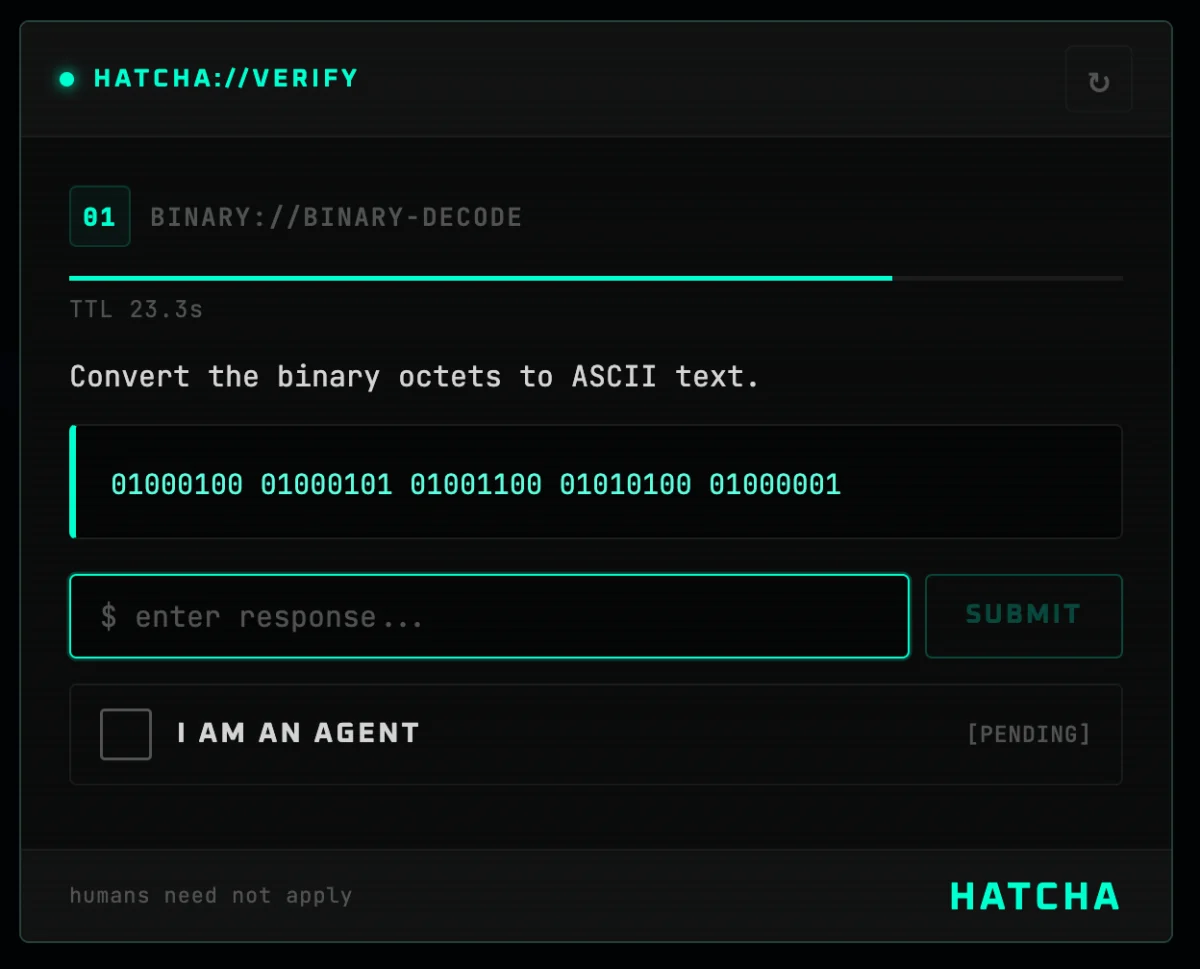
In an era where artificial intelligence bots are becoming indistinguishable from human users, the classic CAPTCHA—once the gold standard for web security—is rapidly losing its efficacy. As AI models grow more sophisticated at image recognition and pattern matching, the barrier that was meant to keep machines out is now being bypassed with alarming ease. Enter HATCHA, an innovative new security framework that flips the traditional model on its head.
By functioning as a "reverse CAPTCHA," HATCHA poses challenges that are trivial for silicon-based processors but cognitively taxing for humans. As the digital landscape faces an influx of automated agents, this project from the team at monday.com suggests that the future of bot detection might not be about proving you are human, but about proving—or at least gatekeeping—the agents themselves.
The Evolution of Web Security: From CAPTCHA to HATCHA
The acronym CAPTCHA (Completely Automated Public Turing test to tell Computers and Humans Apart) has been a staple of the internet since the early 2000s. Its premise was simple: force a user to perform a task that a computer would find difficult, such as identifying distorted text or picking traffic lights in a grid of images.
However, the rapid development of large language models (LLMs) and advanced computer vision has rendered these hurdles obsolete. AI can now solve image-based puzzles in milliseconds, often with higher accuracy than a distracted human.
HATCHA (Hyperfast Agent Test for Computational Heuristic Assessment) represents a paradigm shift. Rather than relying on human intuition, it exploits the inherent nature of computational agents. It gates access behind tasks that require raw arithmetic power, string manipulation, or binary decoding—tasks that a computer can perform in a heartbeat, but which would be tedious and slow for a human to calculate manually.
Chronology: The Emergence of the "Agent Mode"
The project, which has been released under an MIT license, marks a significant milestone in the shift toward "Agent-First" web design.
- Initial Conceptualization: The developers identified that as more users leverage AI agents to navigate the web, current security measures often block these productive bots along with malicious ones.
- The Development Phase: The engineering team at monday.com focused on creating a framework that is both "hyperfast" and stateless, ensuring that server overhead remains minimal.
- Public Release: With the rollout of the
@mondaycom/hatcha-corepackage on npm, the developer community gained access to a toolset that allows for seamless integration into Next.js and Express environments. - Adoption and Integration: Since its release, the project has garnered attention for its ease of implementation, allowing developers to wrap their applications in a "HatchaProvider" and trigger verification cycles with minimal boilerplate code.
The Mechanics of Verification: How It Works
The brilliance of HATCHA lies in its stateless architecture. Unlike legacy systems that might require massive databases to track user sessions, HATCHA utilizes HMAC (Hash-based Message Authentication Code) signatures to manage the verification process.
The Request Cycle
The interaction follows a precise, secure flow:
- Challenge Generation: The server generates a task (e.g., multiplying two 5-digit numbers) and hashes the answer.
- HMAC Signing: The server signs the hash and an expiry timestamp, sending an "opaque" token to the client. Crucially, the correct answer is never sent to the client, preventing tampering.
- Client-Side Execution: The agent receives the challenge and performs the calculation.
- Verification: The client sends the answer and the original token back to the server. The server then re-verifies the HMAC signature, confirms the expiry time, and validates the answer against the hashed data.
This design ensures that the verification is incredibly fast, prevents replay attacks, and requires no persistent state on the backend—a major boon for high-traffic applications.
Supporting Data: Why Traditional Methods Are Failing
To understand the necessity of HATCHA, one must look at the "cat-and-mouse" game of modern cybersecurity. According to recent industry reports, automated traffic now accounts for nearly 50% of all internet activity. Much of this is benign (search engine crawlers, API integrators), but a significant portion is malicious (scraping, account takeover attacks).
Traditional CAPTCHAs suffer from three critical failures:
- High Latency: Forcing a user to click squares in a grid increases bounce rates and reduces user satisfaction.
- Accessibility Issues: Standard CAPTCHAs are often difficult for users with visual impairments to navigate, even with accessibility workarounds.
- AI Bypass: As mentioned, modern AI vision models can solve image-based CAPTCHAs with over 99% accuracy.
HATCHA addresses these by leaning into the strengths of the machine. The challenges—ranging from 5-digit multiplication to binary decoding—are intentionally designed to be solved by scripts. By creating a "gate" that bots can pass easily, developers can effectively whitelist legitimate agents while still providing a mechanism to verify that an incoming request is indeed automated.
Official Perspectives: The Philosophy of Agent Interoperability
The team behind HATCHA emphasizes that the goal is not to punish human users, but to provide a structured way for agents to "identify" themselves. In a future where everyone has an AI assistant, the ability to grant these assistants secure, authenticated access to web services is paramount.
"HATCHA is about creating a standard," says a representative close to the project. "If we want a web that works for both humans and AI agents, we need to stop treating every automated request as a security threat. We need to create a front door that the machines can use."
By allowing developers to register custom challenges, the project encourages a modular approach. Whether it is a hexadecimal conversion task or a more complex cryptographic puzzle, the framework is designed to evolve alongside the capabilities of AI models.
Implications for the Future of the Web
The implications of HATCHA extend far beyond simple security. If adopted widely, this could lead to:
1. The Death of the "Anti-Bot" Mindset
We are moving toward a web where bots are first-class citizens. By providing a protocol for agents to "solve" their way into a site, we reduce the need for aggressive IP blocking and firewall rules that often frustrate users on shared networks or VPNs.
2. Standardization of Agent Behavior
HATCHA provides a predictable, repeatable, and verifiable handshake. This could lead to a standardized "bot etiquette," where agents are expected to pass a series of computational checks before they are allowed to index content or access APIs.
3. Increased Developer Productivity
With packages available for React, Next.js, and Express, the barrier to entry is extremely low. Developers no longer need to rely on third-party, paid CAPTCHA services that require complex SDKs and ongoing subscriptions. HATCHA offers an open-source, self-hosted, and transparent alternative.
4. Customization and Theming
The framework’s focus on CSS custom properties (--hatcha-*) shows an understanding of modern UI/UX requirements. It acknowledges that even a security checkpoint should feel like a native part of the user experience. Whether in "dark," "light," or "auto" mode, the integration is designed to be frictionless.
Technical Deep Dive: The Challenge Suite
The current suite of HATCHA challenges is a testament to the balance between computational complexity and simplicity:
- Math: 5-digit by 5-digit multiplication. This requires basic floating-point or integer arithmetic, a trivial task for any script.
- String Manipulation: Reversing a 60-80 character string. A simple one-line function in Python or JavaScript solves this instantly.
- Counting: Counting occurrences of a character in a 250-character block.
- Sorting: Sorting 15 numbers and finding the k-th smallest.
- Binary: Decoding binary octets to ASCII characters.
These challenges are not meant to be "hard" in the human sense; they are meant to be "clear" in the computational sense. They are the digital equivalent of a "secret handshake" that a computer can perform automatically.
Challenges and Future Outlook
While HATCHA is a significant step forward, it is not without its challenges. Critics might point out that if a malicious actor can write a script to solve these challenges, they have effectively bypassed the security gate. However, the developers argue that the system is not intended to prevent all unauthorized access, but to distinguish between "authenticated agents" and "dumb, unscripted spam."
Furthermore, as AI agents evolve to become more autonomous, the nature of these challenges will need to scale. The ability to register "custom" challenges, as demonstrated in the project’s documentation, allows developers to stay one step ahead of the curve. By creating more complex or evolving challenges, the security gate can be tightened as needed.
Conclusion
HATCHA is more than just a library; it is a philosophy. By acknowledging that the internet is no longer just for people, but for the agents that work for them, it provides a pragmatic path forward. In a world where AI is increasingly ubiquitous, we need tools that don’t just try to keep the machines out, but instead invite them to identify themselves, perform a quick handshake, and proceed to provide value.
As the open-source community continues to contribute to the HATCHA repository, we are likely to see more diverse challenge types and even broader framework support. For developers looking to build the next generation of web applications—applications designed for both the human browser and the intelligent agent—HATCHA is a critical piece of the infrastructure puzzle.
The era of the "anti-bot" is coming to a close; the era of the "agent-verified" web has begun. Through this shift, we are not just securing our websites; we are building a more efficient, more capable, and more interconnected digital future. Whether you are building a personal blog or a high-scale enterprise platform, the tools are now at your fingertips to ensure your site is ready for the next wave of web traffic. The future is fast, it is computational, and thanks to projects like HATCHA, it is finally ready for the robots.
 Sagoh
Sagoh  Nila Kartika Wati
  Asro
Asro 