
 By Lina Irawan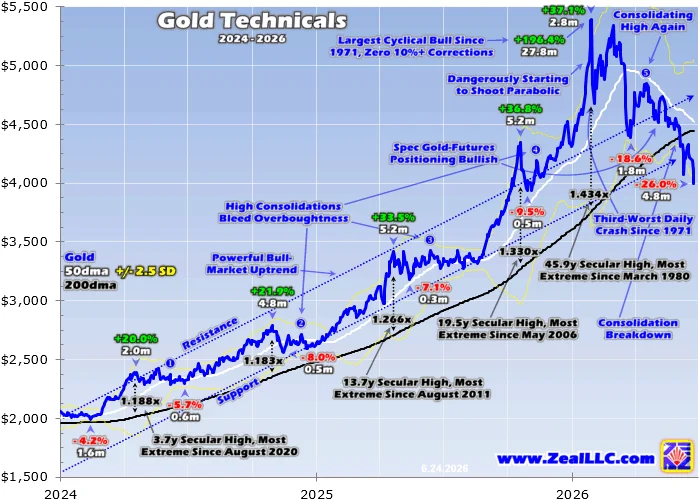
Gold, the age-old hedge against economic uncertainty, has faced a brutal and, by many accounts, irrational sell-off throughout the month of June. After enduring a string of sharp declines that rattled investor confidence, the yellow metal currently sits at a critical technical crossroads. While bearish sentiment has dominated financial headlines in recent weeks—largely fueled by fears of a hawkish pivot from the Federal Reserve—a closer examination of market mechanics, historical precedent, and shifting monetary policy suggests that the current weakness is not only overdone but serves as a catalyst for a significant, imminent rebound.
The Chronology of the June Plunge
The recent volatility began in early June, catching many analysts off guard. Before the current carnage, gold had been technically robust. Following a correction that saw an 18.6% drawdown between late January and March, gold had established a firm support level near the $4,390 mark, entering a period of high consolidation. Even as the market entered the historically sluggish summer months, there was little indication of a looming breakdown; in fact, on June 2nd, hyper-leveraged gold-futures speculators reduced their total short contracts to a 16.8-year low, signaling a high level of complacency.
The atmosphere shifted abruptly on June 5th, following the release of the U.S. monthly jobs report. The headline nonfarm payrolls figure shocked the market, coming in at a four-standard-deviation beat of economist forecasts. When combined with strong revisions for the previous two months and stable wage inflation, the data forced a hawkish recalibration in interest rate expectations. Traders, reacting to the prospect of a potential 25-basis-point rate hike, triggered a massive sell-off. The U.S. Dollar Index (USDX) surged 0.7%—its largest daily gain since the height of geopolitical tensions earlier in the year—pummeling gold by 3.7% to $4,313.
The downward momentum accelerated on June 10th. As geopolitical escalations intensified, the market paradoxically responded with further heavy selling. Despite the traditional "war trade" usually favoring gold as a safe-haven asset, the metal was hammered down another 4.3% to $4,073. Although gold showed resilience by regaining $4,331 by June 16th—erasing nearly two-thirds of the previous losses—the momentum was short-lived. The Federal Open Market Committee (FOMC) decision on June 17th, accompanied by hawkish projections from the Fed and the debut of Chairman Kevin Warsh’s policy stance, triggered a fresh wave of liquidation, driving the metal to a midweek low of $3,993. This brought the total drawdown from the January peak to 26% over 4.8 months.
Technical Analysis: Assessing the Damage
To understand the severity of this move, one must look at the historical context. Gold’s monster bull run saw it soar 196.4% over 27.8 months without a single double-digit correction. June’s anomalous breakdown has effectively erased nearly 40% of those gains.
However, historical data suggests that this drawdown is excessive. Excluding the notorious 1980 bubble, the top ten gold bull markets averaged corrections of approximately 17.5% over 2.2 months. The current 26% decline over nearly five months stands as an outlier. Furthermore, the technical indicator of the 200-day moving average (200dma) paints a compelling picture: gold is currently trading at 0.898x its 200dma, marking its most oversold state in 3.7 years. Historically, such extremes in oversold conditions have frequently served as the launchpad for rapid and powerful mean-reversion rallies.
The "Warsh" Factor: A Shift in Fed Communication
Central to the market’s recent angst is the leadership of new Fed Chair Kevin Warsh. The market has long been conditioned to react violently to "dot plot" projections and forward guidance. However, Chairman Warsh has signaled a decisive break from this tradition.

Upon taking office, Warsh hit the ground running by removing forward guidance from FOMC statements. His stated goal is to pivot the Fed away from the "market-gaming" culture that has characterized recent years, where investors obsessively speculate on future rate paths rather than responding to realized economic data. By prioritizing the fight against inflation and questioning the utility of official interest rate projections, Warsh is attempting to "wean" the market off its addiction to Fed-speak.
The implications for gold are profound. If the Fed successfully reduces the frequency of its market-moving communications, the erratic, knee-jerk reactions that have plagued the precious metals sector should diminish. The irony of the recent sell-off is that it occurred repeatedly on the anticipation of a single, modest 25-basis-point hike—a policy move that was already priced into the market weeks in advance.
Implications: Why the Bearish Consensus is Flawed
The consensus view, which suggests that rising interest rates spell the end for gold, is fundamentally contradicted by history. An extensive study of the 13 Fed rate-hike cycles occurring over the past 55.5 years reveals that gold has achieved average gains of 27.2% during these periods. In the nine instances where gold rallied during a cycle, the average gain was a staggering 43.9%.
The market’s fear, therefore, appears to be a triumph of sentiment over substance. The current environment—characterized by a lack of gold exposure in mainstream portfolios—suggests that the upside potential is significant. Currently, U.S. stock investors hold only an estimated 0.32% of their portfolios in gold. With the "AI-driven" stock market bubble showing signs of extreme valuation, any shift in institutional sentiment toward diversification will inevitably force capital into the precious metals sector.
Strategic Outlook and Conclusion
The setup for the coming months is exceptionally bullish. Speculators in the gold-futures market are currently positioned with very low long exposure, leaving massive "dry powder" for a reversal. As the market exits the seasonally weak summer doldrums, gold is historically primed for an autumn rally. On average, the gold price tends to rise 5.5% between late June and late September; however, when that rally follows a period of extreme oversold conditions, the gains are often significantly higher.
For investors, the recent volatility represents a classic "washout" event. The selling has been fueled by irrational fears of Fed tightening and an over-reliance on dollar-strength cues, both of which are likely reaching their peak. As the new Fed leadership begins to stabilize communication expectations and the broader market realizes that a single interest rate adjustment is not a catalyst for a bear market, the price of gold is poised for a robust recovery.
In conclusion, the fundamental pillars supporting gold—inflationary pressure, the necessity of portfolio diversification, and the exhaustion of short-term bearish bets—remain intact. While the headlines may currently warn of further downside, the data suggests that the bottoming process is nearing completion. Investors who can look past the current turbulence may find that the recent anomalous price action has provided a rare and lucrative entry point into the precious metals market before the inevitable mean-reversion rally begins.
 Raul Delapena Setiawan
  Asro
Asro  Ammar Sabilarrohman