
 By Raul Delapena Setiawan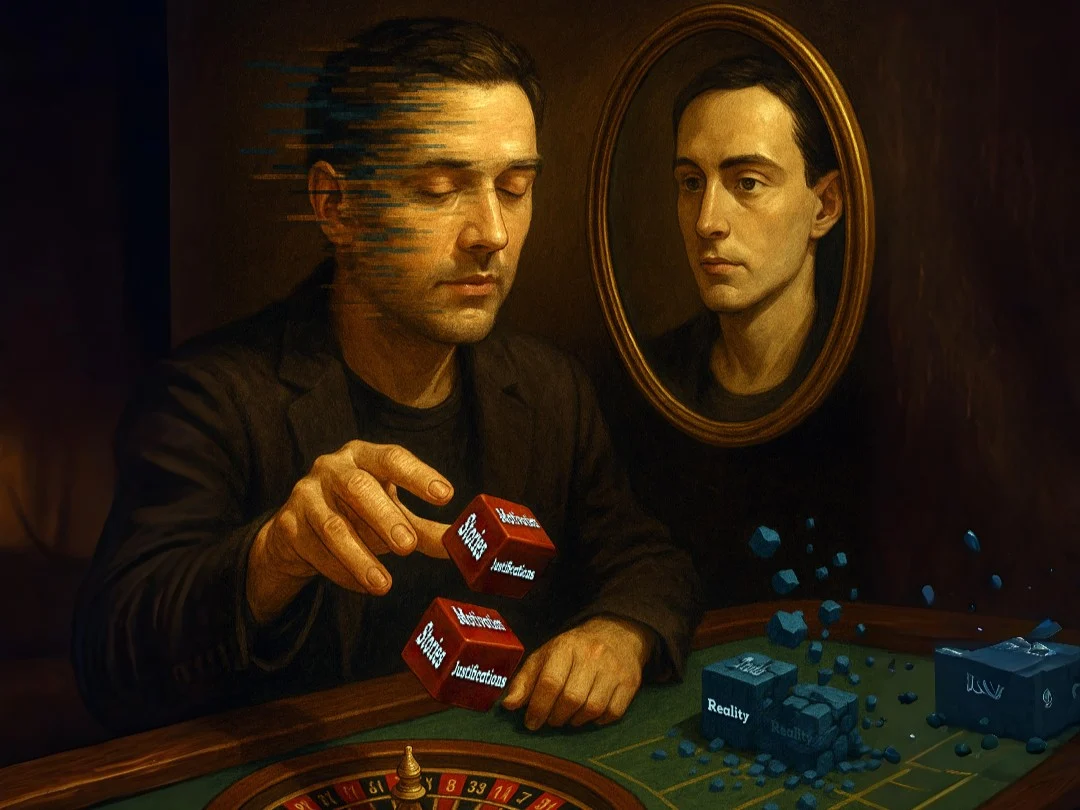
By Guy Hochman
For decades, the bedrock of decision science has been built upon a convenient myth: the notion that humans are fundamentally rational. Economists and psychologists have long oscillated between viewing us as Homo economicus—cold, calculating agents of logic—or Homo heuristicus, efficient, albeit flawed, mental simplifiers.
Yet, as we peel back the layers of cognitive research, neither label captures the complexity of the human experience. We are not merely broken calculators. We are, in fact, Homobiasos: a species defined by our capacity to rationalize with our eyes wide shut. We weave elaborate, coherent narratives to justify our choices, our moral lapses, and our fears, ensuring that even when our decisions are objectively suboptimal, they remain subjectively comfortable.
The Architecture of Rationalization
To understand Homobiasos, one must first dismantle the traditional view of cognitive bias. We often assume that "rational" thinkers are those who rely on analytic, deliberate processes, while those who act on intuition are the ones prone to error.
However, recent research suggests that the divide is not between "logical" and "illogical" minds, but between different methods of narrative construction. When faced with complex choices, we do not simply flip a coin or rely on a singular shortcut. Instead, we engage in what researchers call "motivated coherence." We gather multiple cues, weigh competing explanations, and construct a story that aligns with our desired self-image.
In this light, bias is not a byproduct of laziness or an inability to process information; it is an active, integrative process. We are not passive machines processing data; we are master storytellers, molding the messy facts of reality into a narrative that confirms we are reasonable, moral, and consistent individuals.
Two Minds, One Motive: The Failure of the Dual-System Model
For years, the field of behavioral science has been dominated by dual-system theory, which bifurcates human thought into System 1 (intuitive, fast) and System 2 (deliberative, slow). The prevailing wisdom held that if we could only push people to engage their System 2, we would eliminate bias.
Data from contemporary studies, however, complicates this narrative. Deliberation often acts as a vehicle for distortion rather than a corrective tool. When individuals engage in deep, analytical thinking, they frequently use that time to generate more sophisticated justifications for irrelevant cues, effectively using logic to build a fortress around their poor judgments.
Conversely, relying on intuition can sometimes lead to more accurate outcomes, as it bypasses the "motivated reasoning" that allows us to construct elaborate, self-serving lies. Both systems serve the same master: the psychological need for internal justification. We do not reason to discover the truth; we reason to defend the instincts we have already decided to follow.
Moral Anesthesia: The Psychology of the "Honest" Cheater
Perhaps the most startling manifestation of Homobiasos is found in our moral decision-making. We possess an uncanny ability to cheat, deceive, or behave unethically while maintaining a firm belief in our own integrity.
A recent review of behavioral ethics highlights that most people do not view themselves as corrupt. Instead, they cheat just enough to reap the benefits of dishonesty without triggering a shift in their self-perception. This is achieved through moral rationalization—the psychological equivalent of an anesthetic.
In controlled studies, participants who lied to benefit a charity were found to have lower physiological arousal than those who lied for purely selfish reasons. They were so successful at reframing their dishonesty as "altruism" that they effectively bypassed the typical stress responses associated with lying. This "ethical dissonance" allows us to alter our perception of the act rather than the act itself, protecting our ego from the uncomfortable truth of our behavior. As Friedrich Nietzsche poignantly remarked, "We lie to ourselves more than we lie to others."
The Strategy of Selective Blindness
When reality becomes too difficult to reconcile with our preferred identity, Homobiasos employs a defensive maneuver: motivated ignorance.
In the realm of financial decision-making, for instance, people frequently avoid information that could challenge their sense of competence or fairness. This is not merely a lack of interest; it is an existential coping mechanism. When faced with the complexities of pension systems or economic policies, many choose to remain in the dark.
Admitting uncertainty or systemic failure is an admission of vulnerability. By ignoring uncomfortable data, we preserve our dignity and maintain a sense of equilibrium. Ignorance, in this context, is not a failure of intelligence but a deliberate strategy to maintain the internal coherence of our worldview. As Mark Twain famously quipped, "The truth has no defense against a fool determined to believe a lie."
Anticipatory Anxiety and the AI Age
The same mechanisms that govern our moral and financial choices also dictate how we respond to rapid technological change. Our research into human engagement with Artificial Intelligence reveals a distinct "U-shaped" curve of anxiety.
Moderate engagement with AI tends to reduce fear, while both complete avoidance and total overexposure heighten it. This suggests that our reaction to technology is not a rational assessment of its utility or danger, but an emotional reaction to the threat it poses to our sense of self. We frame our hesitation as "prudence" and our fear as "logical concern," but these are often just masks for a deeper, existential anxiety about our place in a world that is evolving beyond our control.
Implications: The Price of Stability
Why does Homobiasos exist? Why are we so structurally predisposed to favor comfort over accuracy?
The answer lies in the necessity of meaning management. A life lived in constant, objective confrontation with the chaos of reality would be paralyzing. Our biases act as the glue that holds our societies, relationships, and individual identities together. They allow us to function in a world that is inherently contradictory.
The danger, however, is not the existence of these stories, but our refusal to acknowledge that they are stories at all. When we mistake our rationalizations for objective truths, we lose the ability to navigate the world with genuine insight. We become trapped in a feedback loop of our own making, defending narratives that may no longer serve us.
Conclusion: Toward an Honestly Biased Life
To recognize ourselves as Homobiasos is not to succumb to nihilism or to abandon the pursuit of truth. Rather, it is to understand the true nature of human cognition. Our stories are not "bugs" in the system; they are core features of the human experience, designed to keep us whole.
The path forward is not to attempt the impossible task of becoming a perfectly rational, unbiased machine. Instead, it is to cultivate the awareness required to spot when our narratives are comforting us rather than clarifying the situation. We can choose to be more "honestly biased"—aware of our own tendency to rationalize, vigilant about our need for coherence, and willing to occasionally peer through the filters we have constructed.
By accepting that we are, by design, biased storytellers, we reclaim the agency to decide when to open our eyes. In doing so, we move from being captives of our own rationalizations to being architects of a more conscious, if necessarily subjective, existence.
This article was edited by Lachezar Ivanov.
About the Author:
Guy Hochman is an associate professor of behavioral decision-making at Reichman University. He is the founder and former head of the MA program in Behavioral Economics. His research explores moral judgment, the cognitive mechanisms that shape social behavior, and the interplay between intuition and deliberation in high-stakes environments.
 Lina Irawan
  Iffa Jayyana