
 By Dwi Wanna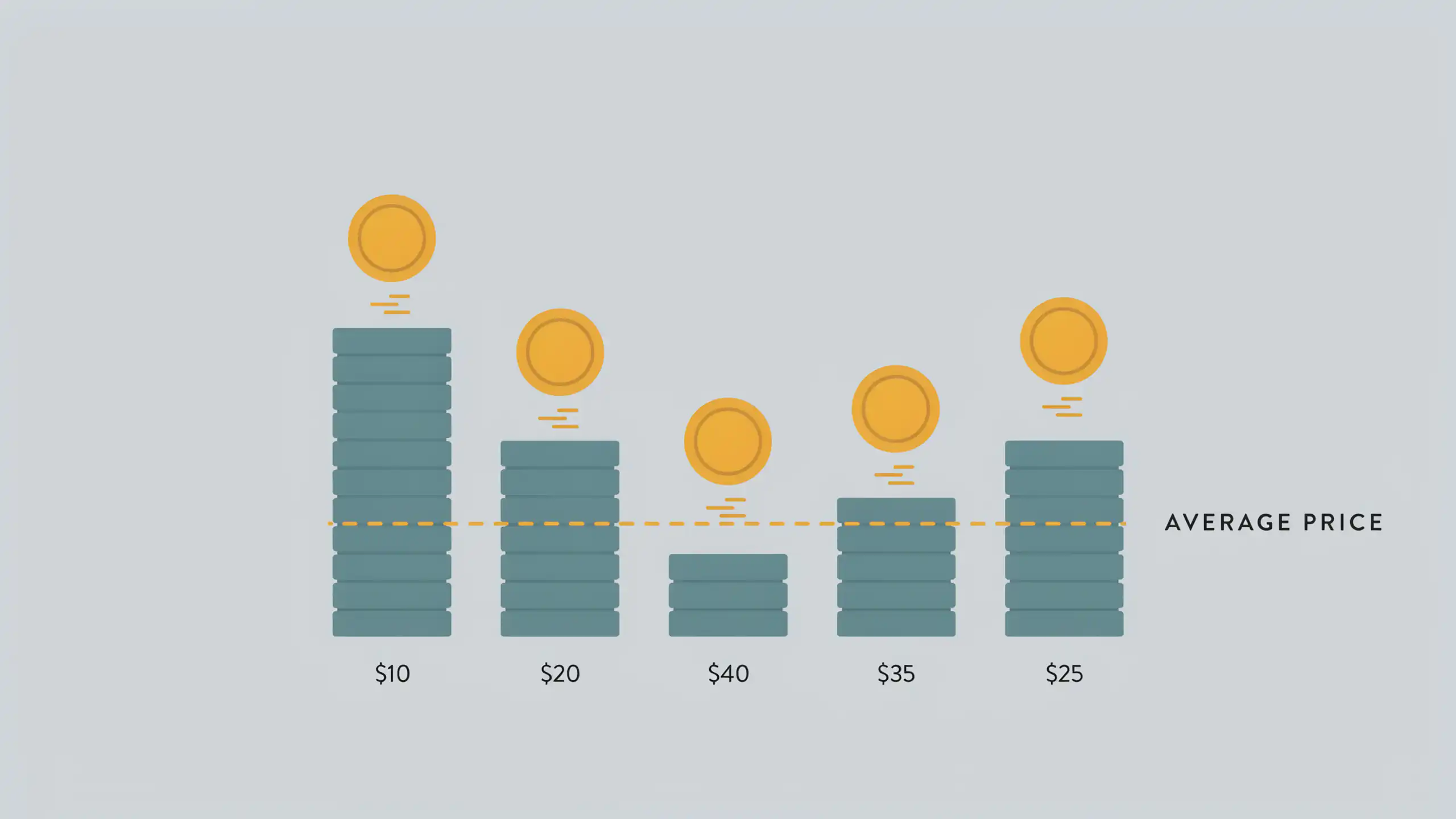
In the volatile theater of global financial markets, the siren song of "market timing"—the attempt to buy at the absolute bottom and sell at the absolute peak—remains one of the most expensive delusions in retail investing. For the average individual, the quest for the "perfect entry point" often leads to a state of analysis paralysis, where capital remains trapped on the sidelines, forfeiting the quiet, compounding power of long-term participation.
The antidote to this anxiety is a time-tested, mathematically elegant strategy known as Dollar-Cost Averaging (DCA). By automating investment contributions regardless of market fluctuations, investors can remove the emotional burden of decision-making, ensuring that they consistently accumulate assets while systematically lowering their average cost per share over time.
Main Facts: The Mechanics of DCA
At its core, Dollar-Cost Averaging is a strategy where an investor commits a fixed dollar amount to a particular investment on a rigid, recurring schedule—regardless of the share price at the time of purchase.
The mechanism is deceptively simple:
- When prices are high: Your fixed dollar amount buys fewer shares.
- When prices are low: Your fixed dollar amount buys more shares.
Over a long enough time horizon, this behavior ensures that you purchase more shares when they are "on sale," effectively lowering your average cost per share relative to the average price of the asset during that same period. It transforms a complex, stressful judgment call into a mechanical "standing order," effectively removing human psychology from the equation.
Chronology: The Evolution of Passive Accumulation
The history of DCA is intertwined with the democratization of the stock market. Before the advent of automated brokerage systems, this strategy required manual effort—writing checks or visiting bank branches to execute trades.
- Mid-20th Century: The concept gained prominence as institutional and retail investors sought ways to mitigate the risk of "lump-sum" investing, where a market crash immediately following a large investment could devastate a portfolio.
- The 1980s and 90s: The rise of the 401(k) retirement plan fundamentally changed the landscape. Millions of American workers began practicing DCA by default, as payroll deductions automatically purchased index funds or target-date funds with every single paycheck, regardless of whether the S&P 500 was hitting record highs or suffering a correction.
- The Modern Digital Era: Today, the "set-it-and-forget-it" model has been perfected by fintech platforms. With the click of a button, modern investors can link bank accounts to brokerage platforms, automating everything from the transfer of funds to the final purchase of broad-market index ETFs.
Supporting Data: Why "Time in the Market" Beats "Timing the Market"
The primary argument against market timing is the high cost of missing out. Historical data consistently shows that missing even a handful of the best trading days in a decade can slash an investor’s total returns by more than half.
The Mathematics of the "Bad Timing" Hedge
Consider a hypothetical scenario: You invest $200 into a fund.
- Month 1: The fund trades at $20/share. Your $200 purchase yields 10 shares.
- Month 2: The market dips, and the fund trades at $16/share. Your $200 purchase now yields 12.5 shares.
By the end of two months, you have accumulated 22.5 shares for a total investment of $400. Had you attempted to "time the market" by waiting for a recovery, you might have sat on the sidelines during the $16 dip, only to buy back in when the price climbed back to $20, thereby acquiring fewer shares for the same amount of capital.
DCA turns market volatility from a source of fear into a tool for accumulation. When prices drop, your fixed budget acts as a bargain-hunter, automatically acquiring more equity. When prices rise, your portfolio value grows, rewarding the patience shown during the down cycles.
Implications: The Behavioral Edge
The most profound impact of Dollar-Cost Averaging is not found in a spreadsheet, but in the investor’s psychology.
Overcoming Paralysis
Market headlines are designed to provoke emotion. Whether it is fear-mongering about a recession or euphoria over a tech bubble, these headlines trigger the "fight or flight" response. DCA functions as a behavioral circuit breaker. When the news cycle turns apocalyptic, the DCA investor does not panic-sell; they follow their standing order. This discipline prevents the two most common errors in investing: buying at the top due to FOMO (Fear Of Missing Out) and selling at the bottom due to panic.
The Power of Automation
The most successful investors are those who remove the "decision" from the process. By tying your investment schedule to your payday, you ensure that your capital is deployed before you have the chance to "spend it" on discretionary items. This creates a "forced savings" effect that is far more effective than trying to save what is left over at the end of the month.
Official Perspectives: Expert Consensus
Financial advisors and fiduciary planners almost universally endorse DCA for retail investors, particularly those building long-term wealth for retirement. While sophisticated traders may employ tactical asset allocation, the consensus for 99% of individual investors is that simplicity wins.
"The best investment strategy is the one you can actually stick to," notes a leading financial analyst. "DCA isn’t about beating the market; it’s about making sure you are in the market long enough for the market to work for you."
Critics sometimes point out that, in a strictly rising market (a "bull run" that never pulls back), lump-sum investing mathematically outperforms DCA because all capital is deployed at the start. However, this relies on the assumption that an investor has the capital available to invest immediately and the nerves of steel to withstand a potential drop immediately after. For the vast majority, the risk of "timing regret" far outweighs the theoretical gain of perfect lump-sum entry.
Implementing Your Strategy: A Five-Minute Blueprint
If you are ready to remove the guesswork from your financial life, follow this proven roadmap:
- Define Your Sustainment Level: Calculate an amount you can afford to invest every month without impacting your emergency fund or ability to pay for essentials. Consistency is more important than the size of the contribution.
- Align with Cash Flow: Automate your transfers to occur on the same day (or the day after) your paycheck hits your bank account. This minimizes the temptation to redirect those funds toward non-essential spending.
- Choose a Broad-Market Vehicle: Avoid the temptation to "pick winners." Select a low-cost, broad-market index fund or ETF. These vehicles provide instant diversification, ensuring that your long-term success is tied to the growth of the entire economy rather than the performance of a single company.
- Enable Automatic Reinvestment: Ensure that dividends and capital gains are automatically reinvested. This accelerates the compounding effect, turning your interest into additional shares that will themselves begin to generate returns.
- Ignore the Noise: Once the system is live, your only job is to do nothing. When the market lurches or the news cycle turns loud, simply let the schedule run. Your future self will thank you for the boredom of your success.
Conclusion: The Quiet Path to Wealth
Wealth creation is rarely the result of a single, brilliant trade. It is the result of thousands of small, disciplined actions repeated over decades. Dollar-Cost Averaging is the ultimate expression of this philosophy. By removing the need to predict the future, you gain the ability to master your own financial behavior. In the high-stakes game of investing, the person who wins is not the one who knows the most about the next trend, but the one who stays the course when everyone else is running for the exit.
Editorial Disclosure: The content provided here is for informational purposes only and does not constitute financial, investment, or tax advice. Always conduct your own research or consult with a certified financial planner before making significant investment decisions.
 Suro Senen
  Jia Lissa
  Muslim