
 By Evan Lee Salim
By Melina Moleskis
Imagine a single mother living in an urban apartment. Her life is a relentless cycle of arithmetic: calculating the cost of electricity against the price of fresh vegetables, juggling school fees, and managing a household in a home where the heating is perpetually inefficient. Every month, she makes a choice that is less of a financial strategy and more of a desperate gamble. Her home is a drain on her resources—leaky windows, outdated appliances, and an aging electrical system—forcing her to pay more for energy than her wealthier counterparts.
As global governments accelerate the race toward net-zero emissions, they are introducing ambitious climate policies intended to modernize infrastructure. Yet, these policies often overlook a critical reality: for millions of households, the "green transition" is not a choice, but an insurmountable barrier. We are witnessing the rise of energy poverty—a systemic failure that leaves the most vulnerable trapped in a cycle of inefficiency. To bridge this gap, policymakers must look beyond spreadsheets and budgets and begin to address the cognitive architecture of poverty itself.
The Challenge of Energy Poverty: A Systemic Inequity
Energy poverty—the inability to secure adequate, affordable, and clean energy—is emerging as one of the defining challenges of the 21st century. It is a paradox of economics: those with the lowest incomes frequently pay the highest relative costs for their energy. This is not due to profligate consumption, but to the "poverty penalty" embedded in their living conditions.
Low-income families are disproportionately likely to reside in poorly insulated, older buildings or rely on inefficient, aging appliances. These structural failures transform energy into a luxury good. When a home lacks proper insulation, the energy used for heating or cooling is effectively wasted, leaking out through walls and windows. The household pays the utility company for comfort they never actually receive. Consequently, these families are trapped in a state of energy insecurity, where the financial burden of basic utility bills consumes the capacity to save, invest, or plan for the future.
The Participation Gap: Why Aid Remains Untapped
Governments have recognized this crisis and have developed an array of countermeasures, ranging from direct income support—unconditional cash transfers meant to bridge the gap during high-inflation periods—to long-term capital grants for building renovations, such as the installation of heat pumps, solar panels, and improved insulation.
The European Union, for instance, is preparing for the 2026 launch of the "Social Climate Fund," an ambitious initiative designed to mitigate the social impacts of the transition to cleaner energy. Yet, historical data presents a sobering reality: there is a profound disconnect between the availability of aid and its actual uptake. In many instances, the programs that could offer a lifeline to the poor are significantly underutilized.
Why do those most in need fail to claim the assistance to which they are entitled? The answer lies not in apathy, but in the psychological toll of scarcity.

Cognitive Scarcity and the Architecture of "Tunneling"
The concept of "cognitive scarcity," pioneered by behavioral economists Sendhil Mullainathan and Eldar Shafir, offers a vital lens through which to view this issue. When an individual is subjected to constant resource deprivation, the human brain undergoes a fundamental shift in its processing capacity.
Financial insecurity creates a constant "cognitive load"—a background hum of anxiety that consumes mental bandwidth. When a person is perpetually worried about rent, food, and emergency medical costs, their executive functions are compromised. This leads to a phenomenon known as "tunneling." Much like a person in a dark room focusing solely on a beam of light, the person in poverty focuses intensely on immediate survival. The long-term benefits of an energy-efficiency grant—even one that could save them thousands of dollars over a decade—become invisible because the brain is fully occupied by the crisis of the next 24 hours.
Research confirms that the mental impact of financial hardship is equivalent to losing an entire night of sleep. This exhaustion makes the process of navigating bureaucracy feel like an insurmountable climb. When faced with complex forms, opaque eligibility criteria, and long wait times—the "hassle factors"—the natural response for a person experiencing cognitive load is procrastination or total withdrawal. They aren’t choosing to lose money; they are choosing to protect their remaining mental energy.
Case Study: The Cyprus Energy Landscape
The situation in Cyprus provides a clear window into the scale of this problem. With approximately 19% of the population living in vulnerable households, the country is a microcosm of the broader European struggle. Despite the existence of government grant schemes designed to alleviate energy costs, participation rates have historically languished near 45%. More than half of those eligible for support never complete the application process.
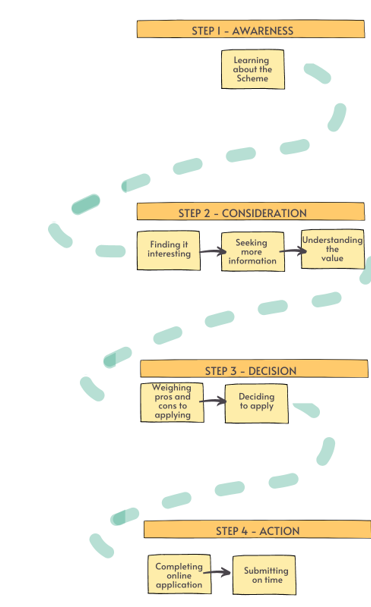
Recent research conducted at the Cyprus Institute, in collaboration with my colleagues Pantelis Solomou, Meltem Ikinci, and Theodoros Zachariadis, mapped the "behavioral journey" of a vulnerable household. By analyzing this journey, we identified that the path to assistance is littered with both structural and behavioral roadblocks.
The Four-Step Journey to Assistance
- Awareness: Does the household even know the scheme exists?
- Consideration: Does the individual believe the effort required is worth the potential reward?
- Application: Can the individual navigate the documentation and bureaucracy?
- Verification and Receipt: Does the system provide clear feedback and timely disbursement?
At every stage, the "hassle factor" acts as a filter, systematically excluding those with the least capacity to navigate complexity.
Implications for Policy: Moving Beyond "More Funding"
The data suggests that simply increasing the size of grants will not solve the participation gap. If the application process remains a "cognitive tax," only those with the time and mental bandwidth to navigate it will benefit—further exacerbating inequality.
To create a just, green transition, policymakers must adopt a "behaviorally informed" approach. This involves three primary shifts in strategy:
1. Reducing Hassle and Cognitive Load
Instead of requiring applicants to master complex technical documents, governments should simplify the journey. "Passport pages"—single-sheet executive summaries that distill key points—can significantly reduce information overload. Furthermore, pre-populating application forms with data already held by the government can turn a daunting task into a simple verification step.
2. Framing and Loss Aversion
Behavioral science shows that humans are more motivated by the fear of loss than the promise of gain. Communicating the cost of not participating in a scheme is often more effective than highlighting the potential savings. For example, framing a message as, "By not installing solar panels, your household loses €50 per month," is psychologically more potent than saying, "You can save €50 per month."
3. Leveraging Social Proof and Norms
The stigma associated with receiving state aid can be a major barrier. Replacing detached, bureaucratic communication with community-based discussions allows for the organic development of positive social norms. By highlighting the success stories of neighbors who have successfully navigated the process, policymakers can build trust and provide a sense of in-group identity, making the leap to apply feel safer and more attainable.
The Path Toward a Just Transition
The transition to a sustainable economy is not merely a technical challenge of retrofitting buildings or decarbonizing the grid; it is a human challenge. If we continue to design policy based on the assumption that individuals have infinite time, energy, and mental bandwidth, we will inevitably leave the most vulnerable behind.
The findings from our work in Cyprus and beyond indicate that the most effective solutions are often the most cost-effective. By recognizing the reality of cognitive scarcity, governments can make small, structural adjustments to their programs—simplifying language, reducing paperwork, and framing choices in ways that align with human psychology.
We are currently at a crossroads. As we invest billions in the green infrastructure of the future, we must ensure that the "social" side of the climate transition is not treated as an afterthought. By integrating behavioral insights into the heart of energy policy, we can transform the system from a barrier into a gateway, ensuring that the transition to a greener world is also a transition to a more equitable one.
The goal is clear: we must stop asking the vulnerable to adapt to our systems and start building systems that respect the reality of their lives. Only then can we truly claim that the green transition is for everyone.
 Muslim
  Raul Delapena Setiawan