
 By Muslim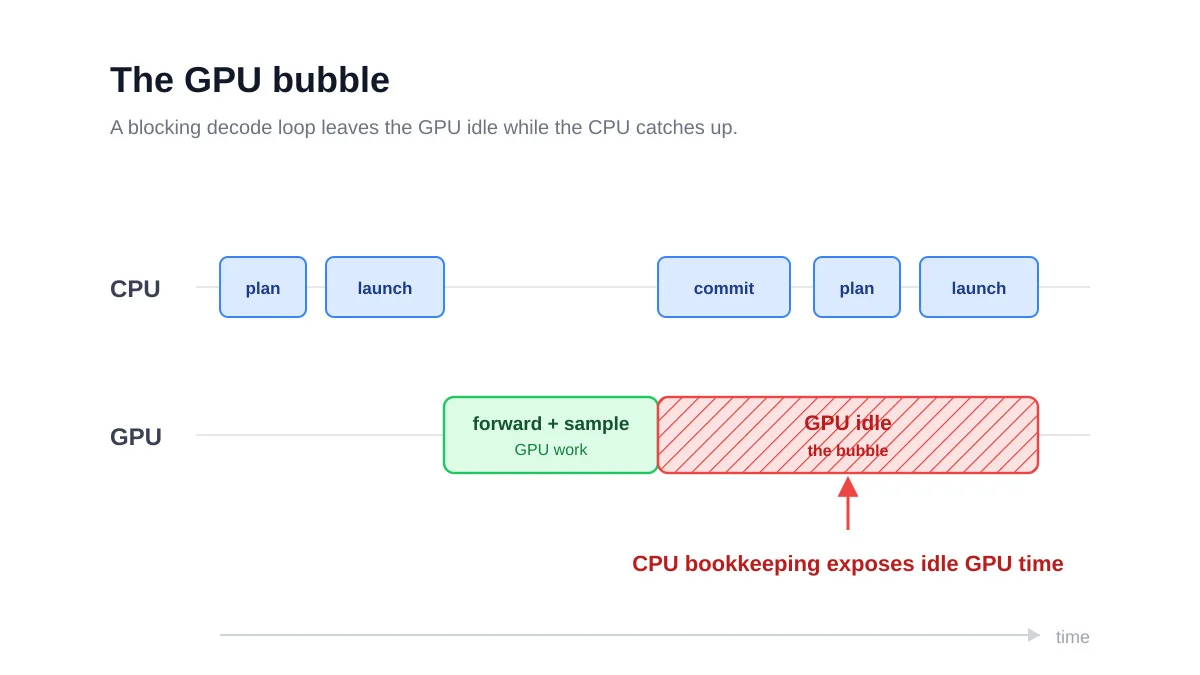
June 4, 2026 — In the high-stakes arena of Large Vision-Language Models (VLMs), speed is the ultimate currency. As AI applications move from experimental chatbots to critical infrastructure—powering everything from real-time industrial visual inspection to rapid-response automated assistants—the latency of model inference has become a primary bottleneck. Today, Moondream Engineering officially unveiled the inner workings of "Photon," its bespoke inference engine, which achieves near-realtime performance, clocking in at approximately 33ms per inference step on NVIDIA’s flagship B200 GPU.
The breakthrough, which delivers up to 35% higher decode throughput, is not the result of a single hardware upgrade, but rather an obsessive, low-level architectural refinement focused on a pervasive, silent killer of AI performance: the "GPU bubble."
The GPU Bubble: A Problem of Synchronization
To the uninitiated, running an AI model seems straightforward: feed data to the GPU, let it perform the necessary matrix multiplications, and receive the output. However, Moondream engineers argue that this view ignores the reality of the CPU-GPU handshake.
In standard inference environments, the GPU frequently sits idle. This is not due to a lack of computational work, but rather because the CPU—responsible for orchestration, metadata management, and token selection—has not yet prepared the next set of instructions. This period of inactivity is referred to as a "GPU bubble."
"The GPU handles the heavy lifting, performing billions of arithmetic operations to produce a single token," the Moondream engineering team explains. "But there is a surprising amount of work done by the CPU: selecting which requests to run, setting up metadata, and recording the token. Because one token’s worth of GPU work is relatively small, the fixed cost of CPU housekeeping creates a delay in every loop."
In a traditional blocking model, the CPU and GPU operate in a "baton pass" rhythm. The CPU plans and launches a forward pass, the GPU executes, the CPU synchronizes, waits for results, commits them, and only then starts planning the next step. This sequential dependency prevents the hardware from operating at peak efficiency.
The Chronology of Optimization: Pipelined Decoding
The Moondream team’s solution is a technique known as "pipelined decoding." The goal is simple in concept but daunting in execution: overlap the CPU housekeeping with the GPU’s computational cycles.
Phase 1: The Ping-Pong Slot Architecture
To eliminate the idle time, Photon utilizes "ping-pong slots." By maintaining two sets of memory buffers (page-locked host buffers), the system can alternate between them. While the GPU is busy processing the forward pass for one request in the first slot, the CPU is simultaneously committing the results from the second slot.
This requires sophisticated buffer management. Because these buffers are reused, the system avoids costly runtime memory allocations, which would otherwise trigger device synchronization and introduce further bubbles. By utilizing fixed buffer addresses, Photon can capture the decode step as a CUDA graph and replay it, drastically reducing kernel launch overhead.
Phase 2: Forward Now, Sample Later
The second major hurdle for pipelining is the dependency inherent in constrained decoding. In models like Moondream, which produce structured output—such as coordinates for object detection or segment boundaries—the model must follow specific rules for token generation.
Photon decouples the forward pass from the sampling process. By allowing the GPU to run the next forward pass before the CPU has fully finalized the previous token’s constraints, the system ensures that the compute-heavy forward pass is never waiting on the CPU’s "sampling mask" calculations.
Phase 3: Zombie Refcounting
Perhaps the most elegant solution introduced is the handling of "zombies." In a pipelined system, a request might be flagged as finished while its "forward pass" is already queued in the GPU pipeline. Instead of implementing complex and error-prone cancellation logic, Photon treats these as "zombies." The finished sequence remains in the pipeline, riding along harmlessly until the reference count hits zero, at which point the memory is reclaimed. This allows for a smooth, high-throughput flow without the overhead of mid-flight sequence management.
Supporting Data: Benchmarking the Gains
The efficacy of these optimizations is evidenced by the performance delta between blocking and pipelined architectures. Moondream’s internal benchmarks demonstrate that as the complexity and scale of the hardware increase, the gains from pipelining grow exponentially.
On an NVIDIA 3090, the throughput improvements are modest, around 6% to 11%. However, on the enterprise-grade NVIDIA B200, the performance gains jump to between 17% and 35%.
| Hardware/Stream Config | Blocking (ms) | Pipelined (ms) | Improvement |
|---|---|---|---|
| 3090 · 1 stream | 5.44 | 5.10 | +6.5% |
| 3090 · 32 streams | 11.74 | 10.52 | +11.6% |
| B200 · 1 stream | 3.11 | 2.63 | +17.6% |
| B200 · 32 streams | 5.55 | 3.98 | +35.4% |
These figures confirm that the "zombie tax"—the cost of running a finished request for one extra step—is negligible compared to the massive throughput gains achieved by keeping the GPU continuously active.
Implications for the AI Industry
The implications of the Photon engine extend far beyond Moondream’s own models. The software-defined optimization approach highlights a growing trend in AI engineering: as hardware performance reaches a plateau, the focus is shifting toward "stack efficiency."
Industry analysts suggest that Moondream’s work proves that many current inference engines are "leaving performance on the table" by failing to address the fundamental mismatch between CPU control logic and GPU throughput. By minimizing the "bubble," companies can significantly reduce their cloud infrastructure costs or, conversely, increase the number of concurrent users supported by the same hardware footprint.
Furthermore, the ability to integrate prefill and decode tasks into the same pipeline ensures that short-request workloads—common in modern vision-language applications—do not suffer from serialization bottlenecks.
Official Response and Future Outlook
"Photon isn’t fast because of this one technique," the Moondream team noted in their official blog post. "It’s fast because dozens of these details compound across the serving stack. It’s about how we resize and tile images, the kernels that run the model, and the synchronization points we remove from the hot path."
Looking ahead, Moondream has hinted at the upcoming release of "Photon 2.0." While details remain under strict embargo, the company has characterized it as a "big one," suggesting that the next iteration of the engine may focus on even deeper hardware-software co-design.
For developers and enterprises currently struggling with the latency trade-offs of modern VLMs, the success of Photon serves as a roadmap. The era of treating inference engines as black boxes is coming to an end; the future of AI performance lies in the granular, millisecond-by-millisecond orchestration of the GPU pipeline. By refusing to let the GPU wait, Moondream is setting a new standard for how fast, responsive AI can actually be.
 Evan Lee Salim
  Asro
Asro  Pevita Pearce