
 By Azzam Bilal Chamdy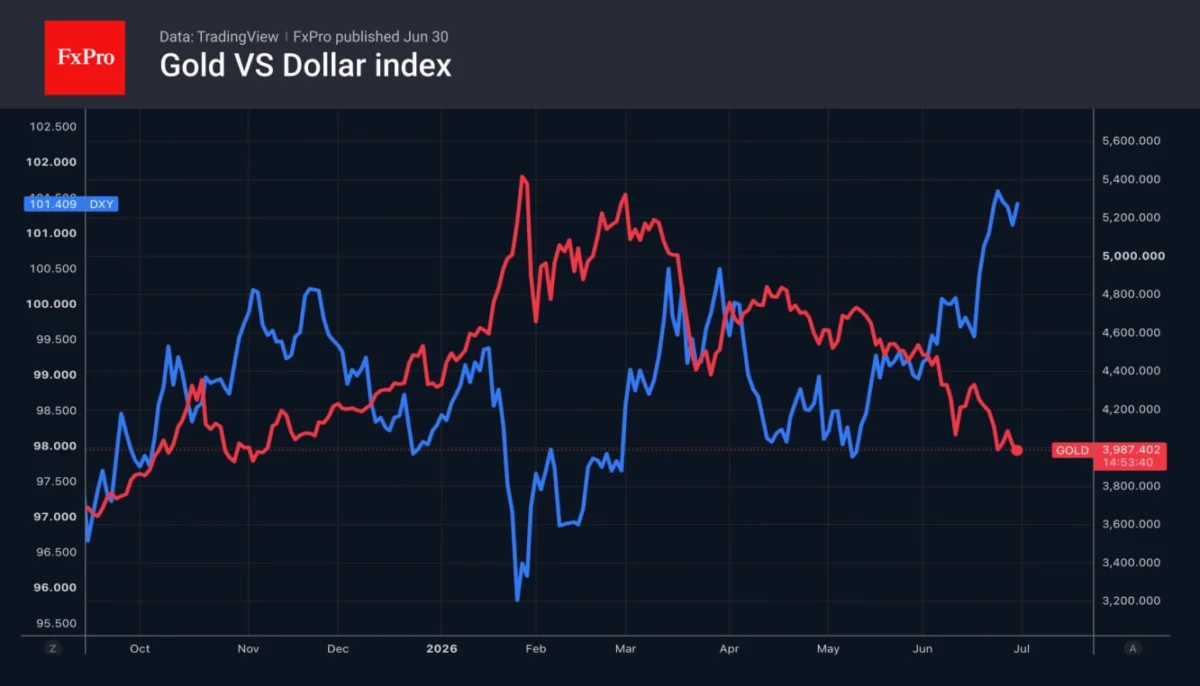
The global financial landscape witnessed a significant pivot this week as the US dollar snapped a three-day losing streak, reclaiming its position as the dominant force in international currency markets. This resurgence, driven by a convergence of geopolitical volatility, institutional stability, and a fundamental shift in Federal Reserve communication strategies, has sent shockwaves through commodities, most notably gold. As investors recalibrate their risk profiles, the interplay between the "greenback" and precious metals has become the focal point of a market increasingly wary of systemic uncertainty.
Main Facts: A Triad of Market Drivers
The strengthening of the US dollar is not the result of a single catalyst, but rather the intersection of three distinct pillars of market sentiment.
First, there is a renewed appreciation for Federal Reserve independence. Recent legal developments have underscored the autonomy of the central bank, insulating it from potential political encroachment that could have compromised its mandate. Second, the geopolitical situation in the Middle East has intensified. The hardening stance of Iran regarding the Strait of Hormuz—a vital artery for global energy transit—has forced capital into traditional safe-haven assets, with the dollar serving as the primary beneficiary. Finally, anticipation surrounding Kevin Warsh’s policy address in Sintra, Portugal, has dominated trader discourse. Warsh’s perceived philosophy—prioritizing decisive action over verbal intervention—has redefined expectations for monetary policy, providing a structural tailwind for the dollar.
Chronology: The Week in Review
- Early Week: The US dollar experienced a slight retracement as markets processed ambiguous signals regarding the Fed’s September trajectory.
- Mid-Week: The US Supreme Court issued a landmark ruling, effectively barring the White House from dismissing Lisa Cook from the Federal Reserve Board of Governors. This decision was interpreted by analysts as a victory for institutional continuity, preventing a shift toward a more dovish, politically influenced policy committee.
- Thursday: Tensions in the Middle East spiked following the collapse of initial de-escalation talks. Iran’s insistence on maintaining control over the Strait of Hormuz signaled an escalation in risk, triggering an immediate flight to quality.
- Friday: Market focus shifted to the upcoming Sintra forum. As Treasury yields climbed, the dollar accelerated its gains, while gold—the non-yielding competitor—suffered a sharp contraction in demand.
Supporting Data and Market Metrics
The mechanics behind these movements are rooted in shifting probability models. Just one week ago, the probability of a monetary tightening cycle in September stood at a robust 70%. That figure has since retreated to 62%. Similarly, the market’s conviction regarding two federal funds rate hikes in 2026 has softened, falling from 50% to 38%.
Despite these lower expectations for immediate rate hikes, gold has struggled to maintain its footing. The reason lies in the "persistence factor." Investors are no longer betting on the magnitude of near-term hikes; instead, they are pricing in the reality that interest rates will remain "higher for longer." Because gold pays no interest, the opportunity cost of holding the metal increases in an environment where Treasury yields remain elevated. Consequently, gold has retreated below the psychological $4,000-per-ounce threshold, with some market bears projecting a potential slide toward $3,600 before a floor is established.

Official Responses and Strategic Shifts
The most profound change in the current financial climate is the "Fed’s new reticence." Under the guidance of figures like Kevin Warsh, the Federal Reserve appears to be transitioning away from the era of "forward guidance" verbosity that characterized the post-pandemic recovery.
Warsh’s mantra—that the Fed should talk less and act more—represents a philosophical departure from the central bank’s recent history. By allowing the markets to dictate the signal for rates rather than the central bank dictating to the markets, the Fed is essentially stripping away the safety net of clear communication. While this reduces the risk of mismanaged market expectations, it simultaneously increases "noise" and uncertainty.
In response, the market is demanding a higher risk premium for debt instruments. This shift toward a more opaque, action-oriented Fed has heightened the volatility in Treasury yields, creating a secondary effect that strengthens the dollar while putting systemic pressure on commodity valuations.
Implications for the Global Economy
Geopolitical Fragility and the Safe-Haven Premium
The current stalemate in the Middle East is perhaps the most dangerous variable in the global outlook. The Strait of Hormuz represents a strategic choke point; any disruption to shipping lanes there would have immediate, inflationary consequences for energy prices. However, the paradox of the current situation is that while higher oil prices usually trigger inflationary fears, the market is currently more preoccupied with the "Dollar-as-Safety" narrative. Investors are prioritizing liquidity and political stability over the potential for supply-side commodity shocks.
The Institutional Integrity of the Fed
The Supreme Court’s intervention regarding the composition of the Fed’s Board of Governors cannot be overstated. Had the executive branch succeeded in replacing key personnel with more dovish appointees, the markets would likely have priced in a "politicized Fed." Such a scenario would have undoubtedly weakened the dollar, as investors would have feared the abandonment of inflation-fighting discipline in favor of electoral cycles. By preserving the status quo, the Court has provided the dollar with a structural foundation of credibility that is currently absent in many other major fiat currencies.

Gold: Bulls vs. Bears
The outlook for gold remains bifurcated. The "Bulls" maintain that gold is a necessary hedge against the long-term volatility introduced by the Fed’s new, more reticent stance. They argue that as the "higher for longer" narrative eventually reaches a breaking point, the intrinsic value of gold will reassert itself.
Conversely, the "Bears" are focused on the immediate technical data. They note that the break below $4,000 is a significant psychological hurdle that could lead to a cascading sell-off. For these traders, the path of least resistance is toward the $3,600 mark, where they anticipate renewed institutional buying interest.
Conclusion: A New Era of Market Discipline
The US dollar’s resurgence serves as a reminder that currency strength is deeply tethered to institutional predictability. While the geopolitical landscape remains fraught with danger and the Federal Reserve’s communication strategy is undergoing a period of experimental silence, the market is signaling a preference for stability.
As we look toward the remainder of the year, the interplay between Treasury yields, the Fed’s policy "action over words" approach, and the geopolitical risk premium will define the investment landscape. For now, the dollar remains the primary arbiter of value, forcing other asset classes—particularly precious metals—to find new equilibrium points in a world where the safety of the greenback remains the ultimate currency of influence.
Reporting provided by the FxPro Analyst Team.
 Nana
Nana  Nana Muazin
  Reynand Wu