
 By Jia Lissa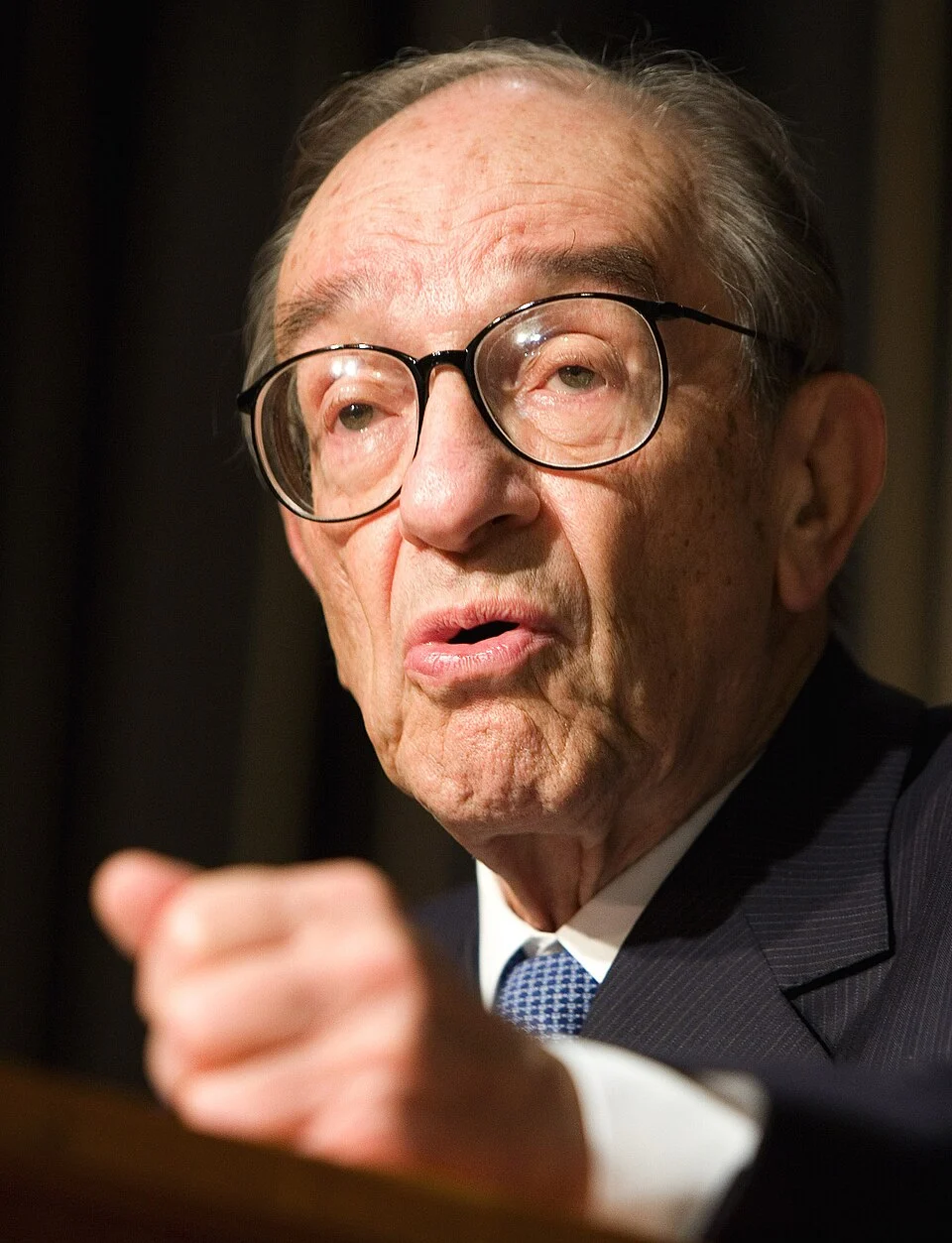
The global financial community is mourning the loss of Alan Greenspan, the long-standing Chairman of the Federal Reserve who passed away this week at the age of 100. For nearly two decades, from 1987 to 2006, Greenspan occupied the most influential seat in the world of finance. To a generation of market participants, he was more than a central banker; he was an enigma, a maestro of monetary policy whose every cryptic utterance could send the Dow Jones into a tailspin or trigger a rally. As we reflect on his century-long life, it is impossible to ignore the resonance of his work—specifically his warnings about market psychology—within our current, AI-fueled investment landscape.
The Architect of Monetary Policy: A Chronology
Alan Greenspan’s tenure spanned five U.S. presidential administrations, surviving the 1987 stock market crash, the 1990s dot-com boom, and the early tremors of the 2008 financial crisis. His career was defined by a shift from the rigid, rule-based monetary policy of his predecessors to a more pragmatic, data-driven approach that often relied on his personal intuition.
- 1987: Greenspan is appointed Chair of the Federal Reserve Board by President Ronald Reagan, just months before the infamous "Black Monday" market crash. His decisive, calm response to the liquidity crisis cemented his reputation as a steady hand.
- 1996: Greenspan delivers his seminal "The Challenge of Central Banking in a Democratic Society" speech, introducing the world to the concept of "irrational exuberance."
- 1999: Amid the height of the dot-com fever, Greenspan famously equates tech stock speculation to the lottery, warning that the vast majority of companies would fail, even as the market reached dizzying new heights.
- 2006: After nearly 20 years at the helm, Greenspan retires, leaving behind a legacy that is simultaneously celebrated for the era of low inflation and criticized for the long-term impact of his "easy money" policies.
The Linguistic Art of Obfuscation
Greenspan was legendary for his, at times, impenetrable speaking style. His ability to provide testimony to Congress that left even the most seasoned analysts guessing was a deliberate tool of the trade. As his wife, veteran NBC correspondent Andrea Mitchell, once famously joked, their courtship was complicated by his inability to be direct. "He claims he proposed three times before I was able to understand," Mitchell once remarked. "He was so oblique. It was like his testimony."
This obliqueness was not a personal quirk; it was a strategic barrier. By speaking in "Greenspan-speak," he ensured that the Federal Reserve remained unpredictable, preventing market participants from front-running his interest rate decisions. However, his most famous contribution to the lexicon was strikingly clear. In his 1996 address to the American Enterprise Institute, he asked: "How do we know when irrational exuberance has unduly escalated asset values, which then become subject to unexpected and prolonged contractions?"
The Shift to a Knowledge-Based Economy
Greenspan’s 1996 warning was not merely about stock prices; it was a profound observation regarding the changing nature of value. He noted that the industrial economy, defined by physical goods and tangible assets, had been eclipsed by an economy driven by software and intangible services.
"What is the price of a unit of software or a legal opinion?" he mused. This fundamental uncertainty—the difficulty of applying traditional unit-economics to assets that did not exist in the physical realm—is exactly what fueled the dot-com bubble. When the value of a company is tied to future potential rather than current cash flows, the window for "irrational exuberance" opens wide.
The Dot-Com Lessons: Winners and Losers
The late 1990s provided a visceral case study for Greenspan’s concerns. The period saw companies like Webvan and Pets.com achieve valuations that defied conventional logic, only to collapse when the capital markets dried up. Nortel Networks, once the darling of the Canadian tech sector, saw its market capitalization evaporate almost overnight.
Yet, as history has shown, the "irrationality" of the bubble masked the birth of a new reality. While the companies that failed are now footnotes in business textbooks, the companies that survived—Google, Amazon, and their peers—have fundamentally reshaped the global economy. Together, these titans now command a combined market capitalization nearing $8 trillion, proving that while the valuation may have been exuberant, the underlying technology was transformative.

The Lottery Analogy: Still Applicable?
In 1999, when pressed about the meteoric rise of internet stocks, Greenspan drew an analogy to the lottery. He argued that investors were paying for the remote possibility of hitting a jackpot, even when the odds of success were mathematically dismal. He was correct; most of the internet startups of the 90s were destined for failure.
Today, we see a striking parallel in the Artificial Intelligence sector. Investors are pouring billions into startups that are, in many cases, not yet profitable. The "AI mania" mirrors the dot-com era in its intensity and its reliance on the "future potential" of a transformative technology.
However, there is a critical distinction. The modern AI landscape is populated by giants. Unlike the small-cap dot-coms that Greenspan was referring to in 1999, the current leaders in the AI space are established behemoths. Companies like OpenAI and Anthropic are not operating in a vacuum; they are backed by the world’s largest tech conglomerates. Furthermore, private entities like SpaceX, now one of the most valuable companies in the U.S., suggest that we have moved past the era of "speculative startups" into an era of "capital-intensive infrastructure."
Official Perspectives and Market Implications
The debate over whether we are currently in a bubble remains the central tension of modern finance. While some market analysts echo Greenspan’s caution, citing price-to-earnings ratios that are historically elevated, others argue that AI represents a productivity paradigm shift that justifies these premiums.
The Federal Reserve, post-Greenspan, has moved toward greater transparency, but the fundamental challenge identified by the late chairman—the difficulty of valuing intangible assets—remains unresolved. If Greenspan were with us today, looking at the multi-billion-dollar valuations of OpenAI ($852 billion) and Anthropic ($965 billion), he would likely refrain from giving a binary answer.
Conclusion: The Oracle’s Final Lesson
Alan Greenspan’s legacy is not that he could predict the future, but that he understood the limits of our ability to measure it. His life and career serve as a reminder that markets are driven as much by human psychology as they are by economic data. As we navigate the complexities of the current AI-driven bull market, his warnings about "irrational exuberance" remain as relevant today as they were thirty years ago.
Whether we are on the verge of a new, sustained industrial revolution or a catastrophic correction, the lesson of the Greenspan era is clear: value is a moving target, and when the narrative of progress outpaces the reality of balance sheets, the market eventually finds its equilibrium—often at a painful cost. Perhaps, as we face these new, stratospheric asset levels, the most appropriate response is the one Greenspan would likely have provided: a long, thoughtful, and thoroughly cryptic pause.
 Dwi Wanna
  Siti Muinah
  Nana
Nana 