
 By Nila Kartika Wati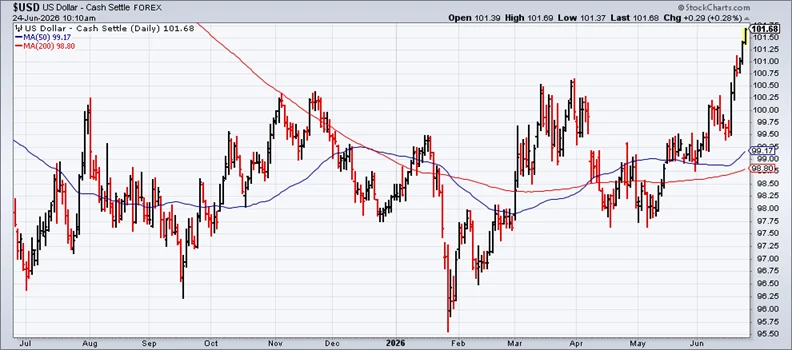
The geopolitical volatility that defined the early months of this year may have reached a tentative resolution, but the structural scars left on global financial markets remain deep. For the American investor, the post-conflict landscape for foreign bonds has been characterized by a persistent and punishing environment. A comprehensive analysis of Exchange Traded Fund (ETF) performance from the onset of the conflict on February 28 through the close of markets on June 23 reveals a sobering reality: foreign fixed-income assets are currently caught in the crossfire of a resurgent US dollar and escalating domestic inflationary pressures.
While the broader bond market has struggled to find its footing, the divergence in asset performance highlights a complex interplay between currency valuation, interest rate expectations, and the lingering "safe-haven" status of the greenback.
The Market Landscape: A Divergence of Fortunes
Since the dawn of the conflict in late February, the narrative for foreign bonds has been largely one of contraction. As US investors rebalanced portfolios amidst global uncertainty, the majority of offshore bond segments have seen their valuations erode.
However, the sector has not been monolithic in its decline. A striking exception has emerged in the form of high-yield fixed-income securities issued in emerging markets. The VanEck Emerging Markets High Yield Bond ETF (HYEM) has managed to buck the prevailing bearish trend, recording a gain of 1.8% over the period from February 28 to June 23.
This modest advance stands in stark contrast to the broader carnage across the fixed-income landscape. Developed-market government bonds, particularly those with intermediate maturities, have faced significant headwinds, suffering a 5.2% decline. Even the bedrock of conservative portfolios—US investment-grade bonds—has failed to provide shelter, shedding 1.3% over the same timeframe. This uniform weakness underscores the severity of the macroeconomic pressures currently acting upon fixed-income instruments.
The Currency Conundrum: The Dominance of the Greenback
The primary engine behind the weakness in foreign bonds is the sheer strength of the US dollar. In the realm of international investing, currency valuation acts as a multiplier; when the greenback appreciates, the value of foreign-denominated assets—when translated back into US dollar terms—inevitably diminishes.
The "currency hit" has intensified significantly in recent weeks. The US Dollar Index (DXY), which tracks the currency against a basket of major global peers, surged to a 13-month high on June 23. This rally is not merely a technical movement but a reflection of deep-seated shifts in global capital flows.

The Safe-Haven Rebound
Despite years of speculation regarding the erosion of the dollar’s global dominance, the events of the past four months have reaffirmed its role as the ultimate refuge. In times of geopolitical uncertainty, capital naturally migrates toward the liquidity and stability of US assets. Even as the immediate conflict subsided, the momentum behind the dollar remained, suggesting that institutional investors still perceive the US financial system as the primary bulwark against global instability.
Chronology of the Conflict and Financial Impact
To understand the current state of the market, one must look at the timeline of events that have shaped investor sentiment:
- February 28: Conflict begins. Initial market reactions are characterized by extreme volatility and a "flight to quality," triggering the first wave of capital outflow from emerging markets into dollar-denominated cash equivalents.
- March–April: Markets grapple with the realization that the conflict will have prolonged supply chain disruptions. Inflationary expectations begin to tick upward, setting the stage for hawkish rhetoric from the Federal Reserve.
- May: The US Dollar Index begins its steady ascent as the Federal Reserve signals a departure from its previously accommodative stance, catching many international bond holders off-guard.
- June 23: The DXY hits a 13-month high. Data reveals the stark divergence between high-yield emerging market bonds (which maintained marginal gains) and traditional government bonds, confirming the risk-off sentiment dominating the mid-year landscape.
The Inflationary Catalyst: The Federal Reserve’s Hawkish Pivot
Beyond the dollar’s safe-haven status, a fundamental shift in US monetary policy is driving capital away from bonds. The persistence of "hot" inflation data has effectively forced the hand of the Federal Reserve. Market participants are increasingly betting that the central bank will be compelled to maintain higher interest rates for a longer duration to temper consumer prices.
Bank of America’s Projections
The institutional outlook remains decidedly hawkish. Bank of America has signaled that the current Fed funds target range of 3.50%–3.75% is likely insufficient to combat current price indices. Analysts at the firm are projecting a target range of 4.25%–4.50% by the end of the year.
This outlook is bolstered by the composition of the Federal Open Market Committee (FOMC). Nine of the 18 FOMC members have expressed support for at least one additional rate increase in 2026. This consensus, coupled with the debut of Fed Chair Kevin Warsh, has fundamentally reset market expectations.
Official Responses and Expert Analysis
The debut press conference of Fed Chair Kevin Warsh served as a watershed moment for market communication. His rhetoric was perceived as "unambiguously hawkish," signaling that the Fed is no longer merely reacting to data but is taking a proactive stance on anchoring inflation expectations.
Christopher Hodge, chief US economist at Natixis, provided a sobering assessment of the new leadership style in a recent commentary. Hodge noted that Warsh "doubled down on the notion that ‘inflation is a choice.’" According to Hodge, this indicates that the Fed is undergoing a significant transition in its internal process, analysis, and communication strategies.

"It is clear that inflation will be the focus for the Fed in the near term," Hodge observed. "The shift in rhetoric suggests that the era of policy ambiguity is over, and the era of aggressive inflation management has begun."
Implications for the Global Investor
The current environment presents a challenging puzzle for fixed-income managers. The traditional correlation between bonds and stability has been disrupted by the strength of the dollar and the aggressive posture of the US central bank.
1. The Fragility of Relief
For bondholders—both in the US and international markets—the prospect of near-term relief remains fragile. Until the markets are satisfied that the risk of runaway inflation is fully contained, bond prices will likely remain under pressure. The sensitivity of the market to every new CPI or PPI report suggests that volatility will be the defining characteristic of the coming quarter.
2. The Case for Emerging Market High-Yield
The resilience of the VanEck Emerging Markets High Yield Bond ETF offers a glimpse into how investors are adapting. By pivoting toward high-yield instruments, investors are seeking to offset currency-related losses through higher coupon payments. While this strategy carries its own risks—specifically credit risk—it represents a tactical shift away from the interest-rate sensitivity that has decimated traditional government bond portfolios.
3. Structural Realignments
The rise of the US dollar to 13-month highs indicates that global liquidity is being pulled back into the American orbit. International bond issuers will find it increasingly expensive to service dollar-denominated debt, which may lead to a bifurcation in the market between nations with robust foreign exchange reserves and those susceptible to external debt shocks.
Conclusion
The aftermath of the recent Middle East conflict has served as a stress test for the global financial order. The resulting performance of foreign bonds—marked by broad declines and a desperate search for yield—reflects a world where the US dollar remains the dominant force. As the Federal Reserve moves to solidify its hawkish stance and investors brace for sustained inflationary pressures, the fixed-income market will require a high degree of discernment. For the foreseeable future, the "safe" path of traditional government bonds remains obstructed by the twin forces of a surging dollar and a central bank determined to prioritize inflation control above all else. Investors should prepare for a period of ongoing volatility, where the traditional rules of portfolio construction are being rewritten in real-time.
 rifanmuazin
  Ali Ikhwan
  Nana
Nana 