
 By Muslim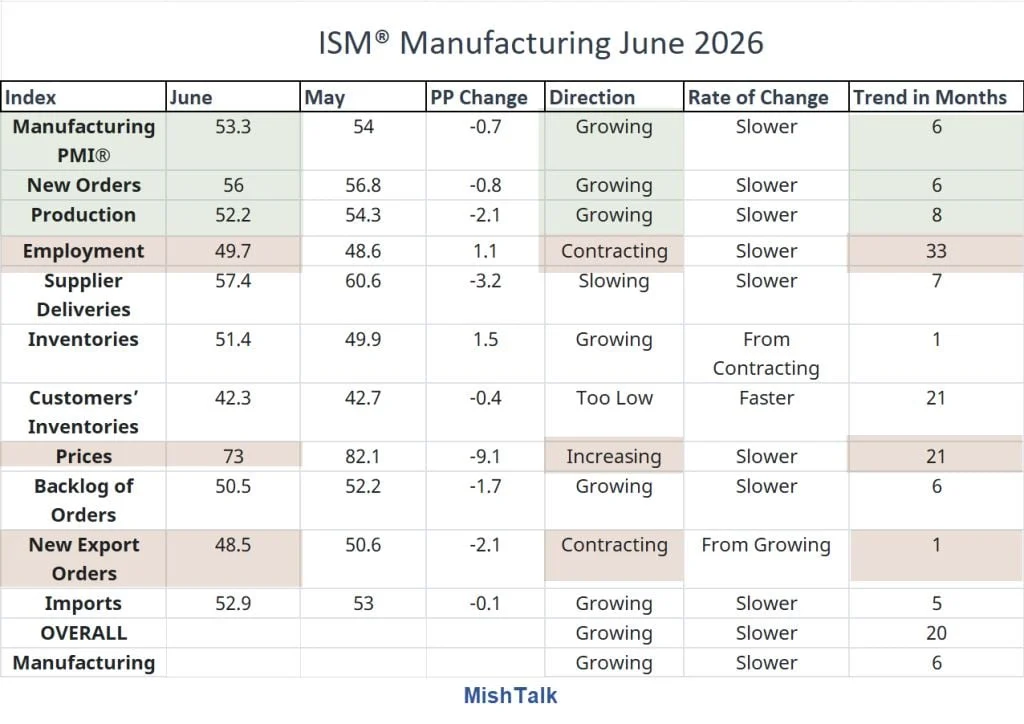
The U.S. manufacturing sector continues to navigate a complex economic landscape marked by decelerating growth, persistent supply-side inflation, and stagnant employment. According to the June 2026 Institute for Supply Management (ISM) Manufacturing PMI report, while the industrial economy remains in expansionary territory, underlying structural challenges—compounded by aggressive trade policies and geopolitical disruptions—are beginning to test the resilience of American factories.
The latest data paints a picture of an economy characterized by positive but weakening production, chronically high input costs, and anemic export performance. While some analysts argue that the current economic phase avoids the worst-case scenario of stagflation, others warn that the combination of stagnant hiring and relentless price pressures signals deep-seated vulnerabilities.
1. Main Facts: The June 2026 ISM Report at a Glance
The manufacturing sector expanded in June for the 20th consecutive month, though at a slightly slower pace than in previous months. The headline Manufacturing PMI registered 53.3 percent, representing a decline of 0.7 percentage points from the 54.0 percent recorded in May. In the ISM’s methodology, any reading above 50.0 percent indicates growth in the manufacturing sector, while a reading above 47.5 percent over a sustained period generally signals an expansion of the broader U.S. economy.
Key June 2026 Index Readings
| Index | June 2026 (%) | May 2026 (%) | Monthly Change (Percentage Points) | Direction / Rate of Change |
|---|---|---|---|---|
| Manufacturing PMI | 53.3% | 54.0% | -0.7 | Expanding / Slower |
| New Orders | 56.0% | 56.8% | -0.8 | Expanding / Slower |
| Production | 52.2% | 54.3% | -2.1 | Expanding / Slower |
| Prices Paid | 73.0% | 82.1% | -9.1 | Increasing / Slower |
| Backlog of Orders | 50.5% | 52.2% | -1.7 | Expanding / Slower |
| Employment | 49.7% | 48.6% | +1.1 | Contraction / Slower |
The report highlights a mixed economic environment. While key demand metrics like New Orders remain in expansionary territory, production rates are softening, and the Employment Index continues to languish below the 50.0 percent threshold, indicating contraction. Meanwhile, despite a month-over-month decline, the Prices Index remains exceptionally high at 73.0 percent, indicating that manufacturers are still facing severe cost pressures.
2. Chronology: Tracking 21 Months of Input Price Pressures
The current economic environment is the result of long-term trends that have built up over nearly two years. To fully understand the June 2026 data, it is necessary to examine the trajectory of both overall economic growth and supply-side inflation over the past 21 months.

[Late 2024] -------------------> [Late 2025] -------------------> [June 2026]
Input prices begin               Supreme Court tariff             June PMI drops to 53.3%;
continuous 21-month rise         rulings; geopolitical            stagnant employment (49.7%)
tensions in Iran escalate and high prices (73.0%) persist- Late 2024 – Early 2025: The Genesis of Price Acceleration. Input prices began their upward trajectory 21 months ago, driven initially by post-pandemic supply chain recalibrations and the introduction of sweeping domestic tariff regimes.
- Mid-2025: Trade Policy Friction. Despite a landmark Supreme Court ruling that reversed several of the Trump administration’s foundational tariffs, trade policy uncertainty remained high. The administration continued to seek alternative legal and executive mechanisms to levy duties on imported industrial inputs like steel, aluminum, and electronic components.
- Late 2025: Geopolitical Shockwaves. Geopolitical tensions escalated into active conflict in Iran. This war immediately disrupted energy markets and global shipping lanes, causing raw material and shipping costs to spike. Crucially, ISM data shows that input prices were already accelerating rapidly before the outbreak of the war in Iran; the conflict merely added fuel to an existing inflationary fire.
- January – May 2026: Order Book Volatility. The New Orders Index experienced four consecutive months of contraction before embarking on its current six-month streak of expansion. By May 2026, the Prices Paid Index peaked at an unsustainable 82.1 percent.
- June 2026: The Current Crossroads. The headline PMI moderated to 53.3 percent. While input price growth slowed from May’s peak down to 73.0 percent, it still marked the 21st consecutive month of rising input costs for manufacturers.
3. Supporting Data: A Deep Dive into Key Sub-Indices
To understand the health of the manufacturing sector, we must look beyond the headline PMI and examine the specific dynamics of the sub-indices.
The Prices Paid Index: Persistent Inflation
At 73.0 percent, the Prices Paid Index remains one of the most critical metrics in the report. Although this represents a 9.1-percentage-point decrease from May’s reading of 82.1 percent, it is important to interpret this index correctly: any reading above 50.0 percent indicates that prices are increasing.
A reading of 73.0 percent means that a vast majority of surveyed manufacturers are still paying higher prices month-over-month for raw materials and components. This marks nearly two full years of uninterrupted input price inflation, severely squeezing corporate profit margins.
Employment: A Stagnant Labor Market
The June Employment Index registered 49.7 percent. Although this is a modest 1.1-percentage-point improvement from May’s dismal 48.6 percent, the index remains in contractionary territory for the second consecutive month.
Employment Index Trend:
May 2026: [|||||||||||||||||||| 48.6%] (Contraction)
June 2026: [||||||||||||||||||||| 49.7%] (Contraction / Near-Stagnant)
The data indicates that manufacturing employment is essentially stagnant. Factories are generally avoiding both major layoffs and significant new hiring, adopting a "wait-and-see" approach in response to high operating costs and macroeconomic uncertainty.

New Export Orders: The Competitive Disadvantage
The index for New Export Orders remains weak. U.S. manufacturers are finding it increasingly difficult to compete in international markets due to a widening cost gap.
The administration’s import tariffs on steel, aluminum, and foreign-made components have raised the cost of production for domestic factories. Because U.S. manufacturers face higher input costs than their foreign competitors, they are forced to raise their export prices, making American goods less competitive globally.
4. Official Responses and Industry Perspectives
The ISM Executive Assessment
Susan Spence, MBA, Chair of the ISM Manufacturing Business Survey Committee, offered a measured perspective on the June data:
"The Manufacturing PMI registered 53.3 percent in June, 0.7 percentage point lower than in May. The overall economy continued in expansion for the 20th month in a row… The New Orders Index expanded for the sixth consecutive month after four straight readings in contraction, registering 56 percent. The June reading of the Production Index (52.2 percent) is 2.1 percentage points lower than May’s reading of 54.3 percent."
Spence also highlighted the modest recovery in employment and the decline in the rate of price increases, noting that while the Backlog of Orders Index fell to 50.5 percent, demand still remains marginally positive.

Manufacturer Feedback: Survey Respondents Speak Out
Anonymized feedback from survey respondents reveals growing frustration with federal trade policy and supply chain disruptions. Several themes emerged from the June survey:
- Tariff Costs: Manufacturers across various sectors—particularly fabricated metals, transportation equipment, and machinery—reported that import duties continue to drive up raw material costs.
- Small Business Pressure: Smaller enterprises noted that they lack the capital and supply chain flexibility of multinational corporations, making it difficult to absorb tariff-related cost increases without cutting staff.
- Geopolitical Concerns: Businesses highlighted that the conflict in Iran has introduced volatility into energy costs and raw material availability, complicating their long-term planning.
5. Implications: Policy, Trade, and Political Consequences
The June 2026 ISM report carries significant implications for monetary policy, international trade, and the domestic political landscape.
                         ┌───> Persistent Inflation ───> Fed Keeps Rates Elevated
                         │
June ISM PMI (53.3%) ────┼───> Tariff-Driven Costs ───> Reduced Export Competitiveness
                         │
                         └───> Stagnant Hiring ───────> Political Risks for Midterms
Monetary Policy: The Federal Reserve’s Dilemma
The persistent inflation shown in the Prices Paid Index (73.0 percent) complicates the Federal Reserve’s policy path. While overall economic growth is slowing—as evidenced by the lower headline PMI and softening production—the Fed cannot easily cut interest rates while supply-side inflation remains high. Financial markets have already priced in further rate hikes to combat these persistent price pressures, which could raise borrowing costs for capital-intensive manufacturing operations.
The Tariff Debate: Economic Realities vs. Protectionism
The data highlights a clear conflict between protectionist trade policies and manufacturing competitiveness. While the administration has positioned tariffs as a tool to protect domestic industries, the ISM report suggests they are acting as a tax on U.S. producers. By raising the cost of critical inputs like steel and aluminum, these tariffs make domestic manufacturers less competitive both at home and abroad.
In an apparent acknowledgment of these challenges, the administration has selectively reduced tariffs on agricultural machinery and fertilizers to support the farming sector. However, economists argue that these piecemeal exemptions do not address the broader systemic damage caused by the wider tariff regime.

Political Outlook: The 2026 Midterm Elections
The combination of persistent inflation and stagnant employment could carry significant political risks for the ruling party ahead of the upcoming 2026 midterm elections. Historically, voters hold the incumbent administration accountable for high consumer prices and sluggish job growth. If manufacturing employment remains weak and input costs continue to pressure consumer prices, the economic environment could present a challenging landscape for the administration’s allies at the polls.
 Asep Darmawan
  rifanmuazin
  Lina Irawan