
 By Dwi Wanna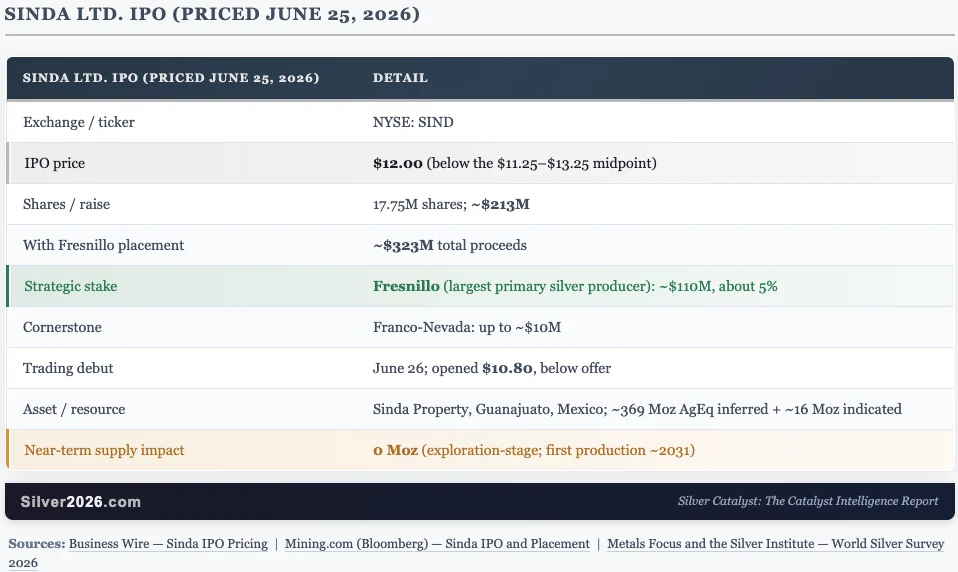
In an era defined by volatile commodity markets and a desperate global scramble for critical minerals, a peculiar financial phenomenon has emerged: investors are pouring hundreds of millions of dollars into silver projects that will not produce a single ounce of metal until 2031. This trend, highlighted by the recent initial public offering (IPO) of Mexico-focused developer Sinda Ltd., underscores a sobering reality in the precious metals sector. As primary silver supply reaches historic lows, the market is no longer pricing in current production; it is aggressively bidding for the promise of future availability.
Main Facts: The $323 Million Bet on Scarcity
On June 25, Sinda Ltd. finalized its initial public offering on the New York Stock Exchange. Trading under the ticker symbol "SIND," the company priced its shares at $12.00—the lower end of its targeted $11.25–$13.25 range—ultimately raising approximately $213 million.
The most significant aspect of the transaction was not the retail appetite, but the strategic participation of industry titans. Fresnillo, the world’s largest primary silver producer, executed a concurrent private placement of $110 million, effectively securing a roughly 5% stake in a company that has yet to generate a single cent in revenue. Furthermore, a prominent gold royalty company stepped in as a cornerstone investor with a $10 million commitment. Despite the institutional backing, the stock’s market debut on June 26 was lukewarm, opening at $10.80. This discrepancy between the aggressive institutional buy-in and the cautious public trading behavior reveals a profound divide: the "smart money" is focused on a multi-decade supply crunch, while the broader market remains fixated on short-term price fluctuations dictated by the Federal Reserve and the strength of the U.S. dollar.
Chronology of a High-Stakes IPO
The path to the Sinda IPO was marked by urgency. Initially slated for June 30, the company pulled the pricing date forward to June 25, a tactical move aimed at locking in capital before further market volatility could jeopardize the offering.
- Pre-IPO Context: Sinda entered the market during a period of significant price correction for silver. After hitting a high of $121.62 in late January, the metal retreated toward the $60 mark. The move was fueled by a hawkish interest rate environment and a firming dollar, which typically acts as a headwind for non-yielding assets like silver.
- June 25: The company officially prices its IPO at $12.00 per share, successfully raising $213 million from the public market, supplemented by Fresnillo’s $110 million injection.
- June 26: Sinda debuts on the NYSE at $10.80. While the sub-IPO price opening suggests a tepid reception, the deal’s success—given the "pre-revenue" status of the firm—remains a landmark event for the mining sector.
- The Path Ahead: With the capital secured, Sinda has outlined a long-term development roadmap. The funds are earmarked for aggressive drilling programs and the construction of an underground decline. However, the industry’s rigorous development timelines—often exceeding a decade for large-scale primary assets—place first production firmly in the 2031 window.
Supporting Data: The Anatomy of a Deficit
The underlying driver of this investment fervor is the structural degradation of global silver supply. According to data from Metals Focus and the Silver Institute, only about 26% of the silver mined in 2025 originated from primary silver mines. This figure represents a modern low.
The remaining 74% of global production is harvested as a by-product of lead, zinc, copper, and gold mining. In these operations, the decision to mine is dictated by the economics of the primary metal, not the price of silver. If the price of copper rises or falls, silver production fluctuates as an incidental consequence. This "by-product dependency" creates a rigid supply chain that is fundamentally incapable of responding to silver-specific price signals.
The structural deficit is not a temporary anomaly but a persistent trend. Projections for 2026 indicate a market shortfall of 46.3 million ounces, marking the sixth consecutive year of deficit. With no significant new primary mines slated to come online before the end of the decade, the market is effectively staring down a "supply cliff." The Sinda IPO, by providing capital for a project that will not yield a single ounce for seven years, serves as a tacit admission that the industry has run out of near-term solutions.
Official Responses and Strategic Rationale
Fresnillo’s decision to invest $110 million into a pre-revenue developer is a strategic play, not a financial gamble. For the world’s largest primary silver producer, the investment acts as a hedge against its own diminishing reserves and the scarcity of high-quality, large-scale primary assets.

In the boardroom, such investments are viewed through the lens of resource longevity. When large-scale assets are becoming as rare as they are today, producers must look to the exploration-stage pipeline to maintain future output. The industry recognizes that even if silver prices were to double overnight, the "lead time" required to permit, develop, and commission a new mine is a fixed variable that cannot be accelerated by capital alone.
By backing Sinda, Fresnillo and other institutional players are effectively "buying the future." They are paying a premium to ensure they have a seat at the table when those ounces eventually hit the market in the next decade.
Implications: The Long-Term Arc for Silver Investors
For the average investor, the Sinda IPO offers a masterclass in market signaling. It is essential to distinguish between the "tape"—the day-to-day fluctuations of the silver price—and the "arc," which is the multi-year trajectory of supply and demand.
1. The Death of the "Price Response" Theory
The traditional economic theory suggests that high prices should incentivize supply. In the silver market, this theory has largely failed. Because most silver is a by-product, a spike in the silver price does not necessarily lead to more mining activity. Investors must realize that the silver deficit is "stubborn" because it is physically anchored to the mining economics of other, unrelated commodities.
2. Scarcity as a Valuation Metric
The Sinda IPO proves that in a market of extreme scarcity, investors are willing to pay for "future ounces." The fact that the deal was completed despite a broader market correction for silver indicates that there is a class of investors—predominantly strategic and institutional—who are prioritizing long-term asset availability over immediate returns.
3. The Decade of the Deficit
The most critical takeaway for investors is that the supply side is effectively "locked" for the remainder of this decade. No amount of public offering capital can shrink the decade-long timeline required to bring a new mine to life. This creates a supply-side floor that should, theoretically, provide a long-term tailwind for the metal.
4. Strategic Capital vs. Retail Sentiment
Investors should monitor the moves of strategic producers like Fresnillo rather than the intraday volatility of silver tickers. When the industry’s largest incumbents start spending hundreds of millions on unproven, distant assets, it is a clear signal that the internal projections for supply are far more pessimistic than those publicly disclosed.
In conclusion, the Sinda Ltd. IPO is a diagnostic tool for the silver market. It confirms that the supply-side crisis is real, deep-seated, and immune to short-term market corrections. As the global economy continues to electrify—demanding ever-greater quantities of silver for solar panels, electronics, and EVs—the chasm between available supply and industrial demand is only expected to widen. For those holding or looking to enter the silver market, the message is clear: the value of silver lies not in the metal currently in the vault, but in the ounces that have yet to be pulled from the ground.
 Nana Muazin
  Neng Nana