
 By Laily UPN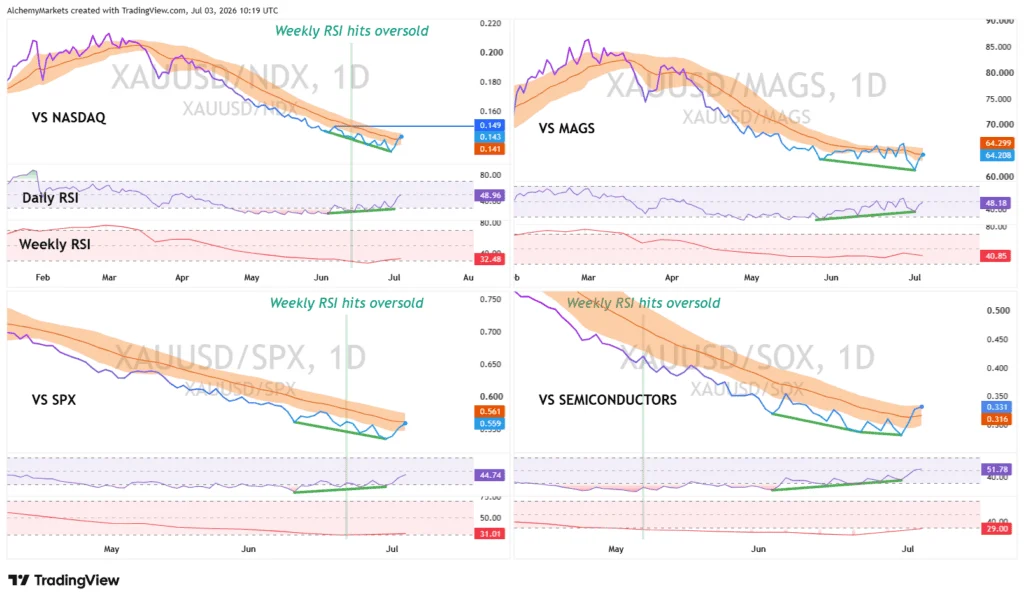
For the better part of the last three months, the financial markets have been defined by a singular, overwhelming narrative: the relentless dominance of the U.S. technology sector. Investors, driven by an insatiable appetite for artificial intelligence (AI) infrastructure, have funneled capital into hardware, software, and semiconductor giants, leaving traditional safe-haven assets like gold in the dust.
However, the tide may be turning. The Gold-to-XLK (Technology Select Sector SPDR Fund) ratio has plummeted by more than 32% during this period, marked by a grueling streak of ten consecutive weekly declines. This technical capitulation has brought the ratio back to critical support levels not seen since the major lows of 2021 and 2024. As the tech sector faces its first meaningful bout of volatility in months, a convergence of macroeconomic shifts and technical signals suggests that gold is finally positioning itself for a potential recovery.
The Macro Catalyst: A Stumbling Labor Market
The primary engine behind gold’s sudden resurgence is a significant cooling in the U.S. labor market. The June Non-Farm Payrolls (NFP) report acted as a watershed moment for market sentiment. The economy added only 57,000 jobs—a staggering 48% miss against the consensus expectation of 110,000.

Compounding this disappointment were downward revisions to April and May data, which shaved a combined 74,000 jobs off the previously reported totals. While the headline unemployment rate ticked down to 4.2%, the decline was largely attributed to a decrease in labor-force participation rather than a surge in hiring, casting doubt on the perceived health of the economy.
While this data does not definitively signal an immediate recession, it fundamentally alters the Federal Reserve’s "higher-for-longer" narrative. In the absence of a blowout inflation or employment report, the Federal Open Market Committee (FOMC) now faces a higher hurdle for hawkish policy shifts. Consequently, market expectations for a rate hike have evaporated, with the probability of a July hike falling below 20%. As the U.S. Dollar index (DXY) weakened by roughly 0.5% following the release, spot gold surged more than 2%, highlighting the inverse relationship between interest rate expectations and the precious metal.
Chronology of the Shift: From Tech Dominance to Defensive Positioning
To understand the current market inflection, one must look at the timeline of the "AI Trade." For the past year, the S&P 500’s performance has been disproportionately driven by semiconductor stocks and mega-cap tech hardware—the core components of the XLK fund. Holdings such as Microsoft, Apple, NVIDIA, and Broadcom have acted as the market’s ballast, shielding investors from the risks of a cooling economy.

However, the momentum began to falter in mid-2024. The following chronology outlines the shift:
- Q1-Q2 2024: Massive capital inflows into semiconductor-related ETFs; Gold enters a period of relative underperformance.
- Late June 2024: Initial signs of exhaustion appear in high-beta tech stocks as valuations reach extreme historical multiples.
- Early July 2024: The NFP print provides the first credible macro-level "shock" to the bullish tech narrative.
- Present: Gold begins to form a bullish divergence on both daily and weekly charts, signaling a potential floor in its relative value against the tech sector.
Supporting Data: Technical Signals in the Gold-to-XLK Ratio
The Gold-to-XLK ratio chart has become the most vital tool for institutional observers. By tracking gold against the semiconductor cycle, analysts are not just looking at a commodity price; they are monitoring the risk-on versus risk-off sentiment of the global market.
Currently, the Gold-to-XLK ratio is showing a classic bullish divergence on the daily timeframe. If the ratio can successfully reclaim its previous high and sustain a position above the 20-day Exponential Moving Average (EMA), it would suggest one of two things: either the tech sector is undergoing a necessary, long-overdue valuation correction, or gold is beginning to reclaim its historical status as a primary hedge against policy uncertainty.

On the weekly chart, gold is attempting to form a "bullish engulfing" candle. While technical analysts warn that one candle does not make a trend, the combination of this pattern with the recent macro-economic weakness provides a compelling argument for a near-term bottom.
The AI Trade: Facing an Expectations Reset
The recent volatility in the technology sector was exacerbated by news regarding Meta Platforms’ cloud infrastructure strategy. While Meta is not a direct component of the XLK, its pivot toward selling excess AI computing capacity sparked a broader, industry-wide re-evaluation of demand.
Investors are now grappling with two competing theories:

- The Optimistic View: Companies are successfully finding ways to monetize their massive capital expenditures, turning cost centers into revenue-generating cloud businesses.
- The Bearish View: The world’s largest tech spenders have vastly over-provisioned their hardware, leading to a glut of capacity that could dampen future demand for semiconductor chips.
This uncertainty is creating a "show me the money" environment for big tech. As investors begin to question whether the astronomical expectations for AI revenue are sustainable, the semiconductor sector has faced a sharp sell-off. This is not necessarily the death of the AI cycle, but rather a healthy "expectations reset." When this uncertainty coincides with a Federal Reserve that is losing its room to maneuver, the stage is set for a defensive pivot back into precious metals.
Implications: Where Does the Market Go From Here?
The relative strength of gold is currently most pronounced against the semiconductor sector (SOX index). Gold vs. SOX is showing the most advanced recovery, with the daily RSI (Relative Strength Index) climbing back above 50, a level that signals a shift in momentum.
Gold vs. Nasdaq-100 is the next most developed setup, with the ratio approaching critical resistance near the 0.149 level. Meanwhile, gold against the "Magnificent Seven" and the broader S&P 500 are in the early stages of recovery. These signals suggest that while the rotation is still in its infancy, the breadth of gold’s improvement is widening.

Strategic Considerations for Investors
The primary implication of this shift is that the "one-way trade" in U.S. technology is effectively broken. Investors should consider the following:
- Policy Sensitivity: Gold remains hyper-sensitive to Fed policy. If future inflation data remains soft, the opportunity cost of holding gold will continue to decline, supporting further upside.
- Rotation Dynamics: A rotation from tech to gold is a classic sign of market maturation. It suggests that investors are moving from "growth at any price" to a more risk-conscious posture.
- Technical Validation: A confirmed close of the weekly bullish engulfing candle in XAU/USD would provide a technical foundation for a long-term bottom.
Ultimately, the market is signaling that the era of blind tech-optimism is being challenged by the reality of a slowing labor market. Whether this proves to be a temporary knee-jerk reaction or the beginning of a major structural shift, the Gold-to-XLK ratio remains the definitive chart to watch. For the "goldbugs," the case for a significant recovery has never been clearer, provided the macroeconomic data continues to support a more dovish path for interest rates.
Disclaimer: This analysis is provided for educational purposes only and does not constitute financial advice. Trading financial instruments involves substantial risk of loss. Investors should conduct their own thorough due diligence and consult with a professional financial advisor before making any investment decisions.
 Basiran
  Sagoh
Sagoh  Siti Muinah