
 By Jia Lissa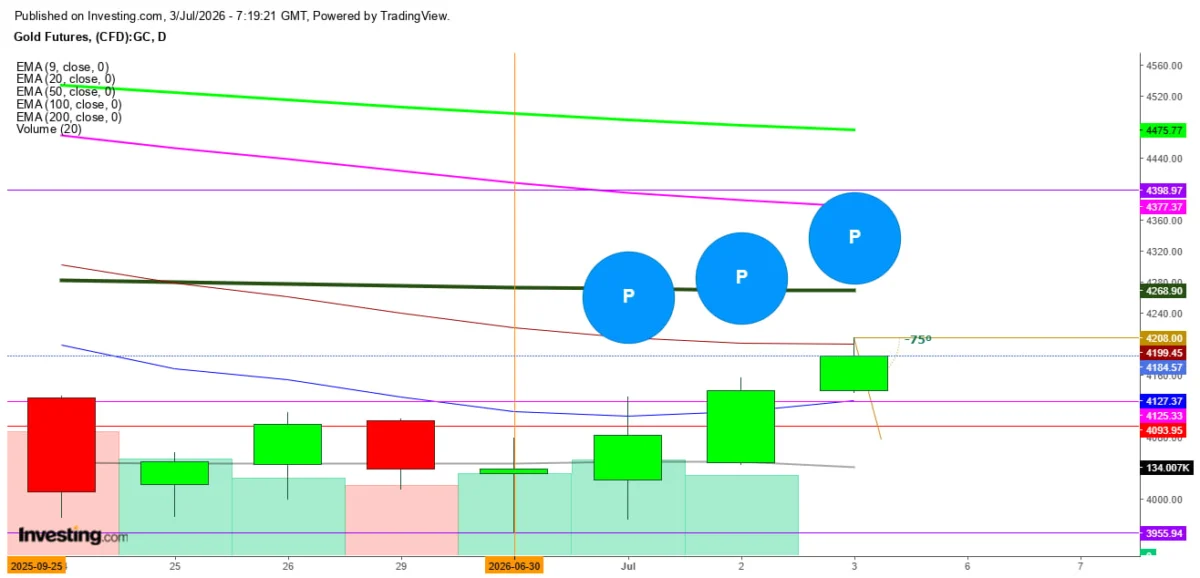
Executive Summary: A Reprieve for Precious Metals
Gold futures staged a notable recovery on Friday, finding firm footing after a brutal second quarter that saw the yellow metal shed approximately 13% of its value. The catalyst for this sudden reversal was a softer-than-anticipated U.S. jobs report, which effectively tempered market expectations for aggressive Federal Reserve interest rate hikes in the near term. With the U.S. labor market showing signs of cooling—a key metric for the Fed’s monetary tightening cycle—investors have begun to recalibrate their portfolios, providing bullion with a much-needed lifeline.
However, as the United States prepares to celebrate its 250th Independence Day, the broader macroeconomic landscape remains fraught with uncertainty. Persistent energy-driven inflation and a fragile diplomatic stalemate regarding the U.S.-Iran conflict continue to cast a long shadow over global financial stability.
Chronology of Market Turbulence
The path to Friday’s recovery was paved by a volatile second quarter. For months, investors have been hyper-focused on the Federal Reserve’s "higher-for-longer" interest rate narrative. This sentiment battered gold throughout April, May, and June, as rising yields on U.S. Treasuries eroded the appeal of non-yielding assets like precious metals.
- Q2 2026 Overview: Gold faced consistent selling pressure, effectively erasing all gains recorded earlier in the year. The dollar surged toward 13-month highs, creating a "perfect storm" that forced institutional liquidation.
- Thursday’s Pivot: The release of the Labor Department’s June payroll data served as a definitive turning point. The market, anticipating a robust figure, was caught off guard by the deceleration in hiring.
- Friday’s Stabilization: Building on Thursday’s momentum, gold futures opened at $4,139.64. By midday, the asset tested a high of $4,207.90 before consolidating around the $4,182 mark, as traders weighed the economic data against the looming geopolitical risks associated with the weekend’s holiday and ongoing international negotiations.
Supporting Data: Labor Market Under the Microscope
The Labor Department’s report revealed a stark departure from economist consensus. While the market had projected the addition of 110,000 jobs for June, the actual print came in at a modest 57,000. The unemployment rate registered at 4.2%, marginally lower than the anticipated 4.3%.
The Fed’s Dilemma
The Federal Reserve has historically utilized a tight labor market as the primary justification for maintaining high borrowing costs. By cooling the labor sector, the Fed aims to suppress wage-push inflation. However, this week’s data suggests that the economy may be reaching an inflection point. Analysts argue that this is not necessarily the start of a long-term trend, but rather a "cooling off" that takes the wind out of the sails for immediate, aggressive rate hikes.
If the upcoming July Consumer Price Index (CPI) report confirms this trend, the case for a prolonged "Fed pause" will strengthen significantly. A pause would be inherently bullish for gold, as lower opportunity costs for holding bullion traditionally draw investors back into the market.
Geopolitical Overhang: The Iran-U.S. Deadlock
While market participants are focused on the Fed, the geopolitical reality is arguably more volatile. The U.S.-Iran conflict, now in its 126th day, remains a primary driver of risk sentiment.
The Peace Accord "Catch-22"
Negotiations between Washington and Tehran have hit a sudden, somber pause, necessitated by the funeral of the slain ayatollah. While President Trump and various mediators have claimed "progress" on a peace accord initially signed on June 17, 2026, experts warn of a significant "Catch-22" hidden within the agreement’s clauses.

The current deal appears to suffer from over-extension, attempting to resolve high-level disputes without addressing the most critical pillars of the conflict:
- De-nuclearization: There is no concrete framework for long-term nuclear disarmament.
- Strait of Hormuz: The agreement lacks clear limitations on Iran’s claims over the world’s most vital oil chokepoint.
As the U.S. celebrates its 250th Independence Day, the administrative focus is split between domestic celebration and a high-stakes diplomatic gamble. Observers are particularly concerned that President Trump’s tendency to shift stances over weekends could lead to market-moving announcements regarding the Iran deal, potentially injecting massive volatility into the energy and precious metal sectors when markets reopen next week.
Technical Analysis: Resistance and Support Levels
From a technical perspective, gold futures are currently navigating a challenging landscape defined by moving averages that act as both psychological and mechanical barriers.
- Immediate Resistance: Gold is currently struggling to break past the 20-day Exponential Moving Average (EMA) at $4,199.38. Sustained trading above this level is required to signal a change in trend.
- Significant Resistance: The 200-day EMA, positioned at $4,268.92, remains the primary hurdle for bulls. Trading significantly below this level indicates that the underlying selling pressure remains robust, and the recent rally may be viewed as a technical correction within a bearish structure.
- Support Levels: Should the market fail to hold the current support at the 9-day EMA ($4,127), the next major floor is located at $4,093.95. A breakdown below this level would likely trigger a wave of algorithmic stop-loss selling, potentially retesting the lows of the quarter.
Implications: The Path Forward
The market is currently in a state of suspended animation. The cooling labor data has provided a reprieve, but the fundamental risks—inflationary energy costs and the precarious nature of the U.S.-Iran peace deal—remain unresolved.
The "Weekend Risk" Factor
Speculative positions built on Thursday’s job data may be liquidated before the closing bell on Friday. Traders are acutely aware that the combination of a U.S. holiday, a thin-liquidity environment, and the unpredictable nature of diplomatic negotiations creates a high-risk environment. Investors are advised that any position taken in gold at this time carries significant exposure to overnight and weekend news cycles.
Economic Forecast
Looking ahead, the interplay between the Federal Reserve’s mandate and the government’s foreign policy will dictate the next phase of the gold market. If the Fed pivots to a neutral stance, gold could recover the losses sustained in the June quarter. However, if energy-generated inflation remains "sticky" despite a cooling labor market, the Fed may be forced to keep rates high, potentially trapping gold in a consolidation phase between $4,000 and $4,300 for the remainder of the summer.
In conclusion, while the immediate data is positive for gold, the macro environment remains fragile. Market participants should prioritize risk management, acknowledging that the intersection of 250th-anniversary celebrations and delicate international diplomacy makes for an environment where traditional technical analysis may be superseded by sudden, headline-driven volatility.
Disclaimer: The information provided in this article is for educational and informational purposes only and does not constitute financial, investment, or trading advice. Readers are advised to conduct their own due diligence and consult with a certified financial advisor before making any investment decisions. The analysis provided is based on observations of market trends and current events; all trading involves risk.
 Laily UPN
  Basiran
  Sagoh
Sagoh 