
 By Suro Senen
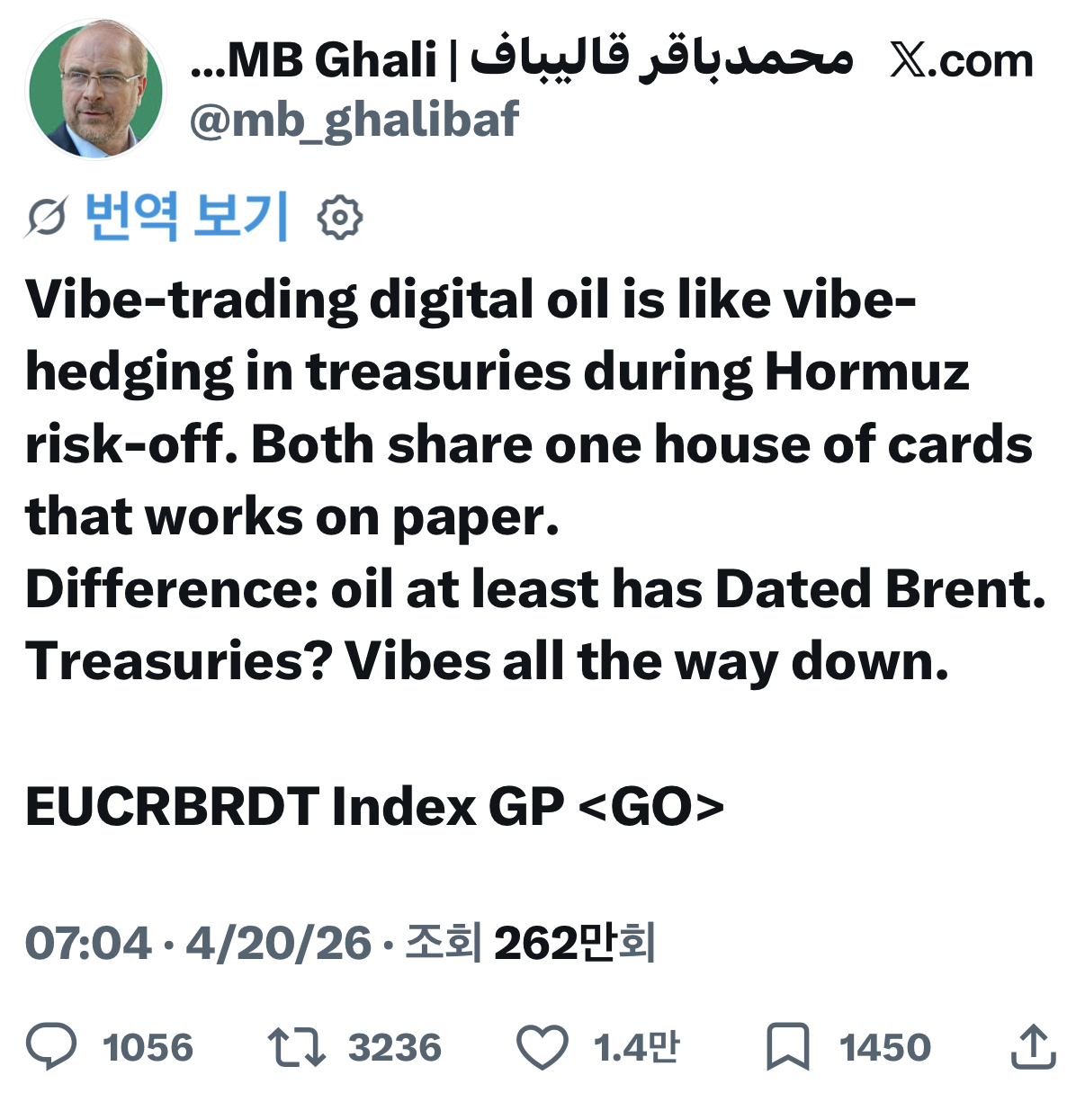
In the high-stakes world of international finance, few things are as potent as a single line of text. Recently, a tweet from Mohammad Bagher Ghalibaf, the Speaker of Iran’s parliament, sent tremors through trading floors from London to Tokyo. While the tweet contained a snide remark comparing the volatility of the oil market to the bond market, the true shock was hidden in plain sight at the very end of his post:
“EUCRBRDT Index GP ”
To the uninitiated, this string of characters looks like a corrupted data file or a random sequence of letters. To a finance professional, it is a definitive signature. It is a command for the Bloomberg Terminal—the legendary, prohibitively expensive, and notoriously cryptic workstation that serves as the heartbeat of global capital. The implication was immediate: a high-ranking official from a country under severe U.S. sanctions was seemingly operating within the sanctum of Western financial infrastructure.
The incident sparked a firestorm of speculation. Was this proof of clandestine oil trading? Was it an inadvertent slip by a staffer? Regardless of the motive, the tweet inadvertently highlighted a singular truth: the Bloomberg Terminal is not just a tool; it is the lingua franca of the global economy, an infrastructure so deeply embedded that even its fiercest geopolitical adversaries find it indispensable.
The Anatomy of a Terminal Command
To understand why this specific tweet caused such a stir, one must understand the syntax of the Bloomberg Terminal. The command “EUCRBRDT Index GP ” is a masterclass in financial brevity:
- EUCRBRDT: This is the specific ticker for the Bloomberg European Dated Brent Forties Oseberg Ekofisk (BFOE) Crude Oil Spot Price. It is a core benchmark for global energy markets, registered as a time series on the European Central Bank’s portal.
- Index: This acts as a qualifier, informing the system that the user is querying an index rather than a single stock or bond.
- GP: Standing for "Graph Price," this command triggers the visualization of the asset’s price history.
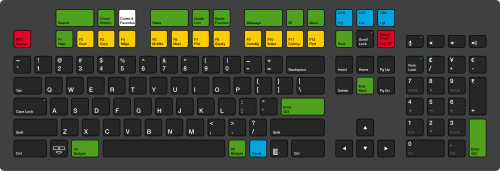
- : The iconic green key on the Bloomberg keyboard, inspired by the "GO" square in Monopoly. It is the execute button, the final bridge between intent and data.
The fact that an Iranian official could navigate this closed-loop, $30,000-per-year system is a testament to the terminal’s reach. Bloomberg L.P. is a private empire, and its terminal is a walled garden. When someone like Ghalibaf uses its proprietary syntax, it suggests that the "Western" financial infrastructure is, in reality, a global utility that even sanctioned entities find impossible to bypass.
A Brief Chronology: From Salomon Brothers to a $150 Billion Empire
The history of the Bloomberg Terminal is the history of the modern financial data revolution. In 1981, Michael Bloomberg, a partner at Salomon Brothers, was abruptly dismissed following the firm’s acquisition by Phibro Corporation. Armed with a $10 million equity stake and a vision of democratizing data, he founded Innovative Market Systems (IMS).
In 1982, the first terminal—christened "Market Master"—was installed at Merrill Lynch. At the time, bond traders were trapped in a manual, glacial era; calculating a single yield curve could take an hour of paper-and-pencil drudgery. Bloomberg’s machine did it in seconds.
By 1990, the launch of Bloomberg News transformed the terminal from a mere calculator into an integrated media-and-data powerhouse. By 1991, there were 10,000 terminals globally. Today, Bloomberg L.P. is valued at approximately $150 billion, with the terminal business accounting for over 85% of its revenue. It has remained a constant in an industry defined by relentless change, surviving the rise of the internet, the 2008 financial crisis, and the current AI gold rush.
The "Bl-daeri" Phenomenon: Supporting Data and Costs
In the competitive landscape of South Korean finance, the terminal is affectionately—and ironically—called “Bl-daeri” (Bloomberg Assistant Manager). The joke is biting: the annual subscription fee, currently hovering around $31,980 per seat, is roughly equivalent to the annual salary of a junior-level manager.
Firms are faced with a stark choice: hire a human or pay for the machine. Invariably, they choose the machine. With additional costs for the proprietary keyboard, installation, and data add-ons, the first-year cost of a single terminal often exceeds $35,000. For a mid-sized asset manager requiring 50 seats, the fixed annual cost can exceed $1.1 billion.
Despite these exorbitant prices, competitors like FactSet and LSEG’s Eikon—which can cost 40% to 60% less—have failed to meaningfully erode Bloomberg’s market share. In fact, Bloomberg raised its prices by roughly 60% between 2010 and 2026, yet its user base continued to expand.
The Four-Layer Moat: Why Nobody Can Compete
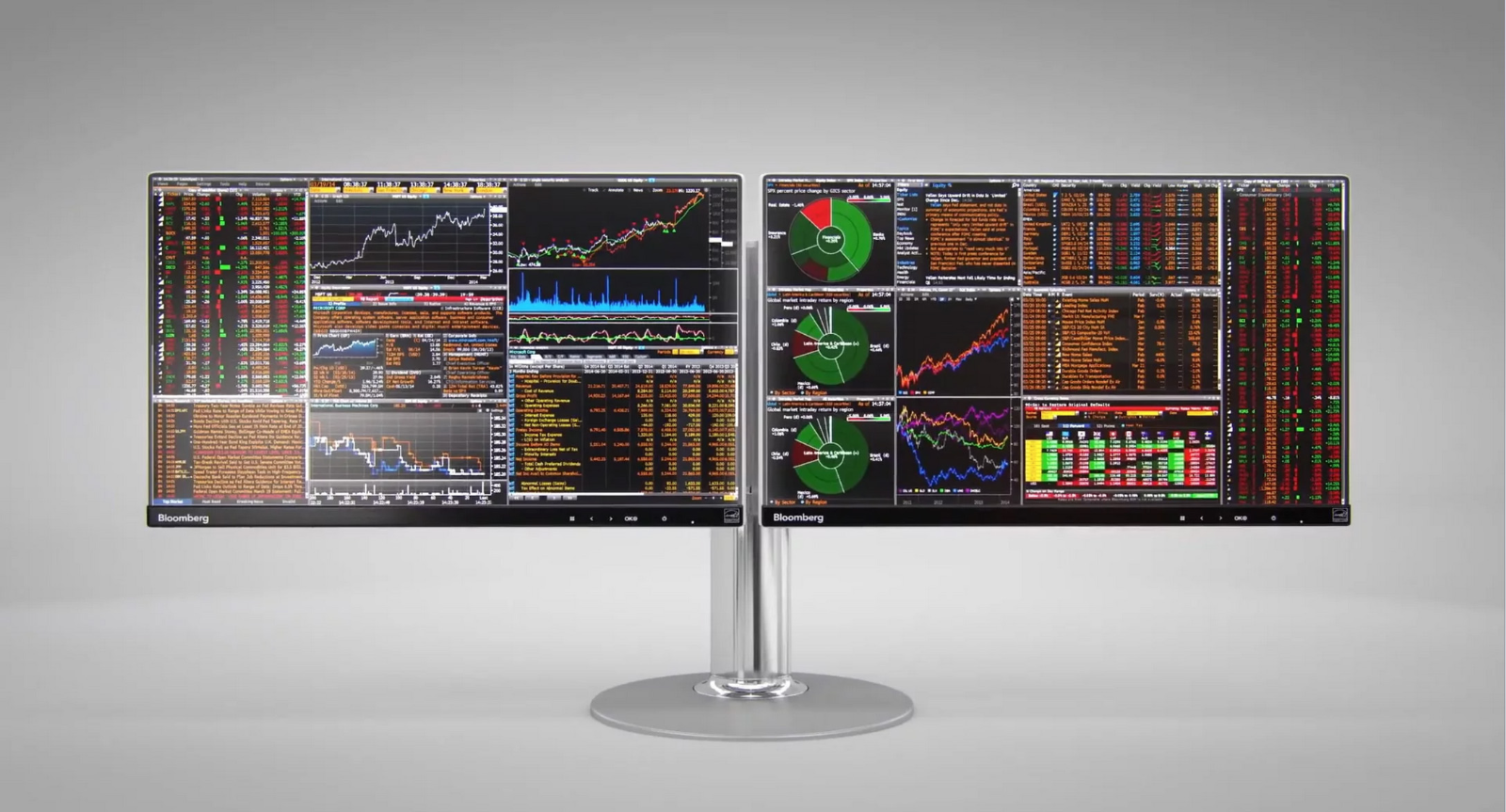
If the terminal is "clunky," expensive, and aesthetically archaic (orange text on black remains a staple), why does it dominate? The answer lies in a four-layer structure of "lock-in" that makes switching nearly impossible:
1. Data Aggregation
While any company with sufficient capital can replicate stock and bond price feeds, Bloomberg’s true value lies in the breadth and integration of its data. It consolidates currencies, commodities, derivatives, and alternative assets into a single interface.
2. The Power of the Index
The "Bloomberg Aggregate Bond Index"—known as "The Agg"—is the standard by which hundreds of trillions of dollars in assets are measured. Because thousands of global contracts and prospectuses are written to benchmark against Bloomberg’s methodology, leaving the platform would require a monumental, multi-year legal and operational restructuring.
3. The "Most Expensive Social Network"
The terminal’s Instant Bloomberg (IB) chat function is the true "killer app." It is where the global financial elite communicate, negotiate, and execute trades. An IB message is a legally binding communication. Because the liquidity pool resides within these chat rooms, the network effect is absolute: if your counterparty is on IB, you must be on IB.

4. Professional Muscle Memory
Knowing how to navigate the terminal is a career credential. The two-to-four-letter commands—DES, GP, MOST, PORT—are etched into the muscle memory of the world’s most powerful traders. Retraining a workforce to use a different, "sleeker" platform isn’t just a technical challenge; it is an organizational nightmare that would result in a massive loss of efficiency and institutional knowledge.
Official Responses and the AI Frontier
Bloomberg is not oblivious to the winds of change. Critics have long argued that the rise of generative AI would render the terminal obsolete. However, in April 2023, the company launched BloombergGPT—a 50-billion-parameter model trained on 40 years of proprietary financial documents.
Unlike other AI firms, Bloomberg is not releasing a standalone chatbot. Instead, it is weaving generative AI directly into the terminal’s existing workflow. From earnings call summaries to complex comparison matrices, Bloomberg’s AI strategy is one of "evolution, not revolution." By focusing on the principles of transparency, data protection, and reproducibility, Bloomberg is ensuring that AI serves as a moat-reinforcer rather than a disruptor.
As Amanda Stent, head of Bloomberg’s AI strategy, noted, the goal is to provide investors with exactly what they need—guidance, capital allocation analysis, and supply chain insights—without ever forcing them to leave the terminal screen.
Implications: The Infrastructure of Finance
The incident involving Mohammad Bagher Ghalibaf serves as a stark reminder of the terminal’s inescapable nature. When even sanctioned actors feel compelled to utilize the infrastructure of the global market, it confirms that the Bloomberg Terminal has transcended its status as a software product. It is, in every sense of the word, critical global infrastructure.
The "moat" around Bloomberg is not built of code; it is built of relationships. The data generated by the collective activity of the market—the dealer runs, the whispers of liquidity, the nuances of bond pricing—cannot be scraped from the open web. It is proprietary, created by the users themselves.
As we look toward the future, the attempts by challengers to breach this fortress will likely continue. Yet, as history has shown, replacing a lingua franca is a task that few have succeeded at. The black screen with the orange text remains the primary interface of the world’s wealth, not because it is the most modern, but because it is where the people are. As long as the market lives in those chat rooms, the Bloomberg Terminal will remain the undisputed center of the financial universe.
 Dwi Wanna
  Sagoh
Sagoh  Neng Nana