
 By Dwi Wanna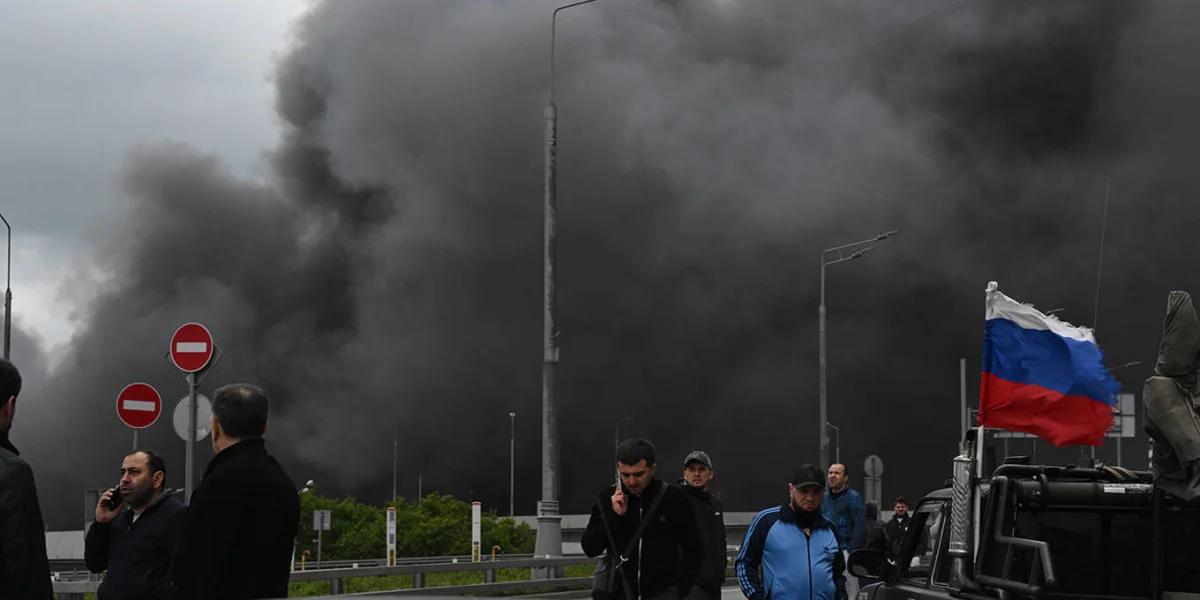
By Ian Bremmer
July 3, 2026
NEW YORK — For a quarter-century, Vladimir Putin has cultivated an image of absolute control, projecting the aura of a grandmaster capable of navigating the most treacherous geopolitical straits. Yet, as of July 2026, the Russian president finds himself in a position more precarious than at any other moment during his long tenure. With his military bogged down in a grinding war of attrition, his economy suffering under the weight of unprecedented sanctions, and his strategic depth being eroded by persistent Ukrainian strikes, Putin is beginning to resemble a leader who has run out of conventional options.
The central question now facing the global intelligence community and Western policymakers is not merely how long Putin can sustain this war, but what he will do when the walls close in. History suggests that when a leader of Putin’s temperament feels truly "cornered," the probability of a "game-changing" escalation—one that risks a direct, catastrophic confrontation with the West—rises exponentially.
I. The Current Strategic Landscape: A Multi-Front Crisis
The Kremlin is currently battling a "perfect storm" of geopolitical and internal pressures. While the Russian state remains intact and the regime’s security apparatus is functioning, the strategic reality on the ground in Ukraine has shifted in ways that undermine Putin’s long-term objectives.
The Crimean Vulnerability
Ukraine’s ability to project power into Crimea—the crown jewel of Putin’s 2014 annexation—has fundamentally altered the strategic calculus. By consistently disrupting Russian supply lines, logistics hubs, and the Black Sea Fleet’s operational capabilities, Kyiv has turned a symbol of Russian imperial strength into a strategic liability. The persistent degradation of the Kerch Bridge and the targeting of airbases within the peninsula have forced the Russian military to expend precious resources simply to hold onto territory that was once considered a secure rearguard.
Strikes in the Heart of Russia
Perhaps more alarming for the Kremlin is the evolution of Ukraine’s long-range strike capabilities. No longer confined to the frontlines or the occupied territories, Ukrainian drones and long-range missiles are reaching deep into the Russian heartland. These strikes—hitting energy infrastructure, military industrial plants, and strategic storage facilities—have pierced the veil of security that the average Russian citizen had previously enjoyed. The psychological impact of these attacks cannot be overstated; they challenge the Kremlin’s narrative that the "Special Military Operation" is a distant, managed affair.
The Economic Attrition
Russia’s economy, while showing surprising resilience in the early years of the war, is increasingly "hobbled." The dual impact of persistent Western sanctions, high inflation, and the massive diversion of capital into the military-industrial complex has created a hollowed-out growth model. With a labor shortage exacerbated by mobilization and emigration, and a reliance on a shrinking pool of international partners, the Russian economy is effectively running on fumes. The state’s ability to continue funding the war effort without triggering significant domestic instability is reaching its terminal limit.
II. A Chronology of Escalation
To understand the current danger, one must look at the trajectory of the conflict since its escalation in February 2022.
- February 2022: The initial full-scale invasion of Ukraine, predicated on the assumption of a rapid regime change in Kyiv.
- Late 2022: The successful Ukrainian counter-offensives in Kharkiv and Kherson, signaling that the Russian military was not the invincible force previously imagined.
- 2023–2024: The stalemate of the trench warfare era, characterized by massive attrition and the solidification of Russia’s "Surovikin line" defenses.
- 2025: The shift in focus. Ukraine, supported by evolving Western technology, begins to prioritize "asymmetric" warfare, focusing on deep strikes and economic sabotage rather than costly frontal assaults.
- Mid-2026: The current juncture. Putin is forced to acknowledge the failure of his "wait out the West" strategy, as the U.S. and Europe show no sign of abandoning Kyiv.
III. Supporting Data: The Indicators of Stress
The indicators of Putin’s predicament are not merely anecdotal; they are backed by shifting geopolitical metrics.
Military Degradation
Recent intelligence estimates suggest that Russia has lost upwards of 500,000 personnel—killed or wounded—since the start of the war. While Russia’s mobilization capacity is vast, the quality of troops is declining, and the loss of experienced junior officers has created a vacuum in command and control. Furthermore, the reliance on aging Soviet-era equipment, supplemented by Iranian drones and North Korean munitions, illustrates a defense industrial base that is struggling to innovate.
The Energy and Fiscal Squeeze
Energy exports, the traditional backbone of the Russian state, have faced systematic targeting. Attacks on oil refineries have cut into export revenues, forcing the Kremlin to tap into the National Wealth Fund at a rate that is unsustainable over the long term. As of July 2026, the Russian ruble remains volatile, and the cost of living for the average Russian has climbed, fueling quiet but persistent grumbling among the middle class.
IV. Official Responses: The West and the Kremlin
The international reaction to the current escalation has been a delicate balancing act.
The Western Stance
Western leaders remain committed to the "long haul," but there is a clear division of opinion regarding the degree of provocation Russia can withstand. The U.S. and its NATO allies have consistently navigated the "red line" problem: providing enough support to keep Ukraine in the fight, while trying to avoid a direct escalation that could lead to a nuclear exchange. However, as Ukraine pushes deeper into Russian-held territory, the "red lines" are shifting, creating a volatile environment where miscalculation becomes more likely.
The Kremlin’s Rhetoric
Moscow’s official line remains one of defiant denial. Putin continues to frame the conflict as an existential struggle against "collective Western aggression." The rhetoric emanating from the Kremlin in recent weeks has become increasingly dark, with frequent allusions to the "inevitability" of a larger clash and warnings of "asymmetric responses" to Western interference. This is classic Kremlin signaling, intended to deter further Western support by introducing the specter of a sudden, unpredictable pivot in tactics.
V. Implications: The Risk of the "Cornered Bear"
The most dangerous phase of any conflict is not when a player is winning or losing, but when they are forced to choose between humiliation and a high-stakes gamble. Vladimir Putin is a leader who defines his legitimacy through strength and defiance. The prospect of an "unconditional" retreat is anathema to his worldview.
The Temptation of Escalation
When a leader feels cornered, the range of acceptable actions narrows to those that offer a potential "game-changer." In Putin’s case, this could manifest in several ways:
- Nuclear Posturing: A tactical nuclear demonstration or a high-altitude detonation to signal resolve and force a Western retreat.
- Hybrid Escalation: Expanding the conflict beyond Ukraine’s borders—targeting critical infrastructure in the Baltics, Poland, or even in the West, to force NATO to focus on its own defense rather than Ukrainian support.
- Cyber-Kinetic Warfare: A massive, coordinated assault on global financial and digital infrastructure, designed to create enough chaos that the West is forced to prioritize domestic stability over the war in Ukraine.
The Paradox of Survival
The paradox of the current situation is that the very pressure intended to force Putin to the negotiating table may be the catalyst that drives him to escalate. By successfully disrupting Crimea and striking within Russia, Ukraine is achieving its tactical goals. Yet, these successes are precisely what heighten the risk of a "black swan" event.
If Putin concludes that he has lost the ability to control the outcome of the war through conventional means, the "sunk cost" of his regime’s survival will dictate his next moves. He will not exit the stage quietly. As the pressure mounts, the international community must prepare for a scenario where the Kremlin’s logic shifts from winning a war to ensuring the survival of the regime through the most desperate of means.
The world is now entering a period of maximum risk. The coming months will test not only the resolve of the Ukrainian people but also the ability of Western leaders to maintain a coherent strategy in the face of a desperate and increasingly unpredictable adversary. In the high-stakes game of 2026, the cost of being "right" about the war may be the necessity of managing the consequences of a Russian leader who believes he has nothing left to lose.
 Layla Zulfa
  Azzam Bilal Chamdy
  Suro Senen