
 By Raul Delapena Setiawan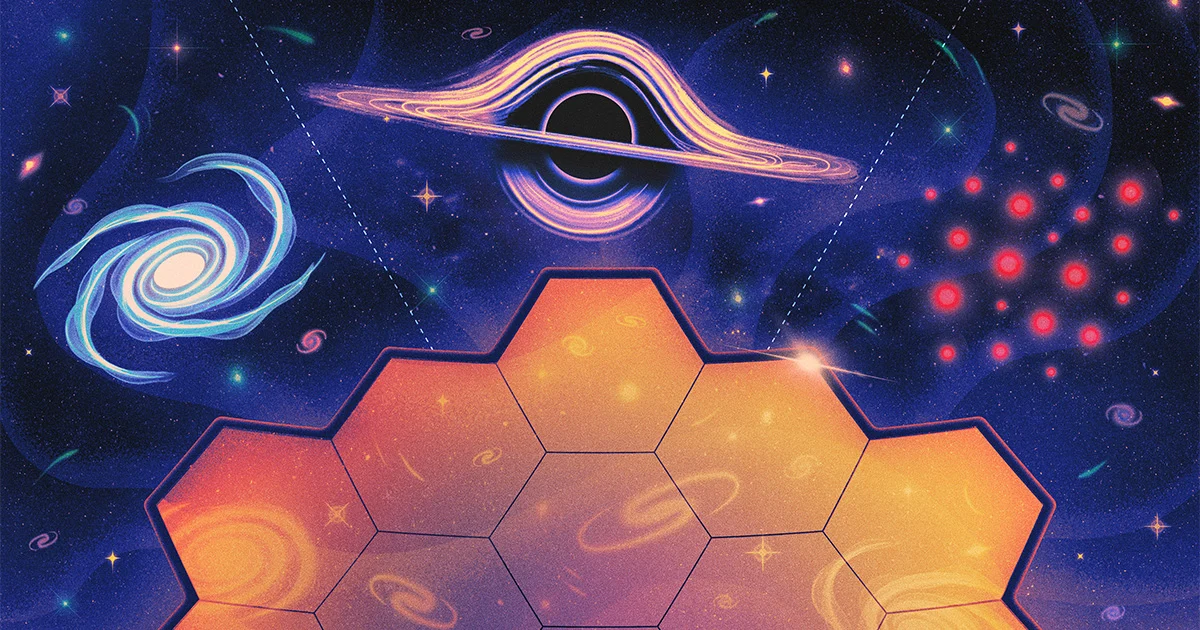
When astrophysicist Charlotte Mason ponders the deepest secrets of our universe, she doesn’t reach for a complex computer model—at least, not initially. She picks up a pen. "I am quite a visual person," she says, sketching the "little red dots" that have become the most discussed, and most perplexing, objects in modern cosmology.
These mysterious, compact, and vividly red sources, discovered in the thousands by the James Webb Space Telescope (JWST) since its deployment in 2022, are the heralds of a new era. They represent a fundamental challenge to our understanding of the first billion years of cosmic history. Joined by black holes that seem "impossibly" massive for their age and galaxies that appear far too bright for their epoch, these observations have forced the scientific community into a period of radical re-evaluation.
We are currently witnessing a "crisis of origin." While the JWST has provided us with a high-definition window into the early universe, the data it returns often contradicts the foundational models of astrophysics. Researchers are now tasked with a monumental challenge: sifting through a sea of new, often conflicting theories to determine which of them accurately maps the dawn of time.
A Chronology of the Impossible
To understand why the current data is so disruptive, one must look at the standard timeline of the early universe.
- The Big Bang (0 years): The singular event that initiated the expansion of space and time.
- The Cosmic Dark Ages (0–200 million years): A period of expansion and cooling where the universe was a featureless expanse of hydrogen and helium gas.
- The Birth of Structure (200–400 million years): Gravity, driven by the mysterious scaffolding of dark matter, began pulling gas into "halos." The first stars ignited, marking the end of the dark ages.
- The Epoch of Reionization (400–1 billion years): Intense radiation from the first stars and early black holes began ionizing the surrounding neutral hydrogen gas, transforming the universe from an opaque, foggy state to the transparent cosmos we observe today.
The JWST has observed galaxies dating back to just 280 million years after the Big Bang. According to previous standard models, these galaxies should be faint, unformed, and sparse. Instead, the telescope reveals a universe that was bustling with activity, populated by mature-looking galaxies and behemoth black holes that, by all rights, should not have had enough time to grow.
The Mystery of the "Little Red Dots"
The "little red dots" are among the most enigmatic findings of the JWST. Appearing in significant numbers roughly 650 million years after the Big Bang, they defy easy categorization.
Initial hypotheses suggested they were simply distant, dusty galaxies. However, recent spectral analysis has hinted at something more radical: they might be black holes "cocooned" in thick, dense gas. Some researchers have even proposed the existence of "black hole stars"—theoretical objects where a central black hole is shrouded in a gas cloud so dense that it radiates light with the brilliance of an entire stellar atmosphere.
Mason and her colleagues have been testing these theories by analyzing the light spectra emitted by these dots. Their findings are counterintuitive. If the dots were merely dense gas clouds, the light passing through them should show specific "absorption signatures." The absence of these signatures has forced a pivot: perhaps the gas is "clumpy," containing gaps that allow light to escape in unexpected ways. This refinement of the model illustrates the current scientific process—a constant, iterative dance between observation and theory.
The Universe’s Bottomless Pits: Supermassive Black Holes
Perhaps the most jarring discovery of the JWST era involves the size of early supermassive black holes. Astronomers have identified black holes with masses equivalent to a billion suns appearing only a few hundred million years after the Big Bang.
"In order to get them that big so quickly, you have to do some gymnastics," says Jenny Greene, an astrophysicist at Princeton University.
In the modern universe, black holes are the "corpses" of massive stars that have run out of fuel. These seeds typically start at roughly 100 solar masses. To grow to a billion solar masses in a cosmic blink of an eye requires sustained, rapid consumption—a process that is usually limited by the "Eddington limit." This physical threshold dictates that as a black hole consumes material, the resulting radiation pressure pushes back against the incoming gas, effectively shutting off the food supply.
However, recent simulations suggest that the early universe may have operated under "super-Eddington" conditions, where accretion disks "puffed up" in ways that allowed gas to funnel inward despite the radiation pressure. Another theory involves "direct collapse," where gargantuan gas clouds bypass the star-formation phase entirely, collapsing directly into a 10,000-solar-mass black hole seed. While mathematically possible, this requires "Goldilocks conditions"—a specific density, rotation, and chemistry that may be too rare to explain the sheer number of supermassive black holes observed.
Reassessing Galactic Formation
The discovery of unexpectedly bright, early galaxies has led to a similar scramble for explanations. Rachel Somerville of the Flatiron Institute notes that the field has moved from having "too few early galaxies" to "too many theories to explain them."
Current models are exploring several variables:
- Efficiency: Did the first galaxies convert gas into stars more efficiently than our current simulations allow?
- Turbulence: Were these early environments characterized by violent, periodic bursts of star formation?
- Stellar Populations: Was the "Initial Mass Function"—the distribution of star sizes—weighted toward larger, brighter, short-lived stars?
Recent data from the JWST’s Mid-Infrared Instrument (MIRI) has revealed a surprising diversity among these early galaxies. Some appear to be "naked" star clusters that have blown away their surrounding gas, while others remain heavily shrouded. This diversity points toward a dynamic, chaotic history of star formation, where galaxies cycled through periods of intense activity followed by dormancy.
The Human Connection: From Dust to Discovery
The study of the early universe is, ultimately, a study of our own lineage. The elements that constitute our bodies—carbon, oxygen, iron, and phosphorus—were forged in the hearts of those first, massive stars and scattered across the void by their explosive deaths.
As Lise Christensen of the Cosmic Dawn Center aptly puts it, "We’re looking back at what created us."
In a poetic alignment of history and science, a recent gathering of over 100 researchers to discuss these findings took place in Helsingør, Denmark—mere miles from the setting of Shakespeare’s Hamlet. While the Prince of Denmark famously lamented the universe as a "foul and pestilent congregation of vapors" and humanity as the "quintessence of dust," modern astrophysicists view this same reality with exhilaration.
Science has confirmed that we are indeed made of stardust, "the quintessence of dust," forged in the furnaces of the early universe. The mysteries currently being unearthed by the JWST are not merely academic puzzles; they are the narrative of our origins.
As researchers continue to refine their simulations and analyze the incoming data, they are inching toward a unified picture of the cosmic dawn. We may not have all the answers yet, but for the first time in human history, we have the tools to ask the right questions—and the persistence to wait for the light of the first stars to reveal the truth.
 Suro Senen
  Dwi Wanna
  Sagoh
Sagoh 