
 By Layla Zulfa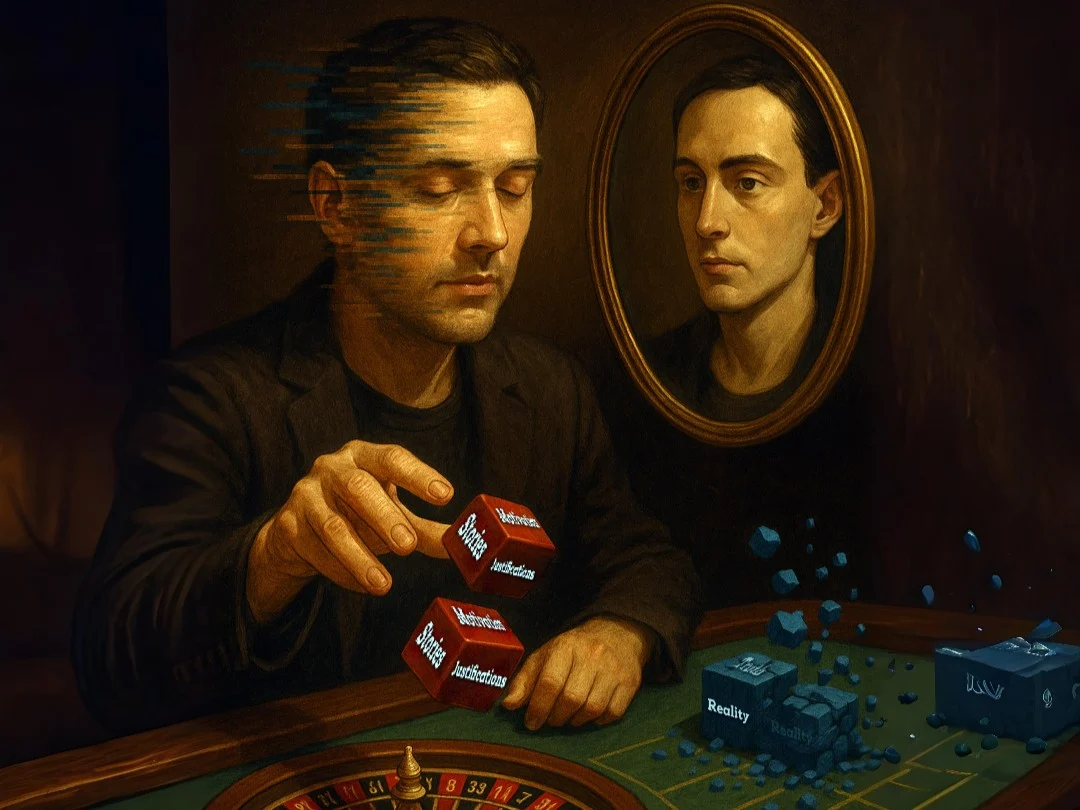
By Guy Hochman
For decades, the standard model of human decision-making has been anchored in a flattering myth: that we are, at our core, rational calculators. Economists have long championed the concept of Homo economicus—the perfectly rational agent who maximizes utility—while psychologists have offered the slightly more forgiving Homo heuristicus, an efficient, albeit occasionally shortcut-prone, processor of information.
However, recent behavioral research suggests that both models miss the mark. We are not cold machines or simple minimalists. We are, instead, Homobiasos: a species defined by our capacity to rationalize our choices with eyes wide shut, weaving elaborate internal narratives that render our decisions coherent, moral, and "correct," even when the evidence dictates otherwise.
The Illusion of Rationality: Decoding the Human Mind
The quest to understand why humans make suboptimal choices has occupied the brightest minds in behavioral science for half a century. The prevailing wisdom suggests that our cognitive failures stem from "System 1" thinking—the fast, intuitive, and emotional brain—while "System 2" thinking—the slow, analytical, and deliberate brain—serves as a necessary corrective.
Yet, this dichotomy is increasingly viewed as an oversimplification. Recent evidence suggests that deliberation is not always the antidote to bias; sometimes, it is the architect of it. When we engage in deep thought, we are often not objectively analyzing data; we are "motivated reasoners" seeking to justify a conclusion we have already reached.
We do not merely fail to perceive reality; we actively filter it to protect our sense of self. We act first and rationalize second. We are not irrational in the sense of being broken; rather, we are deeply, profoundly human in our craving for internal consistency. Our eyes remain physiologically wide open, but our psychological perception is perpetually half-closed.
Chronology of a Cognitive Shift
The evolution of our understanding of bias has moved through three distinct phases:
- The Error Era (1970s–1990s): Influenced by Kahneman and Tversky, researchers focused on identifying the specific "bugs" in the human software—anchoring, availability, and framing—that led to predictable deviations from logic.
- The Heuristic Era (2000s): Scholars argued that these biases were actually adaptive "rules of thumb" that allowed us to navigate a complex, high-velocity world where perfect calculation is impossible.
- The Motivated Coherence Era (Present): Led by contemporary researchers, this perspective argues that bias is not a byproduct of laziness or error, but a deliberate, integrated process of "meaning management." We consider multiple cues and test competing explanations, but we do so with a predetermined outcome in mind.
Supporting Data: The Anatomy of Motivated Reasoning
The empirical evidence for Homobiasos is robust. Studies on "process-tracing"—where researchers monitor how individuals evaluate information—show that people often spend significant effort comparing options across multiple dimensions. This suggests that the mind is not avoiding effort; it is directing that effort toward a specific goal: justifying a preferred choice.
The Deliberation Trap
Research conducted by Ayal, Hochman, and others has challenged the notion that more thinking leads to better outcomes. In several choice tasks, participants who engaged in deliberate, slow reasoning actually placed more weight on irrelevant, misleading cues. By using their cognitive power to weave complex justifications for these irrelevant factors, they effectively legitimized poor judgments. In this sense, deliberation serves as a sophisticated mask for bias.
The Moral Anesthesia of Justification
Perhaps the most striking manifestation of Homobiasos occurs in our moral lives. Most people view themselves as honest, yet we regularly engage in "petty corruption"—cheating just enough to profit without violating our self-image as a "good person."
In experiments involving altruistic lying—where participants lie to benefit a charity—the findings are chilling. Participants who cheated for a "good cause" did not just act more dishonestly; they displayed significantly lower physiological arousal. Their brains had effectively neutralized the guilt response, creating a narrative of "altruistic necessity." This is what psychologists call "ethical dissonance": the mind’s ability to reframe dishonesty as virtue to avoid the pain of confronting one’s own moral failure.
The Strategy of Selective Blindness
Why do we choose to be ignorant? In financial decision-making, it is common to see individuals avoid critical information regarding their pensions or investments. This is not apathy. It is a protective strategy.
When information threatens our sense of competence or fairness, we practice "motivated ignorance." By choosing not to know, we maintain the integrity of our belief system. We are not just avoiding the truth; we are protecting the fragile architecture of our self-worth. As Mark Twain famously noted, "The truth has no defense against a fool determined to believe a lie." In the modern context, that "fool" is a survival mechanism, shielding us from the existential anxiety of a world that is often unfair, unpredictable, and beyond our control.
Implications for the AI Era
The arrival of Artificial Intelligence has provided a new stress test for the Homobiasos framework. In recent studies regarding public perception of AI, researchers identified two primary drivers: "anticipatory anxiety" (fear of the future) and "annihilation anxiety" (fear of losing one’s unique human identity).
The data reveals a distinct U-shaped curve in human engagement with AI. Those with moderate engagement maintain a healthy equilibrium, while both total avoidance and complete overexposure spike anxiety levels. We see here the same pattern as in other domains: humans are not regulating their relationship with technology based on objective utility or logic, but on the need to maintain psychological equilibrium. We mask our fear as "prudence" and our hesitation as "logic," further proving that our justifications are often just defenses against internal discomfort.
Conclusion: Living with Homobiasos
Recognizing ourselves as Homobiasos does not mean we must descend into cynicism or despair. It is not an admission of stupidity, but a recognition of how our minds actually function. Our stories, our rationalizations, and our biases are not "bugs"—they are the features that allow us to navigate a chaotic world without falling into total existential dread.
However, the cost of this "psychological anesthesia" is high. When we prioritize coherence over accuracy, we lose the ability to correct our course. We become captives of our own narratives.
The path forward is not to attempt the impossible—to strip away all bias and become a pure machine—but to practice "honest bias." By developing the meta-awareness to notice when our stories are comforting us rather than clarifying the truth, we reclaim a measure of agency. We can choose, in moments of critical importance, to open our eyes fully, acknowledging that while we may never be truly "rational," we can at least be aware of the story we are telling ourselves.
This article was edited by Lachezar Ivanov. Guy Hochman is an associate professor of behavioral decision-making at Reichman University. His research explores the cognitive mechanisms that shape human morality and social behavior.
 Asro
Asro  Lina Irawan