
 By rifanmuazin
By Melina Moleskis
Imagine a single mother living in an urban center, navigating the precarious balance of modern life. She juggles a low-wage job, the relentless demands of household management, and the crushing anxiety of ensuring her children are fed and housed. Her home is dimly lit, her appliances are aging and inefficient, and her budget is a zero-sum game. Each month, she faces a series of impossible trade-offs: pay the electricity bill, buy fresh groceries, or set aside a pittance for an inevitable emergency.
This is the reality of energy poverty—a condition where essential utilities are not a guarantee, but a source of constant, looming stress. For millions, this relentless prioritization of basic needs consumes all available mental bandwidth, leaving no room to plan for the future. As governments race to meet ambitious climate goals, they are discovering that the most significant obstacle to a "just transition" may not be a lack of funding, but a fundamental misunderstanding of the human mind under pressure.
The Challenge of Energy Poverty: A Structural Trap
As global economies shift toward net-zero, the economic ripples are being felt most acutely by the vulnerable. Energy poverty is no longer a fringe issue; it is a systemic crisis. Recent data indicates that low-income households frequently pay more for energy than their wealthier counterparts—not because they consume more, but because they are trapped in a cycle of inefficiency.
Many vulnerable families occupy older, poorly insulated buildings and rely on outdated, power-hungry appliances or aging, gas-guzzling vehicles. They are, in effect, paying a "poverty premium." They lack the upfront capital to invest in the very technologies—such as solar panels, modern insulation, or high-efficiency heating systems—that would lower their long-term costs. While governments recognize this, the prevailing policy response has often been purely financial: direct cash transfers or grants. However, these programs are missing a critical, hidden hurdle: the psychology of the recipient.
Chronology of a Crisis: From Policy Design to Underutilization
The path to modern energy support began in earnest with the push for climate-resilient infrastructure. In the European Union, for instance, the upcoming "Social Climate Fund," set to launch in 2026, represents a massive legislative commitment to shielding vulnerable populations from the costs of the green transition.

However, looking at the historical trajectory of similar programs, a consistent pattern emerges:
- The Announcement Phase: Governments roll out comprehensive grant schemes designed to help low-income families modernize their homes.
- The Participation Gap: Despite significant financial incentives, take-up rates remain stubbornly low. In many jurisdictions, less than half of eligible households ever complete the application process.
- The Policy Pivot: Authorities often interpret low participation as a lack of interest or a lack of awareness, leading to even more advertising and information-heavy campaigns.
- The Stagnation: Despite increased outreach, the participation gap persists, proving that the barrier is not a lack of information, but a cognitive one.
Cognitive Scarcity: The Silent Saboteur
The root of this underutilization lies in the concept of "cognitive scarcity," as championed by behavioral economists Sendhil Mullainathan and Eldar Shafir. Scarcity—whether of time, money, or emotional stability—fundamentally alters how the brain functions.
When an individual is under chronic financial stress, they enter a state of "tunneling." Their brain narrows its focus to the immediate, urgent problem—the next rent payment or the next meal. This hyper-focus on survival comes at the cost of long-term planning. The "bandwidth" required to navigate a complex, bureaucratic application process for an energy grant simply does not exist.
Furthermore, financial hardship increases "cognitive load." The mental energy required to parse complicated forms, wait on hold for government offices, or gather extensive documentation is immense. For someone struggling to survive, these "hassle factors" are not mere inconveniences; they are insurmountable walls. Research suggests that the cognitive impact of poverty is equivalent to the impairment caused by a full night of lost sleep. When you are already exhausted by the struggle to survive, the effort to apply for a complex, uncertain benefit feels like an unnecessary risk.
Supporting Data: The Case of Cyprus
The situation in Cyprus provides a stark illustration of this phenomenon. With approximately 19% of the population living in vulnerable households, the country has launched several initiatives to combat energy poverty. Yet, internal data suggests a participation rate of only 45% in recent schemes. More than half of those who qualify for aid—and who desperately need it—fail to access it.
In recent work conducted by the Cyprus Institute, in collaboration with colleagues Pantelis Solomou, Meltem Ikinci, and Theodoros Zachariadis, we mapped the "behavioral journey" of a vulnerable household. The journey from learning about a scheme to actually securing the grant is fraught with obstacles:
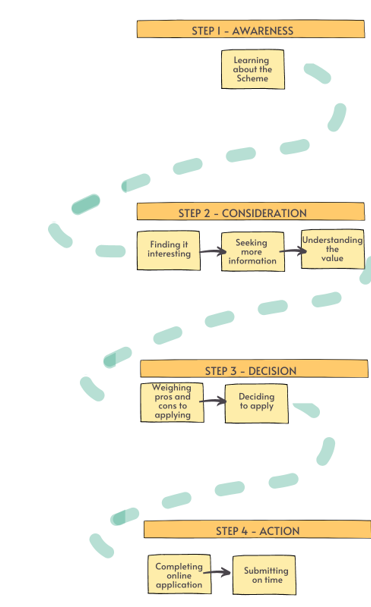
- Discovery: Does the information reach them in a way that doesn’t feel like more noise?
- Consideration: Can they weigh the future benefits against the immediate effort?
- Application: Can they navigate the documentation requirements without professional help?
- Execution: Can they survive the wait times between application and receipt of funds?
Each step presents a "friction point" where the behavioral barriers of shame, complexity, and skepticism can cause the applicant to drop out.
Official Responses and Policy Implications
Policymakers are slowly beginning to acknowledge that "throwing money at the problem" is insufficient. The challenge is to shift from a "supply-side" perspective—where the focus is on the availability of funds—to a "demand-side" perspective, where the focus is on the user experience of the most vulnerable.
Strategies for Reform
To bridge this gap, behavioral science offers a roadmap for more effective policy design:
- Redesigning Social Norms: Moving away from impersonal, bureaucratic presentations toward small-group discussions. These forums allow for peer-to-peer sharing, which helps alleviate the stigma of receiving aid and builds social proof.
- Harnessing Loss Aversion: People are more motivated by the fear of loss than the promise of gain. Instead of framing a grant as "saving money," messaging should focus on the "cost of inaction." By showing exactly how much money a household loses every month by not having efficient insulation, the urgency becomes immediate rather than abstract.
- Reducing Friction: Hassle factors must be eliminated. "Passport pages"—one-page executive summaries of grant requirements—can cut through information overload. Furthermore, pre-populating application forms with data the government already holds (such as tax information) significantly reduces the burden on the applicant.
- The Power of In-Group Identity: Communication campaigns are more effective when they feature testimonials from people who look, sound, and live like the target audience. When a household sees a neighbor successfully navigating a scheme, the "uncertainty" of the process is replaced by the "possibility" of success.
Conclusion: A Just Transition Requires a Human-Centric Approach
The transition to a green economy is a moral and economic imperative, but it cannot be achieved by leaving the most vulnerable behind. The evidence is clear: the barriers to accessing support are rarely just financial. They are cognitive, psychological, and structural.
If policymakers continue to ignore the reality of the scarcity mindset, they will continue to see low participation in vital programs, regardless of how much capital they allocate. However, by embracing behavioral insights, we can make small, cost-effective adjustments to the way we design our policies.
By simplifying the path, reducing the mental tax on applicants, and reframing the benefits to resonate with those living in the "tunnel," we can ensure that the green transition is not just a policy triumph, but a social one. The goal is not just to provide energy; it is to provide the bandwidth for vulnerable families to look up from their struggle and see a future that is sustainable, efficient, and within their reach.
 Sagoh
Sagoh  Evan Lee Salim
  Layla Zulfa