
 By Ali Ikhwan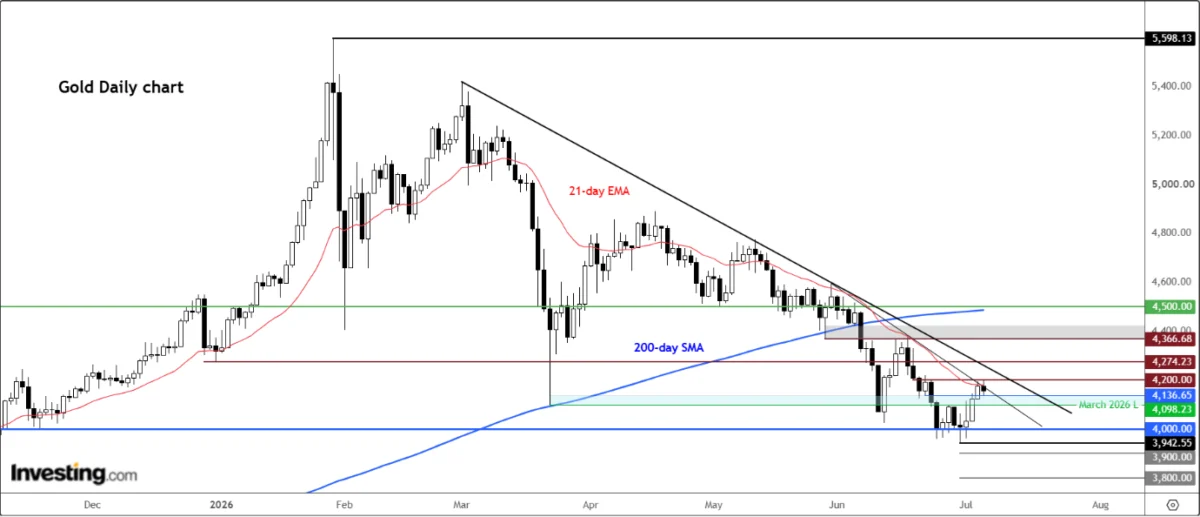
Gold has entered the new week on a cautious note, struggling to maintain momentum after a modest 2% rally during the previous trading period. While this uptick marked the precious metal’s first weekly gain in over a month—a welcome reprieve for long-term holders—it arrives against a backdrop of intense macroeconomic pressure. The recent weakness in the US dollar, sparked by underwhelming economic data, provided a temporary life raft for bullion, yet the structural headwinds facing the gold market remain formidable.
The Broader Context: A Quarter of Correction
To understand the current state of the gold market, one must view the recent price action through a wider lens. The second quarter of this year proved to be one of the most punishing in recent memory for gold investors. Following a stellar run to record highs earlier in the year, the metal underwent a sustained correction, shedding nearly 30% of its value by the quarter’s end.
This dramatic reversal was not a mere flash crash but a fundamental shift in investor sentiment. As economic indicators fluctuated and inflation proved stickier than anticipated, the market’s enthusiasm for gold—historically a hedge against volatility—evaporated. Consecutive monthly declines throughout the spring served as a stark reminder that the "safe haven" narrative is highly sensitive to the prevailing interest rate environment.
The Macroeconomic Backdrop: Higher for Longer
The primary antagonist for gold in the current cycle is the Federal Reserve’s commitment to elevated interest rates. Markets have largely abandoned the hope for imminent policy easing, instead pivoting to a "higher for longer" reality.
For gold, which pays no dividend and offers no yield, the opportunity cost of ownership is tied directly to real interest rates. When Treasury yields are high, the incentive to hold non-yielding assets diminishes significantly. Under the leadership of new Federal Reserve Chair Kevin Warsh, the central bank has taken a bold step by abandoning formal forward guidance. While this pivot was intended to grant the Fed more agility in a volatile economy, it has inadvertently increased market uncertainty.
By forcing investors to interpret raw economic data to forecast policy, the Fed has effectively institutionalized a state of high alert. If inflation remains stubborn, the likelihood of rates staying elevated for an extended duration increases, creating a persistent, structural drag on gold prices.
Chronology of the Current Rally
The recent recovery in gold prices was catalyzed by a cooling in the US dollar, which followed a series of softer-than-expected US employment reports. For a few days, the narrative shifted: perhaps the labor market was finally showing the cracks necessary to justify a pivot in monetary policy.
However, the rally hit a wall early this week. As the market digested the potential implications of the latest ISM Services PMI—a critical gauge of US economic health—the "relief rally" lost its steam. The market is now in a waiting game, looking toward the upcoming release of the June FOMC meeting minutes to determine if the Federal Reserve’s hawkish stance is truly as entrenched as recent rhetoric suggests.
Supporting Data and Technical Perspectives
From a technical standpoint, the current price action is a study in indecision. Gold has managed to reclaim the psychologically significant $4,000 level, recording several consecutive daily closes above this threshold. While this provides a degree of support, it is far from a confirmation of a long-term bottom.

Key Technical Resistance and Support Levels
- The Resistance Barrier: The most critical hurdle in the short term lies in the $4,195-$4,200 range. A descending trendline currently acts as a ceiling for the metal; failing to break above this decisively will likely reinforce the bearish trend.
- The Support Floor: The $4,100 zone, and more broadly the $4,098-$4,136 corridor, remains the primary line of defense for the bulls.
- The Breakdown Risk: Should the price close daily below the $4,000 mark, it would likely invite a fresh wave of selling, signaling that the corrective phase has further room to run.
At present, the technical outlook remains neutral. While the recent bounce is constructive, it lacks the volume and momentum required to signal a trend reversal. Analysts remain largely cautious, viewing the current activity as a classic counter-trend rally within a broader bearish market structure.
Official Responses and Geopolitical Shifts
The geopolitical landscape, which often acts as a secondary support for gold, has seen a recent cooling of tensions. The diplomatic agreement between the United States and Iran to reopen the Strait of Hormuz has reduced the "fear premium" that historically inflates gold prices during times of instability.
As geopolitical risks fade into the background, investor focus has recalibrated toward the cold, hard reality of central bank policy. Meanwhile, a quieter, long-term trend continues to provide a floor for the metal: central bank diversification. Global monetary authorities continue to accumulate gold reserves, effectively hedging against their reliance on US dollar-denominated assets. While this provides structural demand, it is currently being outpaced by the selling pressure from speculative and institutional investors reacting to interest rate fluctuations.
Implications for Investors
The road ahead for gold is fraught with complexity. For the metal to break out of its current slump, one of two things must happen: either the US dollar must enter a sustained, structural decline, or the Federal Reserve must signal a genuine departure from its hawkish trajectory.
As the week progresses, the market will scrutinize the FOMC minutes for any signs of a "dovish pivot." Investors will be looking for nuance: is Chair Warsh’s hawkish tone a personal preference, or does it reflect a committee-wide consensus regarding the necessity of keeping rates elevated to crush lingering inflation?
Summary of Risks
- Yield Sensitivity: Continued strength in Treasury yields will likely continue to suppress gold’s upside potential.
- Data Dependency: Under the current regime, every major economic print is a potential catalyst for volatility.
- Dollar Strength: Unless the dollar breaks its current trend, gold will likely remain trapped in a range-bound, defensive posture.
Conclusion: A Cautious Outlook
While the recovery above $4,000 is a positive development for those hoping for a reversal, the fundamental environment remains hostile. Gold is currently caught between its role as a hedge against systemic risk and its vulnerability to a high-interest-rate regime. Until the macroeconomic fog clears—specifically regarding the trajectory of US inflation and the Fed’s policy response—the most prudent approach for market participants is one of cautious neutrality.
The market has proven that it can rally on temporary dollar weakness, but without a fundamental shift in the monetary backdrop, these gains are likely to be treated as selling opportunities rather than the start of a new bull market. Investors should remain vigilant, watching key support levels closely while awaiting clearer signals from the Federal Reserve’s upcoming policy disclosures.
Disclaimer: This article is written for informational purposes only; it does not constitute a solicitation, offer, advice, counsel, or recommendation to invest. As such, it is not intended to incentivize the purchase of assets in any way. Any type of asset is evaluated from multiple perspectives and is highly risky; therefore, any investment decision and the associated risk remains with the investor.
 Sagoh
Sagoh 