
 By Lina Irawan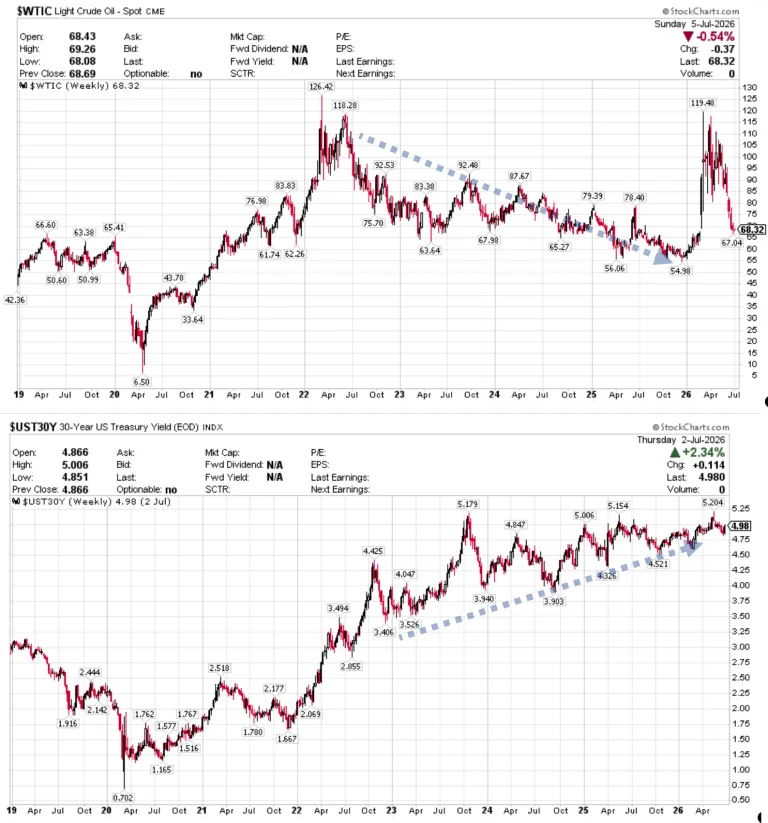
The global financial landscape is currently defined by a singular, persistent mystery: the indecision of the 30-year long bond yield. As market participants scour economic data for signs of a definitive trend, the long bond remains trapped in a technical consolidation, offering little clarity to investors betting on the future of interest rates. While many analysts once hypothesized that a cooling in crude oil prices would alleviate pressure on the bond market, those projections have proven increasingly inaccurate.
As of early July 2026, the long bond yield sits at approximately 4.99%, having surged nearly 20 basis points from its recent lows. This move occurs against a backdrop of technical signals that suggest a major breakout is imminent, even as fundamental indicators remain notoriously opaque.
Technical Analysis: The Apex of Uncertainty
From a technical perspective, the monthly chart for the 30-year long bond is painting a precarious picture. It is currently locked in a classic ascending triangle pattern—a formation that typically signals a significant move toward higher yields. The apex of this triangle, located near the 4.20% threshold, leaves very little room for the price action to maneuver before a decisive breakout occurs.
Historically, ascending triangles serve as consolidation zones that eventually resolve in the direction of the prevailing trend. Given the current trajectory, the technical setup implies that the path of least resistance for yields is upward. However, in the high-stakes world of fixed income, technical signals are often subject to the whims of macroeconomic shifts, leaving traders to grapple with the "clear but unresolved" nature of the charts.

Chronology: The Decoupling of Oil and Bonds
To understand the current volatility, one must look at the shifting correlation between West Texas Intermediate (WTIC) crude oil and the long bond. Throughout the latter half of 2025 and early 2026, oil price gyrations were frequently viewed as a proxy for inflationary pressures in the bond market. For a time, the two moved in relative lockstep.
Between March 2026 and mid-June 2026, a positive correlation existed: as oil prices fluctuated, bond yields mirrored the movement, suggesting that energy costs were the primary driver of market sentiment. This relationship, however, underwent a structural break around June 22.
Since that date, the long bond yields have aggressively moved higher, decoupling from oil price dynamics. This divergence is critical; it suggests that the bond market is no longer reacting solely to energy-driven inflation fears, but is instead pricing in new, potentially more systemic concerns regarding fiscal policy, sovereign debt supply, or a shift in the Federal Reserve’s terminal rate expectations.
Fundamental Ambiguity: Navigating the "Clear as Mud" Landscape
While the technical charts scream of an impending breakout, the fundamental landscape remains as clear as mud. Economists and strategists find themselves in a rare position of collective uncertainty. Traditional models for predicting bond yields—which rely on GDP growth, unemployment, and CPI prints—are currently failing to provide a cohesive narrative.

This "unknowable" quality has created a vacuum often filled by political speculation. Some market participants, such as prominent commentator Thorne, have adopted positions that eschew recessionary warnings, signaling a belief in economic resilience. However, this optimism sits in stark contrast to the caution observed in the bond market. The fundamental disconnect here is that while the economy may be performing well by traditional metrics, the bond market’s aggressive yield pricing suggests a skepticism that is not yet reflected in broad equity market valuations.
Supporting Data: CME Fedwatch and the Path to November
The primary driver of the long bond’s uncertainty is, as always, the Federal Reserve. The CME Fedwatch tool currently provides a snapshot of market expectations that serves as a thermometer for the central bank’s upcoming decisions. As of July 5, 2026, the probability distributions for the target interest rate paint a picture of a Fed that is heavily constrained by the political calendar.
The October Dilemma
The October 26 meeting presents a significant challenge for the Federal Reserve. Historically, central banks are loath to implement major policy shifts, particularly rate hikes, in the weeks immediately preceding a national election. The risk of being perceived as politically motivated is high, and the Fed is likely to avoid any drastic measures unless confronted with an "inflation inferno" that renders inaction impossible.
The September Pivot
Because there is no scheduled FOMC meeting in August, the September 16 meeting becomes the primary focal point for potential action. Current data suggests a roughly 53% probability of at least one rate hike by September. A two-hike scenario—incorporating both July and September—remains a lower-probability outcome but is not statistically dismissed by the market.

Probability Estimates for Near-Term Fed Action:
- July 2026 Meeting: Low probability of a hike, though not zero.
- September 2026 Meeting: High probability of a decision point; the market is pricing in a coin-flip scenario for a hike.
- October 2026 Meeting: Likely hold, barring extreme inflationary data.
Official Responses and Strategic Implications
The Federal Reserve has maintained a stance of data dependency, yet the market has grown weary of this rhetoric. The underlying sentiment is that the Fed is running out of runway to address inflationary pressures without risking a deeper economic contraction.
If the next major move for the bond market is indeed higher—meaning yields rise further—it will likely be due to one of two conflicting catalysts:
- Economic Resilience: Sustained strength in consumer spending and manufacturing, forcing the Fed to keep rates higher for longer to suppress demand.
- Fiscal Anxiety: A loss of confidence in the long-term sustainability of the U.S. deficit, leading investors to demand a higher "term premium" for holding long-dated debt.
Conversely, if yields were to break lower, it would be the result of a sudden, sharp downturn in employment or a systemic credit event. In this view, the upcoming July, August, and September employment and CPI reports will serve as the final determinants for the Fed’s September policy outcome.

Conclusion: The Waiting Game
We are currently in a period of "knowing the unknowable." Investors are forced to weigh the technical inevitability of a bond breakout against the fundamental opacity of an election-year economy.
The bond market is currently signaling that the status quo is untenable. Whether the resolution comes through a sharp rise in yields—reflecting a "higher for longer" reality—or a defensive flight to quality in the event of an economic stumble, the volatility is unlikely to subside until the Federal Reserve provides a clearer path for the fourth quarter of 2026. Until then, the long bond remains the most watched, yet least understood, instrument in global finance. Market participants should prepare for a period of heightened sensitivity to incoming labor data, as these prints will act as the final arbiters of the Fed’s September trajectory.
 Dwi Wanna
  Nana
Nana  Muslim