
 By Iffa Jayyana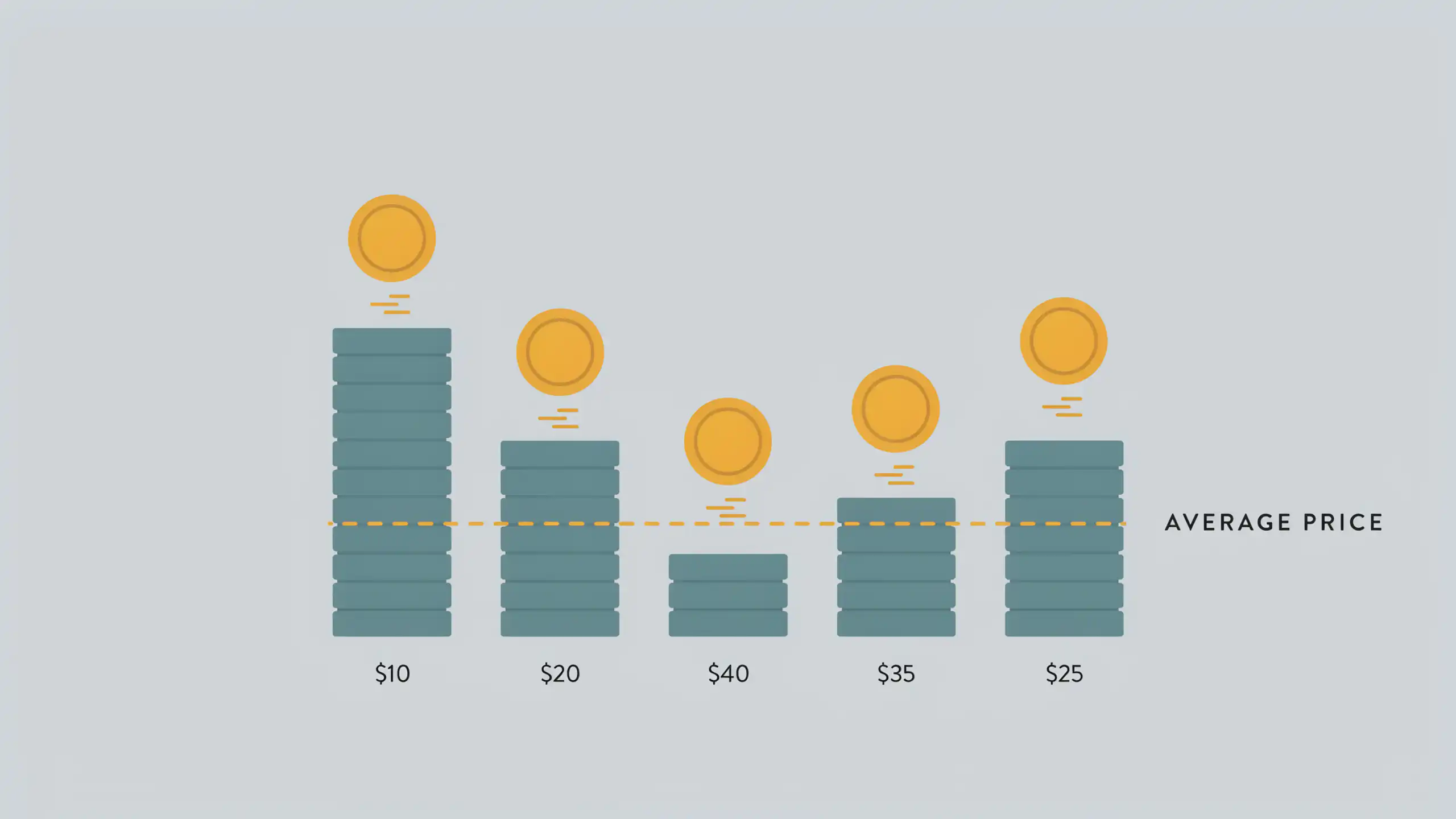
In the high-stakes world of modern finance, few strategies are as universally lauded by institutional investors and retail traders alike as dollar-cost averaging (DCA). While the term may sound like sophisticated jargon, its premise is elegantly simple: rather than attempting to "time the market" by betting on a single entry point, an investor commits a fixed dollar amount to an asset at regular, predetermined intervals.
By divorcing human emotion from the decision-making process, DCA transforms the volatile nature of the stock market from a source of anxiety into a mechanism for wealth accumulation. As global economic uncertainty persists, understanding why this disciplined approach remains the "gold standard" for long-term growth is essential for any serious investor.
The Core Mechanics: How DCA Tames Volatility
At its heart, dollar-cost averaging is a strategy designed to combat the psychological pitfalls of market participation. When prices are high, a fixed-dollar contribution buys fewer shares. When prices are low, that same contribution buys more. Over time, this mathematical phenomenon ensures that the investor’s average cost per share is lower than the average market price over that same period.
The Math Behind the Discipline
Consider a scenario where an investor contributes $500 monthly to an index fund.
- Month 1: The share price is $50. The investor acquires 10 shares.
- Month 2: Market volatility drives the price down to $40. The same $500 now buys 12.5 shares.
- Month 3: The price rebounds to $45. The investor acquires 11.11 shares.
In this instance, the investor has accumulated 33.61 shares with a total investment of $1,500. Their average cost per share is approximately $44.63, despite the fluctuating market prices. Had the investor attempted to "time" the bottom, they might have waited for a dip that never came, or worse, panicked during the Month 2 decline and sold their holdings. DCA removes the "judgment call," replacing it with a standing order that functions regardless of daily news cycles or bearish sentiment.
A Chronology of Behavioral Finance: Why We Fail to Time the Market
The history of market participation is littered with investors who missed out on historic bull runs because they were waiting for the "perfect" moment to enter.
The Era of "The Sidelines"
Historically, "market timing"—the practice of shifting funds in and out of the market to avoid downturns—has been the undoing of many retail portfolios. Studies consistently show that the most significant gains in the stock market are often concentrated in a handful of days. Missing just a few of these "best days" due to sitting on the sidelines can drastically reduce long-term annualized returns.
The Rise of Automation
The widespread adoption of 401(k) plans in the late 20th century served as the primary catalyst for the mainstreaming of DCA. Because these contributions are deducted automatically from paychecks and invested on a recurring schedule, millions of employees have been practicing DCA for decades without ever labeling it as such. As digital brokerage platforms proliferated in the 2010s, the ability to replicate this "set it and forget it" discipline in IRAs and taxable brokerage accounts became accessible to the general public, effectively democratizing the strategy.
Supporting Data: The Case for Consistency
Financial research consistently supports the efficacy of DCA, particularly for those with a long-term time horizon.
The Cost of Inaction
Money sitting in a settlement account or a low-yield savings account is "cash drag." Inflation acts as a silent tax on idle capital, eroding its purchasing power daily. Conversely, money deployed through DCA immediately begins to benefit from the power of compounding. Dividends are reinvested, and the principal begins to earn returns that eventually earn returns themselves.
Risk Mitigation
According to data from major institutional firms, the primary risk for most investors is not market volatility, but rather behavioral risk—the tendency to sell low during periods of panic. By committing to a schedule, an investor creates a "behavioral floor." When headlines scream about a market correction, the DCA investor is already programmed to continue buying. This systematic accumulation creates a psychological buffer, preventing the reactive selling that leads to permanent capital loss.
Official Perspectives: The Institutional View
Financial advisors and asset managers largely agree that for the vast majority of investors, complexity is the enemy of success.
The Professional Consensus
Most certified financial planners (CFPs) view DCA not merely as an investment strategy, but as a risk management tool. By smoothing out the purchase price, an investor avoids the "all-in" trap, where they invest a lump sum at the peak of a market cycle, only to see the value plummet shortly thereafter.
"The best investment strategy is the one you can actually stick to," notes a senior wealth manager at a leading global firm. "Mathematical optimization of a portfolio is useless if the investor abandons their plan during a 10% market drop. DCA provides the psychological guardrails necessary to remain invested through the full economic cycle."
Practical Implementation: Five Minutes to Financial Security
Implementing a dollar-cost averaging strategy is a straightforward process that requires only three key decisions.
- Determine Your Contribution: Choose an amount that is sustainable. It is better to commit a smaller amount consistently than a large amount that you are forced to withdraw when an unexpected expense arises.
- Align with Your Pay Cycle: Automate your transfer to occur on the day your paycheck arrives. This ensures the capital is invested before you have the opportunity to allocate it toward discretionary spending.
- Choose Your Vehicle: Select a broad-market index fund or a low-cost Exchange Traded Fund (ETF). These instruments provide instant diversification, mitigating the risk associated with individual stock selection.
Once these steps are automated through your brokerage, the "work" of investing is complete. The software takes over, executing the trades regardless of whether the market is at an all-time high or in the midst of a correction.
The Broader Implications: Redefining "Success"
The ultimate implication of dollar-cost averaging is a fundamental shift in the investor’s relationship with the market. When you stop viewing market volatility as a threat to your current capital and start viewing it as a mechanism for accumulating more shares at a discount, your entire financial philosophy changes.
Resilience Against Noise
We live in an age of 24-hour financial news cycles, where headlines are designed to trigger fear and urgency. The DCA investor is uniquely immune to this noise. They do not need to read the latest analyst report or guess which sector will outperform in the next quarter. Their plan is agnostic to the news; it is a long-term, systemic approach to growth.
The Behavioral Payoff
The payoff of this strategy is not "mathematical magic." It is a behavioral victory. By removing the need for precision, you gain the benefit of peace of mind. You no longer need to be right about the direction of the market; you only need to be consistent.
As you continue to build your portfolio, the fluctuations in price will become less intimidating and more routine. The next time the market experiences a lurch, you won’t be tempted to check your balance or call your broker in a panic. You will simply let the schedule run, confident in the knowledge that your disciplined, automated approach is working exactly as designed. In the marathon of wealth creation, consistency does not just beat intensity—it defines it.
 rifanmuazin
  Reynand Wu
  Azzam Bilal Chamdy