
 By Nana Wu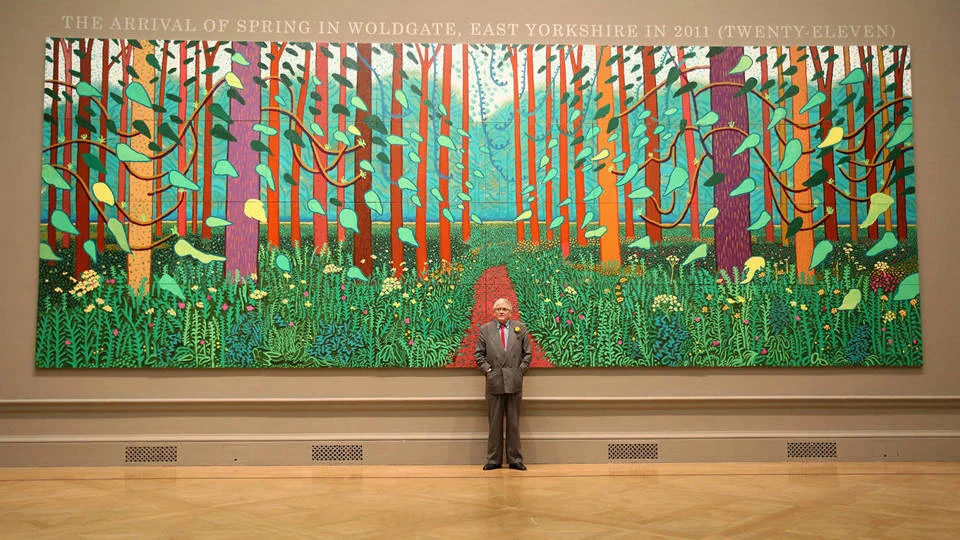
By Angus Armstrong
July 9, 2026
The passing of David Hockney last month has left the art world—and indeed, the broader intellectual community—in a state of reflective mourning. Hockney, a titan of 20th and 21st-century art, was more than a painter; he was a philosopher of perception. His life’s work serves as a sprawling, vibrant critique of the human desire for a singular, static truth.
As we look back on his prolific career, there is a profound irony in the timing of his departure. In an era increasingly defined by data-driven dogmatism and the pursuit of predictive certainty, Hockney’s canvases remind us that reality is inherently multifaceted. Perhaps nowhere is this lesson more urgently needed than in the halls of economics, a discipline that has long clung to the pretense of deterministic models and "single-truth" narratives.
Main Facts: A Life Defined by Shifting Perspectives
David Hockney’s career was defined by a refusal to be pinned down. From his sun-drenched, technicolor depictions of Californian swimming pools in the 1960s to his experimental forays into Polaroid collages and digital iPad sketches in his later years, Hockney constantly interrogated the act of looking.
The fundamental thesis of his work was that the world does not present itself as a flat, objective reality. Instead, it unfolds in fragments, filtered through the movement of the eye and the subjectivity of the observer. By eschewing the traditional "vanishing point" of Renaissance perspective, Hockney invited the viewer to inhabit a space where multiple times and places coexist.
For the modern economist, this is a radical provocation. Economics, since the mid-20th century, has sought to mimic the hard sciences, favoring mathematical precision and the "rational agent" as its North Star. Yet, as global markets face unprecedented volatility and societal shifts, the failure of these models to capture the nuance of human behavior is becoming glaringly obvious. If art imitates life, then Hockney’s life suggests that our obsession with certainty is not just misguided—it is a fundamental misinterpretation of reality itself.
Chronology: The Evolution of a Visionary
To understand the scope of Hockney’s influence, one must look at the arc of his evolution:
- 1960s – The Pop Art Ascent: Hockney emerges as a major figure in the British Pop Art movement. His focus on the domestic—pools, showers, and friends—elevates the mundane into the profound, challenging the elitism of the art world.
- 1970s & 80s – The Deconstruction of Space: Through his iconic "joiners" (photographic collages), Hockney begins to break down the photographic image. He realizes that a single camera lens is a lie; it captures a moment frozen in time, whereas human vision is a continuous, fluid experience.
- 1990s – The Return to Landscape: Hockney moves away from the studio to the rolling hills of Yorkshire. He begins to paint the same scene through different seasons and light conditions, demonstrating that there is no "definitive" version of a place.
- 2010s – The Digital Frontier: Embracing the iPad as a medium, Hockney proves that technology is not a replacement for human perception but a new tool to explore it. He continues to paint until his final days, maintaining a youthful curiosity that defied his aging frame.
- 2026 – The Legacy: Following his death, critics and scholars begin to re-evaluate his work not just as aesthetics, but as a methodological challenge to how we perceive "fact" in an age of misinformation and systemic complexity.
Supporting Data: The Failure of Certainty in Economics
While Hockney was mapping the complexities of light and shadow, the field of economics was busy building "DSGE" (Dynamic Stochastic General Equilibrium) models. These models, which underpin much of central bank policy, rely on the assumption that agents are rational, markets are efficient, and the future can be modeled based on past equilibrium.
Data collected by the International Monetary Fund (IMF) and various central banks over the last two decades suggests a recurring pattern of failure:
- The Predictive Gap: Since 2008, the variance between economic forecasts and actual growth outcomes has widened significantly.
- Behavioral Anomalies: Research in behavioral economics—spearheaded by figures like Daniel Kahneman—has consistently shown that human decision-making is rife with cognitive biases, contradicting the "rational agent" theory.
- Complexity Economics: Newer, alternative models (often referred to as agent-based modeling) suggest that economies are "complex adaptive systems." Much like a Hockney painting, these systems cannot be understood by a single viewpoint or a single equation; they require a mosaic approach.
The data confirms that the more "certain" an economic policy becomes, the more brittle it is when faced with "Black Swan" events—unforeseen, high-impact occurrences that defy traditional forecasting.
Official Responses: A Discipline in Transition
The response from the economic establishment to these criticisms has been slow but discernible. Following the 2008 financial crisis, there was an initial defensive posture, with many arguing that the models were sound but the inputs were flawed. However, in the years leading up to 2026, the tone has shifted.
"We have been operating under the illusion of a single-truth framework," noted a high-ranking official at the Bank of England during a recent seminar on fiscal policy. "We are now moving toward a ‘scenario-based’ approach, acknowledging that our models are not maps of reality, but merely navigational aids."
Academic circles have also begun to bridge the gap between the humanities and the social sciences. Interdisciplinary departments are increasingly using "narrative economics"—a term coined by Nobel laureate Robert Shiller—to explain how stories and perceptions drive economic cycles, much in the way a painting drives an emotional response in a viewer.
Implications: Embracing the "Hockney Method"
What, then, can the economist take from the artist? The implications are profound:
1. From Equilibrium to Process
Economics must move away from the idea that markets always seek an "equilibrium" or a "correct price." Instead, we should view the economy as a living, breathing process—a perpetual state of becoming. Just as Hockney’s paintings of Yorkshire change with the seasons, the economic landscape changes with societal and technological shifts.
2. The Value of Subjectivity
Hockney proved that the "subjective" is not the opposite of "truth." In fact, acknowledging the subjective nature of agents is the only way to reach a higher, more complex truth. Economists should incorporate the psychological and cultural narratives of the people they study, rather than treating them as variables in a vacuum.
3. Radical Humility
Perhaps the most important lesson is the need for humility. Hockney spent his life realizing how little he knew about the act of seeing. Economists, who often project an aura of near-prophetic knowledge, would benefit from a similar admission. By embracing the limitations of our knowledge, we can build systems that are more resilient, flexible, and capable of adapting to the unforeseen.
4. Interdisciplinary Synthesis
Hockney utilized everything from oil paints to digital pixels. Economics must similarly break down the silos between sociology, psychology, history, and mathematics. We need a "multi-perspectival" economics—one that views the market not from a single vantage point, but from many, simultaneously.
Conclusion: A Vision for the Future
David Hockney taught us that the world is far more interesting—and far more complicated—than we dare to admit. He taught us that the "vanishing point" is a fiction we invent to make ourselves feel safe in an infinite space.
As the global economy navigates the choppy waters of the mid-2020s, we would do well to put down the compass and the rigid ruler. We need less of the "dismal science" and more of the vibrant, observational, and deeply human curiosity that defined David Hockney’s life. If we can learn to look at the world as he did—not as a puzzle to be solved, but as a masterpiece to be continuously experienced—we might finally find the tools to manage the uncertainty that defines our age.
The artist is gone, but his work remains. It is now up to those who design the future—be they policymakers, analysts, or citizens—to ensure that we do not let our own myopia obscure the vibrant, shifting reality that lies right in front of us.
 Layla Zulfa
  Basiran
  Sagoh
Sagoh 