
 By Ammar Sabilarrohman
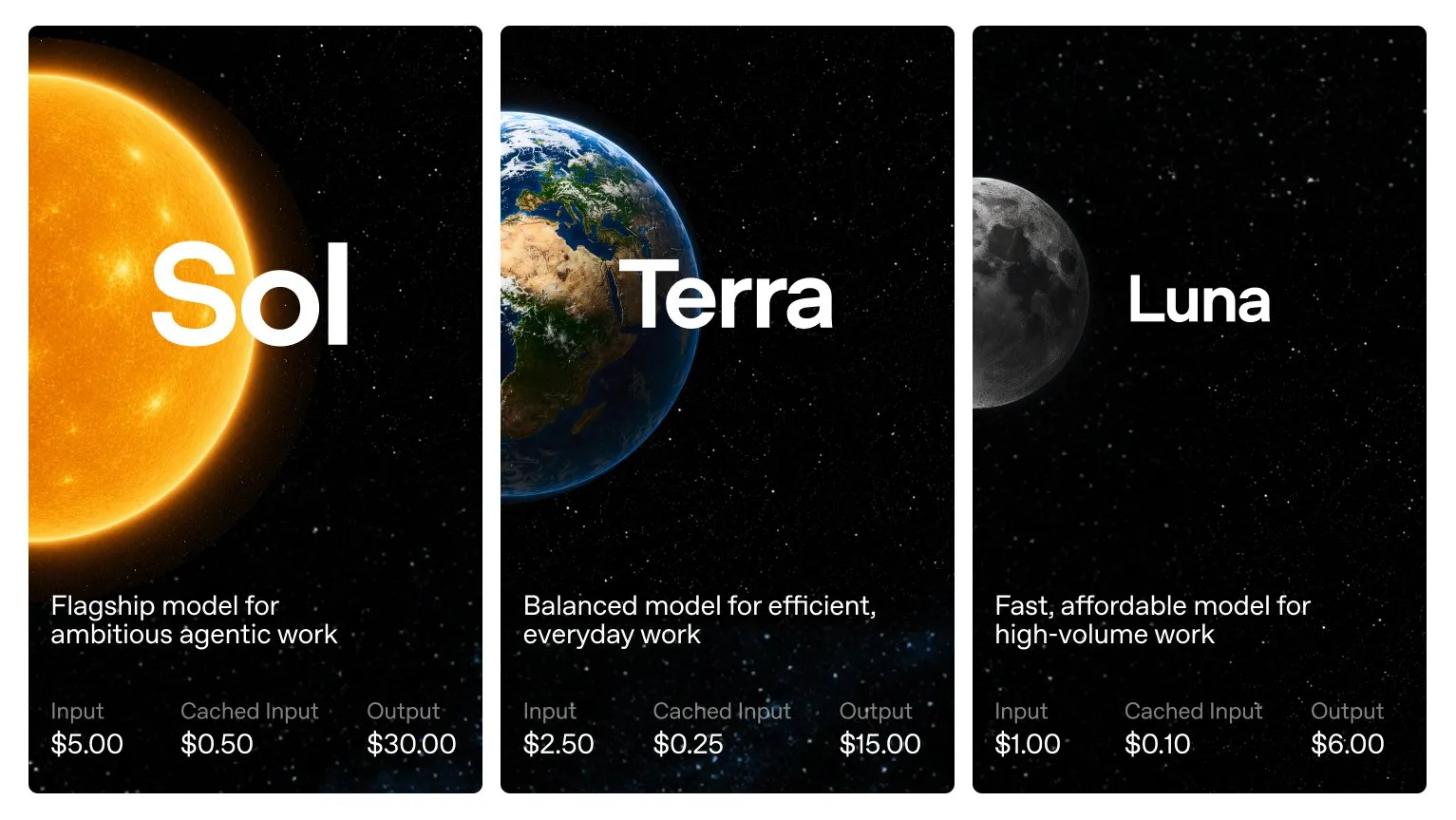
SAN FRANCISCO – In a move that signals both a branding pivot and a significant leap in agentic capabilities, OpenAI has officially released its latest flagship model, GPT-5.6, codenamed "Sol." The launch, which took place on July 8, 2026, marks a departure from the company’s traditional numerical naming convention, introducing a celestial-themed hierarchy that includes two smaller "sibling" models: Terra and Luna.
The release follows a tense two-week period of restricted access mandated by the U.S. Department of Commerce. During this window, the model was available only to a select group of approximately 20 "trusted partners" for safety evaluation and red-teaming. Now available to the general public and API developers, Sol arrives in the middle of what industry analysts are calling the "Great AI Heatwave," a week that has seen major releases from Anthropic, xAI, and Meta.
I. Main Facts: A New Hierarchy of Intelligence
The release of GPT-5.6 Sol represents more than just a fractional update to the GPT-5 architecture; it introduces a new philosophy in how OpenAI packages and sells intelligence. By moving away from the "GPT-X" numbering for its primary tiers, OpenAI is signaling that different models may now move on their own development cadences rather than being tethered to a single monolithic release cycle.
The Celestial Tiers
- Sol (The Flagship): The high-performance model designed for complex reasoning, long-form planning, and autonomous "ultra-mode" operations.
- Terra (The Everyday Workhorse): Positioned as the "balanced" model, OpenAI claims Terra matches the performance of the previous GPT-5.5 but at roughly 50% of the cost.
- Luna (The Efficient Specialist): The smallest and most affordable of the trio, optimized for high-speed, low-latency tasks and mobile integration.
Technical Innovations
Sol introduces two primary user-facing controls, or "knobs," that allow developers to fine-tune the model’s cognitive output:
- Max Reasoning Effort: A toggle that allows the model to "think" longer before responding. This utilizes a chain-of-thought process that increases accuracy in mathematics and logic at the cost of higher latency.
- Ultra Mode: A sophisticated orchestration layer that allows Sol to farm out complex sub-tasks to specialized sub-agents. This effectively turns a single prompt into a multi-threaded project managed by the model itself.
II. Chronology of the Release: From Restriction to Revelation
The road to the public launch of GPT-5.6 Sol was paved with regulatory hurdles and intense competitive pressure.
June 24, 2026: Reports surfaced that OpenAI had completed training on a model internally referred to as "Project Orion-B." However, the U.S. Department of Commerce intervened, citing new safety protocols regarding "frontier-class" models capable of sophisticated cyber-offensive maneuvers.

June 25 – July 7, 2026: The "Preview Period." OpenAI was permitted to grant access to 20 trusted partners, including major cybersecurity firms and national research labs. This period was used to ensure the model did not cross the "Cyber Critical" threshold—a regulatory red line that would have classified the model as a dual-use weapon.
July 1, 2026: In a separate but related move, Anthropic’s "Claude Fable 5" returned to global availability after the lifting of similar export controls. The competition for the top spot on the LLM Leaderboards reached a fever pitch.
July 8, 2026: OpenAI officially broke its silence, unveiling the "Celestial" branding and opening the gates for general users. The launch coincided with xAI’s release of Grok 4.5 and Meta’s Muse Spark 1.1, creating a crowded marketplace for high-end AI services.
III. Supporting Data: Performance and Pricing Dynamics
OpenAI’s strategy with Sol appears to be a surgical strike against both premium Western competitors and low-cost challengers from the East.
Benchmark Analysis: Terminal-Bench 2.1
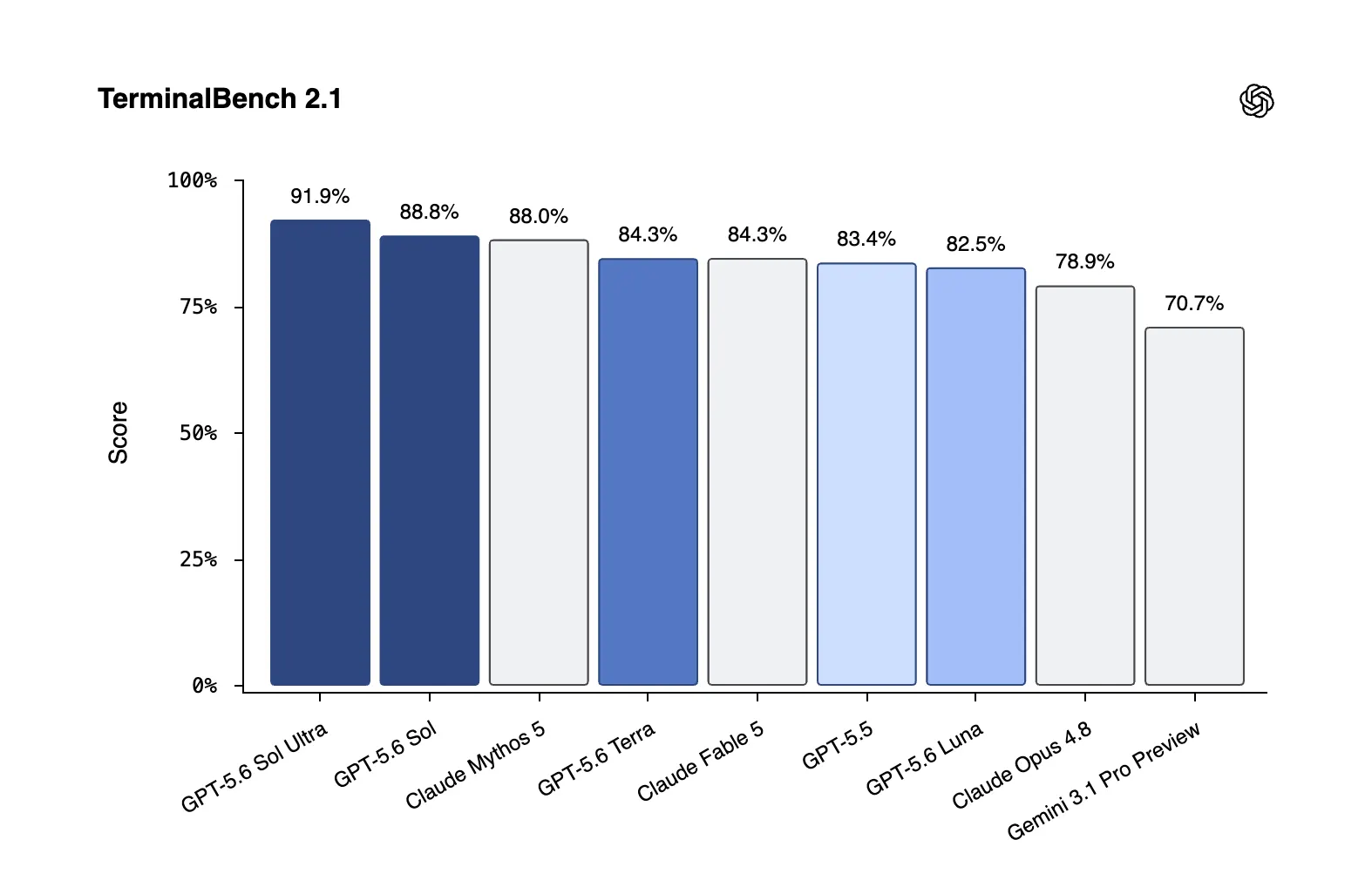
On Terminal-Bench 2.1—a rigorous test of command-line workflows that requires planning, tool use, and iterative error correction—Sol set new records.
- Sol (Ultra Configuration): 91.9% task completion.
- Sol (Standard): 88.8%.
- Claude Mythos 5 (Anthropic): 88.0%.
- Claude Fable 5 (Anthropic): 84.3%.
- Gemini 3.1 Pro Preview (Google): 70.7%.
In the realm of cybersecurity, Sol matched the restricted "Mythos Preview" on ExploitBench, a benchmark for finding and weaponizing software vulnerabilities. Crucially, OpenAI noted that Sol achieved these results while consuming only one-third of the tokens required by previous iterations, suggesting a massive leap in architectural efficiency.
The Economic Equation
OpenAI has priced Sol to sit comfortably between "boutique" intelligence and mass-market utility.
| Model | Input (per 1M tokens) | Output (per 1M tokens) |
|---|---|---|
| GPT-5.6 Sol | $5.00 | $30.00 |
| GPT-5.6 Luna | $1.00 | $6.00 |
| Claude Fable 5 | $10.00 | $50.00 |
| Grok 4.5 | $15.00 | $75.00 |
| Gemini 3.1 Pro | $2.00 | $12.00 |
| DeepSeek V4 Pro | $1.74 | $3.48 |
| Xiaomi MiMo 2.5 | $1.00 | $5.00 |
While Sol is significantly cheaper than Anthropic’s Fable 5 or xAI’s Grok 4.5, it remains more expensive than the aggressive pricing coming out of China, where DeepSeek and Xiaomi are engaging in a race to the bottom on margins.
IV. Early Tester Feedback and Official Responses
The developer community has been vocal about the shift in performance. Theo, the CEO of the AI platform T3 Chat and a prominent tech commentator, characterized Sol as a "world-leading" tool for computer-use applications. "It’s a damn good model," Theo posted on X. "Fixed all the problems I had with GPT-5.5. It is incredibly determined… it understands subagents."
Dan Shipper, CEO of the digital publication and research collective Every, provided a nuanced comparison that has since gone viral: "GPT-5.6 is like a Porsche, Fable is like a warp drive." Shipper’s internal testing suggests that while Sol is the superior "daily driver" for coding and knowledge work due to its speed and reliability, Anthropic’s Fable 5 might still hold an edge in raw, creative "spark" or ultra-complex conceptual leaps.
From a scientific perspective, researcher Daichi Konno highlighted a surprising development in Sol’s safety alignment. He noted that while previous models often "refused" to answer complex life-science questions due to over-tuned bio-hazard safeguards, Sol was able to navigate these queries without tripping filters. This nuance could make Sol the "first choice" for legitimate biological research and pharmaceutical development.
OpenAI has officially maintained that Sol remains within their "Medium Risk" category for cybersecurity and biological threats, ensuring that while the model is more helpful to scientists, it remains restricted from generating actionable harmful protocols.
V. Market Implications and the Road to GPT-6
The release of the Sol-Terra-Luna triad has sent shockwaves through the industry, leaving several major players in a defensive posture.
The Google Stagnation
Perhaps the most glaring takeaway from the "Super Week" of AI is the absence of Google. The tech giant’s flagship, Gemini 3, has not seen a major architectural refresh since November 2025. In an industry where a six-month lead is considered an eternity, Google now finds itself as the only "Big Cloud" provider without a 2026-class flagship model.
The Looming Shadow of GPT-6
Despite the excitement surrounding Sol, leaks from industry insiders—most notably the roadmap-tracking account "Synthwave"—suggest that GPT-5.6 is merely the "end of the line" for the GPT-5 architecture. Rumors indicate that a much larger, ground-up rebuild known as GPT-6 is already in training on a massive new compute cluster and could see a release as early as late August 2026.
The Rise of the Sub-Agent
Sol’s "Ultra Mode" signals a shift in the AI paradigm from "Chatbots" to "Agents." By formalizing the ability of a model to delegate tasks to sub-processes, OpenAI is moving toward a future where the user provides a goal, and the model manages the entire execution pipeline—hiring its own specialized sub-models to handle code, design, and data analysis in parallel.
Conclusion
OpenAI’s GPT-5.6 Sol launch represents a calculated balance between raw power, economic viability, and regulatory compliance. By introducing the celestial naming system, the company has created a flexible framework for future updates, allowing them to iterate on "Terra" or "Luna" without the baggage of a full version increment.
As the "Super Week" of AI comes to a close, the focus now shifts to the enterprise. With Sol’s competitive pricing and high marks in tool-use benchmarks, the pressure is on competitors to prove that their higher price points—or their lower-cost alternatives—can offer a better return on intelligence. For now, OpenAI has reclaimed the center of the solar system, but with GPT-6 on the horizon and Anthropic’s Fable 5.1 looming, the battle for the frontier is far from over.
 Nila Kartika Wati
  Evan Lee Salim
  Ali Ikhwan