
 By Evan Lee Salim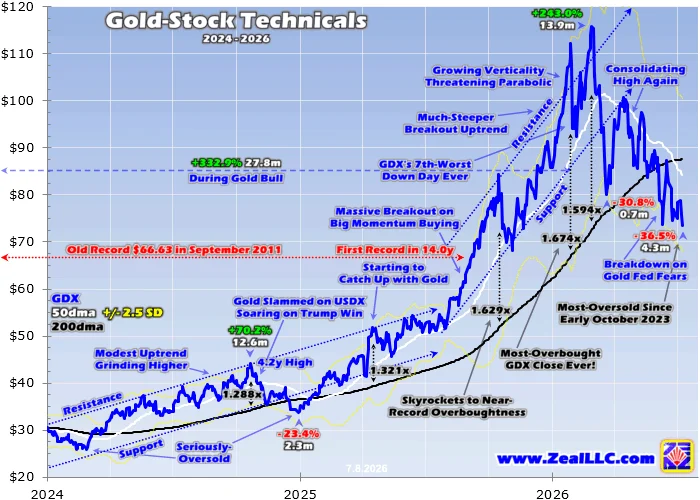
The gold mining sector currently finds itself at a fascinating, if paradoxical, crossroads. While the underlying fundamentals of the industry have never been stronger, market sentiment has been battered by a combination of macroeconomic anxiety and seasonal volatility. As the sector prepares to report near-record earnings for the second quarter of 2026, a significant technical disconnect has emerged: gold stocks are trading at their most oversold levels in nearly three years, even as their profit margins reach heights rarely seen in the history of the commodities market.
For patient investors, this environment represents more than just a fluctuation; it presents a potential structural buying opportunity. With gold prices remaining elevated and mining costs stabilizing, the stage is set for a major mean-reversion rally as the market reconciles the sector’s impressive balance sheets with its depressed share prices.
The Financial Reality: Record-Breaking Profitability
The primary driver of gold-mining profitability is the relationship between the prevailing price of gold and the all-in sustaining costs (AISC) required to extract it. Despite a challenging second quarter—marked by a notable 17.8% correction in the dominant gold-mining ETF (GDX)—the average price of gold remained robust at $4,512 per ounce. While this represents a slight retreat from the record-breaking $4,873 observed in Q1 2026, it remains the second-highest quarterly average in history, marking a 37.3% surge year-over-year.
When analyzing the top 25 components of the GDX, the industry is effectively printing cash. By applying conservative estimates for mining costs—projected at roughly $1,725 per ounce—the implied unit profit for these miners reaches a staggering $2,787 per ounce. This figure represents a 50% increase compared to the same quarter last year. Should these numbers hold, they will mark the 12th consecutive quarter of earnings growth for the sector—a streak of performance that is effectively unparalleled in the broader equity markets.
Chronology of a Market Correction
To understand why gold stocks have lagged behind their own success, one must look at the turbulent events of the second quarter of 2026. The sector’s decline was not driven by poor operational performance, but by a "perfect storm" of irrational market fears.
June’s "Irrational" Sell-Off
June served as the epicenter of the sector’s decline. Roughly six-sevenths of the total quarterly drop in the GDX occurred within that single month. Three primary catalysts fueled this volatility:
- Macroeconomic Misinterpretation: An upside surprise in U.S. nonfarm payrolls prompted traders to price in aggressive Federal Reserve interest rate hikes. Historically, gold has proven resilient during rate-hike cycles, yet the market reacted with knee-jerk panic.
- Geopolitical Friction: A resurgence of the "war trade" following escalations in the Middle East ironically weighed on gold prices. Despite the reality that geopolitical uncertainty typically boosts investment demand for gold, traders treated the escalation as a signal to liquidate risk assets.
- The "Warsh" Effect: The debut of the new Fed Chair, Kevin Warsh, was interpreted by the market as overly hawkish. By pivoting away from forward guidance and threatening to dismantle the "dot-plot" projections, Warsh’s move to curb market distortion caused short-term confusion, leading to further selling.
The Seasonal Doldrums
Compounding these factors was the "summer doldrums"—a period typically characterized by low liquidity and lower trading volumes. In an environment where institutional participation wanes, even minor sell-side pressure can trigger exaggerated price swings. While gold dropped 11.6% during the June episodes, the gold stocks contained in the GDX fell 15.7%. While significant, this 1.4x leverage is notably lower than the 2x to 3x amplification historically expected, suggesting that the sector displayed remarkable resilience despite the broader market carnage.
Analyzing the Fundamentals: Why Costs Are Not the Culprit
A common fear among retail investors is that rising operational costs will erode the profits gained from high gold prices. However, deep research into the top 25 GDX components suggests otherwise.

The Seasonality of Mining
Mining output is heavily influenced by geography and climate. With the majority of global production centered in the Northern Hemisphere, Q1 represents the seasonal "ebb" due to winter conditions that impede chemical efficiency in heap-leaching operations. Conversely, Q2 and Q3 represent the transition toward peak efficiency. Historically, global gold output grows by approximately 5.3% from Q1 to Q2.
Debunking the Cost Outliers
Analysts must be careful when interpreting cost data. In previous quarters, outliers like the Peruvian miner Buenaventura—which reported skewed AISC figures due to heavy base-metal byproduct credits—artificially lowered the sector’s average cost metrics. With Buenaventura now ranking outside the top 25, the AISC data is far more reflective of true primary gold mining operations. The industry’s own guidance for 2026 suggests AISC midpoints of $1,703, a figure that remains well below the current profit-generating gold price, reinforcing the thesis that the industry is in a sustained period of windfall-grade profits.
Implications for Investors: The Road Ahead
The current technical landscape for gold stocks is the most "oversold" it has been since October 2023—a month that preceded a 347% rally in the GDX. With share prices at roughly 84% of their 200-day moving average, the valuation of many top-tier miners has compressed into the "low-teens" or even single-digit price-to-earnings (P/E) ratios.
The Valuation Gap
As the Q2 2026 earnings reports are released, the "trailing-twelve-month" P/E calculations will incorporate these record-breaking quarterly results, forcing valuations even lower. When investors see companies growing earnings by 50% year-over-year while trading at single-digit multiples, the logic for a massive "mean-reversion" rally becomes difficult to ignore.
The Autumn Rally
Gold is entering its historically strongest season. As the sector moves past the summer liquidity crunch and into the autumn, the combination of strong physical demand, low valuation multiples, and the undeniable reality of record earnings is expected to spark a fire under the sector.
Conclusion: A Strategic Window
The current disconnect between the financial health of gold miners and their stock market valuation is a classic example of market sentiment decoupling from reality. While the June volatility provided a painful lesson in short-term trading, the long-term outlook remains incredibly bullish.
For the investor who looks past the noise of the Federal Reserve’s "hawkish" posturing and the transitory nature of summer volume, the data is clear: gold miners are on the verge of a second consecutive quarter of historic profitability. With the sector now at its most oversold point in nearly three years, the ingredients for a major, sustained rebound are not just present—they are historically significant. As these earnings results hit the wires, the market will likely be forced to correct the current discount, potentially providing a substantial upside for those positioned ahead of the curve.
 Laily UPN
  Asep Darmawan
  Nana Wu